Sunday, September 3, 2017

Retailers Should Think Like Zara: What We Learned At The August Magic Trade Show

 Opinions expressed by Forbes Contributors are their own.
Source: istockphoto.com; Zara shop
Last week, my team and I attended the Magic trade show in Las Vegas. One of the largest fashion trade shows, Magic is held twice a year and consists of 13 unique communities covering footwear, apparel, accessories and manufacturing. Over three days, we met with a variety of apparel and media leaders and attended presentations and panel discussions on retail, sourcing, social media, apparel manufacturing, automated manufacturing technology, fashion, store layout and design, outsourcing to countries such as Vietnam and China, and many other topics.
An overarching theme at the August Magic show was that retailers need to get products from the design phase to consumers much faster. The current fashion cycle is broken, a number of presenters suggested, because when consumers see a trend, they want to buy it right then—not 12 to 18 months later. Zara was cited frequently at the trade show as a retailer that is pushing boundaries in terms of newness, seasonlessness and customer traffic.
Zara’s Value Proposition of Newness and Scarcity Is Driving Store Traffic
Zara’s value proposition is newness and scarcity, said Ed Gribbin, President of Alvanon, a retail, fashion and apparel consulting firm. Once the product is gone, it is gone, he said. Gribbin highlighted an NPD Group survey that found that the average shopper who is brand loyal visits a store 4.1 times per year, whereas the average Zara shopper visits a Zara store 17 times per year—likely because she is afraid of missing something. If you happen to be in New York City, visiting a Zara can necessitate a strategic approach, depending on the time of day, because the fitting room line is often 10–15 deep. That is anecdotal, of course, but it reflects how exciting consumers find Zara’s product assortment.
According to Gribbin, 65% of Zara’s production is based on proximity, and all of its products can be delivered from the factory by air within one day to any of its 4,400 stores. Zara has the highest inventory turns in the business, Gribbin said, emphasizing that retailers might take a lesson from the company and work to shorten the front-end time it takes to get products “from design to on the back.” He noted that doing so will save retailers money on markdowns in the long run.
But retailers will have to transform themselves in order to be competitive. Steve Hawkins, SVP of Sales for American Textile & Apparel, said that reducing turnaround times requires close collaboration and communication between retailers and factories because the factories have to plan for equipment, staffing and overall infrastructure needs.
  • The big lesson here is not about creating fast fashion per se, but about creating timely, fresh products that consumers want.
Traditional Fashion Seasons Do Not Exist at Zara
Zara delivers new product every two weeks, on average, i.e., 26 times a year, rather than only during the typical, fall, winter, spring and summer seasons. This is in line with how today’s customers shop: when they see a trend, they want to buy it right away, not 18 months later. Gribbin suggested that the reason retailers are struggling—and the reason there have been more retail bankruptcies in 2017 than in any year since the recession—is that the product development cycle is broken.
Today’s procurement processes must be adapted based on consumer shifts, Gribbin said. Consumers are technology driven and unpredictable, and they want to buy trendy items as soon as they discover them. But retailers are following an outdated cycle that involves trying to predict what consumers will want to buy 18 months from now. A responsive supply chain can respond within two to three weeks to capture consumers’ desire to buy trends immediately, Gribbin said.
Several other retailers and companies at Magic noted that the seasons are becoming blurred and that consumers are no longer following fashion rules. Some examples they cited include seasonless clothing, where there are no limitations in terms of style, color or materials. According to The NPD Group, the most successful shoe brands offer styles with seasonless silhouettes, such as sneakers, mules and ankle boots. The seasonless dressing trend is also spurring innovation. The NPD Group has noted that innovative footwear styles include hybrids such as espadrille sneakers, peep-toe boots and the Nike Air Huarache Gladiator. Consumers’ wardrobes are also becoming more casual as people seek ease and comfort in apparel.
  • The lesson here is that seasonless apparel is already a real trend. It promotes fashion innovation through hybrid products and also keeps new products in stores all year long.
Sellable Products Are More Important than Design Perfection
Finally, we heard at Magic that designers can often be their own worst enemy when it comes to perfection and getting a product out the door. Often, designers stress over finding the perfect button, the right thread, or the perfect finishing—convinced that those details will make the difference on a garment or accessory. In the end, though, for many designs, a button is just a button—and speed to market is more important today. Sweating the details is not always productive, as companies must get products out the door more quickly.
Products also need to be sellable and relatable, with a point of view, advised Mercedes Gonzalez, Director at retail consulting firm Global Purchasing Companies. “If I haven’t seen it before, then I probably don’t want to see it,” she said. Gonzalez’s point was echoed in a panel titled “Looking at the Future of Creating a Brand and Getting It to Market.” Panelists emphasized the need for a fashion point of view, the importance of not getting stuck on perfection, and the need to get out there and produce—because the retail market today is hungry for products that are unique or differentiated. Panelist Anthony Bergin, CEO of fashion lifestyle brand Lumber Union, suggested that every brand needs a secret sauce, something different that is not a fad and that the brand can call its own.
  • The big lesson here is that it is more important to get the product out the door than to worry about perfection, in most cases.
bita ad 5.PNG

Deloitte projects by 2025 that 10% of global GDP to be built on blockchain applications

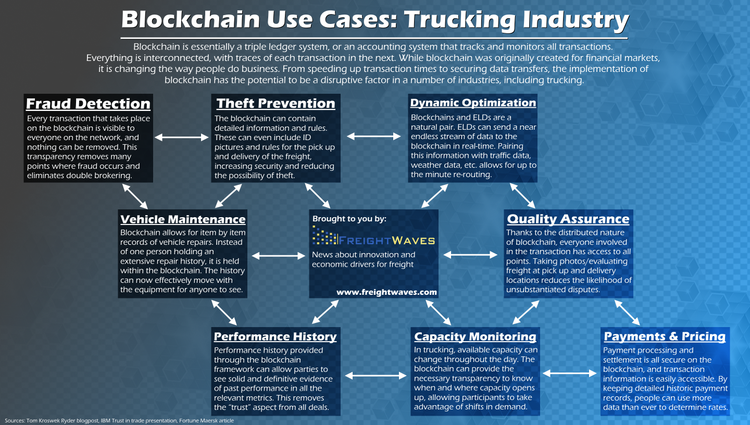
Blockchain Infographic - Med.png
In May 2017, Deloitte tweeted that 10% of global GDP would be built on top of blockchain applications. This huge and ambitious claim was made because of the transformative nature of the technology and the effect it will have on society. For logistics and transportation, it will have a bigger impact promising to shake up the $8T industry.
What is blockchain?
To put it simply, a blockchain is like a database, it’s a way of storing records of value and transactions. However, calling blockchain a new type of database is like saying email is a new way of sending people letters. While the blockchain is a database, that definition doesn’t explain the true genius behind how the blockchain stores records of value and transactions.
Where the blockchain offers significant potential is in transactions where parties don’t trust each other. There are many instances in trucking where two parties do not trust each other or the need to verify someone is very high. Examples include:
  • Freight brokerage
  • Safety compliance
  • Payment transactions
  • Fuel purchases and repricing
  • Driver employment records
  • Freight payment and bills of lading processing
  • Factoring
  • Truck maintenance records for resale purposes
  • Shared assets among different parties
  • Load confirmation sheets
  • Forward contract commitments
  • Asset tracking
  • Chain of custody for freight
  • Insurance records
  • Claims
  • Food safety
  • Cross border customs documentation
A decentralized database built on the blockchain removes the need for centralized institutions and databases. Everybody on the blockchain can view and validate transactions creating transparency and trust.
Trust lays at the core of the blockchain – it provides a system of trust between people without the need for an intermediary involved in the transactions.  The blockchain allows people to transact between each other with anything of value.

People are moving out of big city centers and its changing the freight landscape

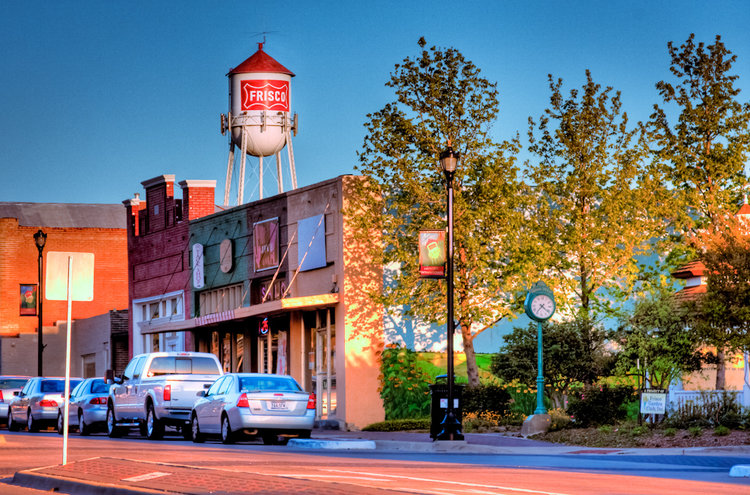
Frisco, Texas is a suburb just north of Dallas and one of the fastest growing cities in the US
FRISCO, TEXAS IS A SUBURB JUST NORTH OF DALLAS AND ONE OF THE FASTEST GROWING CITIES IN THE US
Most people in America believe that urbanization is increasing, but the opposite is true. City centers are losing people as they flock to smaller cities and towns across the US. This reverses a constant that has been true since the dawn on industrialization, where people flocked to major urban centers to take advantage of resources, jobs, education, and entertainment opportunities.
In the past, the lifestyle afforded by only the biggest urban centers were a huge draw, but in a digital environment, the opposite is true. As telecommunications improved and companies like Amazon offered real-time delivery on major shopping products, the draw of big cities changed. After all, living in a city comes with great sacrifices.
The cost of having an urban center address Is very high. Taxes, rent, and housing prices are much greater the closer you are to major commerce centers. Urban infrastructure buildout usually means that taxes will be increased to support such initiatives. In cities such as San Francisco and New York the cost of living has gotten so big that people are finding extreme ways to cope. Some people are taking airplanes for a daily commute from cities like Reno, Las Vegas, and Southern California and finding it to be cheaper than owning or renting a property in San Francisco.
University of Kansas has studied IRS data to examine the trend of people leaving major cities. In a study released in 2009, the University reported that 14% of people in the US relocate to another city each year and tend to leave larger urban cities with populations greater than 5 million for cities with populations less than 1 to 2 million.
More recently, this trend has accelerated. In a recent article, the New York Times quoted William Frey, a demographer at the Brookings Institute that recently studied the concept of deurbanization, “While many, if not most, large cities grew faster than their suburbs between 2000 and 2015, in the last two years the suburbs outgrew cities in two-thirds of America’s large metropolitan areas.”
There also appears to be a high-correlation between crime and deurbanization. According to Frey, cities with high murder rates saw the greatest decreases in populations. Chicago, Baltimore, St. Louis, and Milwaukee all had the highest population drain and also have the highest murder and violent crime rates.
Frey stated, “Fourteen big cities lost population in 2015-16 compared with just five in 2011-12, with Chicago, the nation’s third-largest city, hemorrhaging the most people.”
Cities like Charlotte, Orlando, Tampa, Nashville, Austin and Fort Worth all had large gains. Suburban areas surrounding major metro areas also saw huge increases. Dallas, Atlanta, and Phoenix metro areas all had rapid growth, but a large percent of that took place in the suburbs and not the city center.  Low-density suburban areas saw the highest growth as millennials leave city centers and take advantage of lower cost housing, better suburban schools, and low crime rates.
This trend is expected to increase over the next few decades. With the increasing level of same-day and next-day deliveries, combined with ubiquitous high-speed internet, people are expected to continue to choose suburban and smaller cities to call home.
All of this will have profound impacts on freight networks. The cost of residential deliveries is much more expensive than commercial deliveries, by as much as 60%. This is caused by the lack of freight density in last mile deliveries. It also plays havoc on the network of the logistics networks as the companies manage inconsistent delivery schedules and the lack of urban density.
To accommodate growing demand, logistics companies have been creating smaller fulfilment centers throughout metro areas rather than having a single sorting center. They have also been buying up flash warehouse space to manage volume spikes. One large truckload carrier told FreightWaves that some retailers have been using their trailers as mobile warehouses during peak season to allow them to respond to last minute residential orders.
The big question is whether this shift is good or bad for the truckload sector. According to most analyst and industry insiders, the truckload carriers will benefit from the move towards more fulfilment centers in smaller markets, as the large ecommerce companies will have to locate more inventory throughout their delivery networks to respond to last minute e-commerce demand. After all, consumers have become accustomed to same day or next day deliveries and expect all products to be available at the click of a button. Just because they move out of a big city, doesn’t mean they want to give up its many benefits.

How Amazon Fuels Deflation

Daniel Gross
Daniel Gross is executive editor of strategy+business.
Last weekend, in Jackson Hole, Wyo., as they do every year, many of the world’s central bankers gathered to discuss vital economic matters that seize the attention of global markets. Amid the big topics of discussion at the annual shindig convened by the Federal Reserve Bank of Kansas City was inflation, or the lack thereof. Many economists remain puzzled that, after nearly a decade of remarkably stimulative policy from the world’s central banks, the overall price level isn’t budging much. In the U.S., inflation has failed to reach the Federal Reserve’s 2 percent target for several years, and in the past 12 months, the Consumer Price Index rose just 1.7 percent.
On Monday, Amazon, having formally taken control of the upscale grocery chain Whole Foods, set about aggressively slashing prices on a host of products, including ground beef, milk, and avocadoes.
None of the high-minded academic sessions on the Jackson Hole agenda dealt with the Amazon–Whole Foods merger. But perhaps they should have. For even as we puzzle over the ways in which the actions of central banks matter when it comes to influencing the path of inflation, it is becoming clear that the actions of businesses can have as much impact — if not more.
“Inflation is everywhere and always a monetary phenomenon,” as the influential economist Milton Friedman famously said. Put another way, generations of economists and central bankers have been raised to believe that the interest rates, money supply, and balance sheets controlled by the world’s central banks determine the rate of inflation.
But we’re learning in this decade that there are vast deflationary forces afoot in the world that can counteract the efforts of central banks to spur inflation. These include, but are not limited to, international trade, the weakness of labor unions, shell-shocked and insecure workers being afraid to ask for raises, corporations relentlessly managing costs, greater transparency in pricing, gains in technology and productivity, and…the immensely powerful surge of e-commerce and supply chain optimization.
We’re learning that vast deflationary forces can counteract the efforts of central banks to spur inflation.
Amazon, as a company and as a representative of the broader e-commerce, logistics, and optimization industry, serves as both a metaphor and actual proof of how this works in the economy. Since its founding more than 20 years ago, Amazon has been a deflationary force. The Everything Store, as the author Brad Stone calls it, avoided many of the costs that have burdened brick-and-mortar companies and competed on the basis of offering lower prices. As it gained scale and expanded the range of its offerings — from books to apparel, cosmetics, and foods — Amazon has been able to drive better bargains for the goods it sells, and, importantly, to reduce costs in its supply chain. The more fulfillment and distribution centers you operate and the more you automate them, the more planes and trucks you lease, the less it costs you to deliver goods. Amazon has deployed robots, algorithms, software, and hundreds of engineers to take minutes and seconds out of every process it runs.
Amazon’s global annual sales in 2016 were about $136 billion, a small fraction of total retail sales. But, just as Walmart’s relentless cost control in the 1990s forced the rest of America’s retailing complex to reduce its costs (thus helping to tamp down inflation), Amazon’s impact ripples far beyond its own operations. Established companies and upstarts alike know that if they are to compete with Amazon, they must relentlessly rationalize their own operations. To a degree, Amazon is like a powerful cyclist at the head of the peloton at the Tour de France — spurring the teams behind him to increase their velocity or be left behind.
The process has been brutal for the margins and for the business models of many businesses, and has caused economic damage to established retailers, and to their landlords and employees. Just as in bike races, not everybody can keep up. The inability of many established retailers to cut costs or reengineer their businesses so that they can keep pace with Amazon and all the other e-commerce companies has been a key driver of the so-called retail apocalypse.
But it has been an unalloyed good for consumers, who generally reap the economic benefits of lower prices, greater selection, and time saved. Amazon’s foray into grocery stores provides a highly visible and impactful example of the way this works. Bloomberg on Monday provided a handy chart showing some of the big price reductions Amazon implemented at Whole Foods: organic baby kale, off 13 percent; organic bananas, off 30 percent; organic rotisserie chicken, off 29 percent.
These may be showy efforts intended to increase traffic. But it’s hard to deny the deflationary impact of such efforts. And, again, the impact isn’t just at Amazon’s stores. Investors on Monday drove the stocks of several grocery store chains down. Why? They’re presuming that other grocery chains will have to match Amazon’s efforts to reduce prices at Whole Foods. And while that will be great news for the millions of consumers who don’t currently shop at Whole Foods, it may be quite bad news for the margins of established grocers.
Put another way, Amazon’s highly public price-shopping isn’t just deflating prices immediately at the stores it controls. It’s deflating future expectations about the pricing power of all grocers. The economists who are planning next year’s Jackson Hole conference may want to consider having a panel on how the deflation inherent in the ever-expanding realm of e-commerce should influence central bankers’ inflation expectations.

5 Industries A.I. Will Disrupt in the Next 10 Years

Is your industry on the list?
CREDIT: Getty Images
It’s difficult to talk about AI without evaluating its place in the ecosystem. Loosely speaking, it starts with the Internet of Things, in which objects are connected to the internet and used to gather data. Once enough data has been gathered, it passes the arbitrary threshold and becomes “Big Data”, which AI is used to interpret.
When there are so many data points that no human could ever process them all, artificial intelligence becomes the only real alternative. But AI doesn’t always know what it’s looking for, which is where machine learning comes in. Loosely speaking, that’s the process of using AI to analyze data in such a way that it ‘teaches’ itself to interpret it.
AI disruption, then, is largely going to come in the form of new ways of processing and interpreting data that have never before been available. Here are just five of the industries that AI is set to disrupt.

#1 Healthcare

The healthcare industry has been waiting for something to come along and disrupt it, and AI could be just the thing to get the job done. Value-based healthcare evangelist, The Future of Healthcare author and 2017 Boldest Digital Health Influencer nominee Dr. Emmanuel Fombu says, “Artificial intelligence is arguably the single biggest disruptor for the healthcare industry. It’ll free up physicians’ time by taking care of menial tasks, it’ll aid in the discovery of new drugs and treatments and it’ll help to provide personalized healthcare to every single patient in the system. The possibilities are mind-blowing.”
It’s certainly true that AI could drastically change the way that we think about healthcare, but its real impact will be seen in the number of lives that it saves. To give just one example, it could dramatically cut down on the thousands of annual deaths that occur due to adverse reactions to medication.

#2 Marketing

The marketing industry is increasingly relying on tools and automation to get the job done, and there’s nothing wrong with that. Used correctly, these tools allow them to deliver more personalized messages to people, improving the experience for their customers whilst simultaneously selling more product.
Over the next ten years, it’s likely that these tools will rely more and more heavily on artificial intelligence and machine learning technologies as they continue to strive for personalization. In the same way that Netflix bases its recommendations on what other people with similar tastes have enjoyed, the next generation of marketing tools will use AI and machine learning to make communications more relevant than ever.

#3 Lifestyle

AI is also used to power tools like Siri and Alexa, and it’s likely that we’ll continue to use them in our day-to-day lives whether we’re asking a virtual assistant for directions or whether we’re checking into a hotel with a virtual concierge.
Lifestyle brands have a particular edge over those in other industries when it comes to AI because consumers interact with them out of choice, rather than out of necessity. This means that they’re more likely to engage with an AI system for the first time instead of shying away from the technology.

#4: Transportation

Artificial intelligence is also used to power autonomous driving systems, and it’s increasingly looking like the self-driving car will become a reality – not in the distant future but within the next couple of years, and certainly within the next ten.
Self-driving cars are insanely safe. Google’s self-driving car drove 1.8 million miles and was involved in just thirteen accidents – all of which were caused by the other car. They’re so safe that driving manually may one day become illegal, which is bad news for professional drivers but good news for the 1.3 million people who die in road traffic accidents every year.

#5 Finance

A very crude version of artificial intelligence is already used to detect bogus credit card transactions and to combat fraud in the finance industry. But AI technology has so much more potential to further disrupt finance, if only it can get past the regulators and operate in such a way that it obeys the often strict legislation that international financial organizations come up against.
Nevertheless, in the same way that AI and machine learning are being used in marketing to buy and sell advertising space, it can be applied to the finance industry to make data-based decisions about where to invest money and when to buy and sell stocks. It may even find its way into emerging new technologies such as digital currencies, and it can also automate much of the manual work that slows the financial industry down and makes employees less productive.

What’s the future?

Ultimately, artificial intelligence and machine learning have the potential to disrupt virtually any industry on the planet that stores data. In this day and age, you’d be hard pressed to name an industry that doesn’t.
With that comes a quandary that humanity will need to address, and it’s not for us to say what the result will be. If all of this data is in the hands of artificial intelligence, what happens if that AI makes a bad decision? Take healthcare, for example – if a doctor follows suggestions from an AI system and the patient is killed by an adverse reaction, who’s to blame? Is it the doctor or the AI?
Regardless of these questions and their lack of answers, AI can no longer be ignored. The potential benefits so heavily outweigh any negatives that we may not have much choice in the matter. The only question is whether you’ll move with the times or get left behind.

Saturday, September 2, 2017

5 Stages of Logistics Maturity

These 5 stages of maturity will help supply chain and logistics leaders set strategic goals that are appropriate to their organization’s maturity level
Organizations often find it difficult to define what their journey to logistics excellence should look like. This journey typically involves development of several operational capabilities, but without a clear frameworksupply chain and logistics leaders may find it challenging to focus on the right areas for their organization.
Broader supply chain visibility and timely, fact-based decisions increase market share and growth opportunities.
“The path to logistics excellence is partly defined by an organization’s current level of logistics maturity,” says James Lisica, research director at Gartner. “Gartner has created a five-stage logistics maturity model against which supply chain and logistics leaders can measure their organization’s maturity, and then develop a clear, long-term vision.”
Most leading supply chain organizations consistently take a maturity-based approach to designing and executing strategy. “This is why we have developed five stages to help supply chain and logistics leaders assess their logistics maturity. These stages will help them set a strategic goal that is appropriate to their organization’s maturity level,” adds Lisica.

Stage 1: React — Siloed Autonomous Operation

This stage is characterized by autonomous departments, such as sales and manufacturing, driving logistics priorities via manual processes and disparate, disconnected systems. There is no cross-divisional standardization of the logistics services offered to customers and little coordination. For example, the sales department might take an order for 30,000 items and promise delivery without consulting the logistics team.

Stage 2: Anticipate — Functional Scale and Efficiency

Centralization of the logistics function is beginning to improve efficiency and productivity. Logistics activity and performance are captured and reported using an organization-wide model, enabling better anticipation of demand. At this level, there is a focus on creating standardized processes and methods to benefit from economies of scale and increased efficiency. Performance is internally focused on fulfillment percentage, productivity, costs and return on assets.

Stage 3: Integrate — Integrated With the Supply Chain

The focus now is on integrating the logistics function into the overall supply chain. There is increased consideration of how logistics will affect customer service, procurement and manufacturing. Productivity enhancements and cost reductions are achieved through connections to supply management and third-party logistics providers.

Stage 4: Collaborate — Collaborating With the Value Chain Network

By this stage, logistics is an integrated part of a shared supply chain management vision, with trade-offs orchestrated between profitability and customer value. There is collaboration and visibility with suppliers and customers, as well as strategic partnerships with logistics providers that go beyond simple transactional services. Logistics capabilities are reliable enough to consider opportunities to shape market channel requirements.

Stage 5: Orchestrate — Network Orchestrator of Profitable Customer Value

Logistics and the rest of the supply chain facilitate processes across an ecosystem of partners to capitalize on unique business opportunities. As a result, information flows across the supply chain network in real time. This enables broader visibility and timely, fact-based decisions, which increases market share and growth opportunities.

Friday, September 1, 2017

Amazon Has Twice As Many Fulfillment Centers As The Rest Of The Entire US Retail Industry


Tyler Durden's picture
Ask a number of analysts what is the secret to Amazon's retail (if not overall) success, and 9 out of 10 times the answer will be its meticulous, seamless, and incredibly efficient distribution and logistics system. Or, as Credit Suisse puts it, Amazon has stumbled on (really created) a new distribution model: a "pull" (or demand) model in which the Distribution Center is at the center of the shopping/retail experience, vastly different from the old "push" model, which centered around the retail store.
It's also what Credit Suisse calls the "Amazon Effect", and is the biggest (not so) secret behind the company's retail success. Here is how Credit Suisse describes it:
Amazon has helped fuel the demand chain by offering best-in-class fulfillment capabilities and guaranteeing quick response delivery of packages. Amazon commits to providing free 2-day and deeply discounted 1-day shipping to Prime members (~50M-plus).

In this quick response world, inventory availability within a close enough proximity to the customer is key. Amazon has worked to build out its distribution center network with 230 active fulfillment centers (ex. pantry/fresh food DCs) in the United States.

In our opinion, Amazon's network enables the company to fulfill in the new "pull" distribution model. This is in vast contrast to companies in our coverage which follow the traditional "push" model and only have a few key distribution centers located around the country.
This is also known as the Amazon moat, or why Jeff Bezos' company, well on its way to becoming a mononpolist across many industries, remains insurmnoutnable. Conveniently, it can also be quantified by the number of fulfillment, or distribution centers across the country in comparison to the rest of the retail sector. As the chart below shows, as of this moment, with 230 DCs, Amazon has 40x more logistics centers across the US than the average number of distribution centers across the Credit Suisse coverage universe, and roughly twice as much as the rest of the entire retail sector combined!
So with such a massive moat, in both logistical and invested capital terms, is Amazon simply unreachable for its nearest competitor(s) in this new, "pull model" world of retail sales? Not necessarily.
According to Credit Suisse retail analyst Christian Buss, one possibility would be the conversion of existing brick and mortar stores into mini distribution centers to directly compete with Amazon.
Building out logistics facilities is expensive and time consuming. Brick-and-mortar retailers already have stores built out across the U.S., but we believe these stores could be used in a more efficient way to better capitalize in a demand chain world. Some stores might be put to better use as mini-distribution centers located close to the consumer. Stores located in malls are not ideal as there aren't store specific loading docks and logistics would likely be more challenged.

We estimated the number of Off-Mall stores for our coverage universe and combined with fulfillment enters to get an idea of the total possible distribution network available. In this framework, traditional softline and broadline retailers become more competitive on the distribution front.
Perhaps instead of accusing Amazon of being a monopolist, a war of attrition whose success is hardly guaranteed even under the receptive Trump administration, a better approach would be for the rest of the "legacy" retail sector - which is losing the battle against Jeff Bezos' juggernaut - to request government financial assistance to refit its existing store base, a financially feasible exercise, and then at least take on Amazon on an equal footing. Failing that, it is difficult to see how the prospects for the US legacy retail industry are anything but dire.