Thursday, May 12, 2016

Supply Chain Leaders Making The Move To CEO


The metamorphosis of supply chain from a humble collection of support functions like purchasing, shipping and production to true business leadership is huge. Chief Supply Chain Officers (CSCOs) increasingly control 50% or more of a company’s annual spending, with two thirds of all employees directly reporting to the role. More importantly, CSCOs have begun to play a vital role in strategy development, product and service innovation, and even sales.
Why the change? For one thing, globalization blew up the traditional factory-centric model of most product businesses while adding huge complexity to network design. For another, digitization has upended the merchant-driven operating model of most retailers and forced a radical rethink of how planning works across all industries. Finally, a rise in platforming strategies that bake complexity into core product designs and manufacturing process technologies call for supply network decisions that can take years to pay off.
The net effect is that the modern CSCO approximates the thought process of the CEO, balancing risk and opportunity, fighting the near-term battle with an eye on long term strategy, and focusing above all on profitable growth.
Who’s Making the Move?
Among the more prominent supply chain leaders who’ve made it to the top slot we can count Tim Cook of Apple AAPL -0.93%, Mary Barra of General Motors GM -0.86% and Brian Krzanich of Intel. More recently we’ve seen Fabian Garcia, formerly of Colgate Palmolive, tapped to take over at Revlon and John Hendrickson recently promoted to CEO of Perrigo. Promotions within company for CSCOs include some who have taken over business unit leadership roles, including Beth Ford at Land O’Lakes, Pier Luigi Sigismondi at Unilever, Sonia Syngal at Gap and Gerry Smith at Lenovo.
The common thread in all these cases is an executive who is multi-talented. They think like engineers (most are trained as such), but they also think like salespeople. They’re able to communicate and influence to get the job done. They get their money’s worth, but not at the expense of long-term partnership. They lead by example and don’t wilt in the face of challenge or even conflict.
KOM_Forbes
Emerging supply chain leaders are those who can handle the day-to-day work of plan-source-make-deliver while simultaneously seeing further over the horizon. This means understanding where the business’s strategy is likely to hit a wall or, better still, what confluence of trends might create a sustainable profit opportunity down the road. 
Some CEOs Already Get This
Chief Executive Officer has the ring of ultimate power. In practice, however, most CEOs feel the heat of many bosses with boards, shareholders, equity analysts and even the general public bearing down on their every move. Add in the deep water threat of activist investors whose incentives usually run counter to those of employees and even customers, and one sees the job for what it is – a constant balancing act with incredibly high stakes.
Some CEOs approach this challenge as a supply chain strategist might, recognizing the constraints of time and material science while pushing for breakthroughs that are worthy of capital investment.  They know, in other words, that selling is only half the battle. Delivery is the other half.
Paul Polman, Unilever’s CEO, is one such leader. His 90 minute free-form keynote at SCM World’s Leaders Forum in Gleneagles a few years back demonstrated a deep grasp of operational reality.  More important, however, was the way he used his credibility with an elite supply chain audience to challenge the profession on sustainability. A rousing and spontaneous standing ovation gave witness to the shared understanding between CEO and CSCO.
Another is Stanley Black & Decker CEO and Chairman John Lundgren, who will be keynoting our Leaders Forum this year in Dublin. Lundgren’s approach to supply chain is so much more sophisticated than the increasingly obsolete “cost centre” mentality that it even has a name: Stanley Fulfilment System 2.0.
KOM_Forbes2[1]
SFS 2.0, as they call it, builds on 12 years of operational strategy focused on service excellence and working capital efficiency. The new incarnation (2.0) emphasizes accelerated innovation, proactive leverage of digital and perpetual transformation. The strategic architecture is a perfect expression of CEO goals written in operational terms.
Agility Over All
Stability has given way to agility in business. Capital flows faster than water and customers expect the world. CEOs understand this. 
CSCOs live it.

Wednesday, May 11, 2016

Why the Biggest Big-Box Stores Survive

Sixty years after gigantic stores entered the American retail landscape, many are closing and filing for bankruptcy. But warehouse stores and club stores are doing something right.


  • In the story of American retail, historians generally trace the birth of the big-box store back to 1962. That’s the year that three enduring names entered the retail landscape: Walmart, Target, and Kmart. Back then, these big-box stores broke the rules by simply being huge in store size and offering a wide variety of products. As historian Marc Levinson told NPR, “We're talking about stores that were gigantic for their time, and that meant they might have about 50,000 square feet of space.”
    The sheer size of big-box stores overwhelmed and impressed. Americans embraced them for the next 40 years, driving to these hulking outposts of consumerism to buy all kinds of things.
    In recent years, the retail winds have changed. Just last week, Sports Authority announced that it would be liquidating merchandise and may consider closing all of its 450 stores. Before that, Best Buy was downsizing, big office-supply retailerswere consolidating, and, earlier this year, even Walmart announced that it wouldclose 154 of its U.S. stores.
    Nevertheless, amid all these store closings and bankruptcies, some big-box stores are still enjoying a surprising, decades-long upward trend: warehouse stores and supercenters.
    In an NBER working paper last year, Ali Hortaçsu and Chad Syverson, two economics professors at The University of Chicago’s Booth School of Business, looked at the major changes in the U.S. retail sector in the past 20 years. They found that, contrary to conventional wisdom, the rise of online retailers hadn’t brought about the demise of brick-and-mortar shopping. As a point of comparison, the study found that between 2000 and 2013, Costco’s sales grew by $50 billion while Amazon added $38 billion.
    “What we found is that a certain kind of big-box stores, that is supercenters and warehouse stores, they've been doing great and they're still doing great. That's your Walmart supercenters, that's your Meijer, Costco, Sam's Club,” explains Syverson. “If you get to specific other stores that sell specific goods, like sporting goods, office equipment, then it's a mixed bag.”
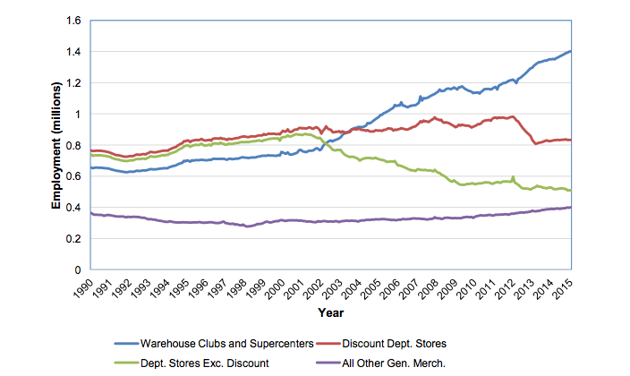
    According to Syverson’s research, sales at warehouse stores and supercenters grew 10 times from $40 billion to $420 billion from 1992 to 2013. But over the same period, sales and employment at department stores shrunk. A recent studyby real-estate firm Green Street Advisors found that Sears and JC Penney would both need to close 300 stores in order to get back to its sales-per-square-foot levels 10 years ago.

    Retail Employment by Store Type, 1990-2015
    Hortaçsu and Syverson via NBER/BLS

    The question of why e-commerce has cut into the sales of certain kinds of stores and not others likely has to do with convenience. There will always be consumers that never buy items online and there will always be items that consumers want to buy in person. Among the latter appears to be food.
    “One of the commonalities in the stores that are succeeding is some sort of emphasis on food,” says Paul Ellickson, a professor of marketing and economics at the University of Rochester’s Simon School of Business who studies the history of supermarkets. “Club stores, supercenters, and big-box grocery stores all involve some element on food which is perishable and really has not had much success being delivered online.”
    Beyond food, Ellickson adds that the perks of convenience and variety offered by online shopping tend to lose value when it comes to items that consumers may want to inspect personally, may be uncomfortable buying online, or may be difficult to return.
    As for the future of retail, while Syverson says he doesn’t foresee the demise of physical or big-box stores, he expects that, unlike during the 1980s or 1990s, big-box stores won’t be getting any bigger. “I think it's still going to be a physical establishment,” says Syverson. “Until e-commerce really makes inroads into drugs, cosmetics, food and beverage, there's a huge amount of retail volume out there that basically e-commerce hasn't touched yet at all. So it's still going to be a physical store but what size it is, it's harder to say.

    One in Five Truck Drivers Leave Job Because of Health Issues, Survey Finds 


    Thinkstock Most truck drivers who quit their jobs do so to make more money elsewhere, spend more time at home or to retire. However, one in five drivers who leave are flagged for health problems and that is prompting trucking companies to offer wellness programs and step up recruiting and retention efforts, according to a survey released May 11 by HireRight, a firm that provides background checks, drug and health screening and other recruiting services to companies throughout the world. “Driving is a physically demanding profession and getting proper rest, eating right and maintaining an exercise routine is a challenge due to the nature of the job,” said Steven Spencer, managing director of transportation for HireRight, which is based in Irvine, California, “The workforce is aging and attracting younger drivers remains a challenge due to the trucking lifestyle.” The transportation industry is willing to spend money to attract and retain talent, Spencer noted. COMING MAY 18: LiveOnWeb on Driver Health, Wellness From A to Zzzzz In addition to wellness initiatives, survey respondents said they were increasing pay (51%), upgrading equipment (49%) and offering recognition and rewards programs (41%) as part of an effort to recruit and retain drivers. A large majority of fleets (57%) said they have invested in driver appreciation events and 35% said they offer flexible work arrangements. Companies are also creating longer orientation and training periods and, in some cases, appointing a driver liaison or mentor to help new drivers acclimate to the job.

    Mid-year Forwarding Forecast

    Although recovery seems to be stabilized in the United States and, to a lesser extent, in Europe, there is still some concern about the behavior of some emerging markets...especially in China
    By Patrick Burnson, Executive Editor
    May 10, 2016
    Pangea Logistics Network, an international group of independent freight forwarders based in London, recently presented a cautionary economic forecast for the industry through the remainder of the year. 
    “The World Trade Organization expects international trade to grow 3.9% in 2016, which is slightly higher than the 2.8% reported for 2015, but still below the average of 5% we’ve witnessed over the past two decades,” say Pangea analysts.
    Although recovery seems to be stabilized in the United States and, to a lesser extent, in Europe, there is still some concern about the behavior of some emerging markets, especially in China, even though Asia will continue leading global growth. According to Pangea analysts, these five areas will shape market developments in the freight forwarding sector in 2016.
    1) Free trade agreements will accelerate international trade: The trans-Pacific Partnership Agreement (TPP) has been signed and will facilitate free trade among 12 Pacific Rim countries (from the U.S. to Vietnam or Australia), which together amount for 40% of the world’s GDP. Analysts also expected to close the agreement of the Transatlantic Trade and Investment Partnership (TTIP) between the European Union and the United States.
    2) Freight transport rates will remain low: The weak growth in demand expected for 2016 will not be able to absorb the existing overcapacity, especially in maritime transport and also, to a lesser extent, in the airfreight transport area. Shippers will continue managing very tight budgets, meaning margins will be reduced and freight forwarding companies will need stringent cost control and greater efficiency.
    3) The change from the globalization to the regionalization of transport will be highlighted: Global cargo volumes will continue losing ground in favor of the regional flow of goods. This is due to the rise of emerging countries and nearshoring, which brings production closer to the consumer to reduce transport costs. Small and medium-sized freight forwarders have a significant role to play in this new scenario where customer proximity is more important than size.
    4) The cloud will continue reducing the technological divide: Cloud-based tracking and management solutions are now providing small- and medium-sized freight forwarders with access to services that, until very recently, were only available to the big players. This trend will continue in 2016 and extend to next generation technologies, providing improvements in managing transport and logistics such as Big Data, cloud computing and the Internet of Things.
    5) Merging will continue, along with collaboration among independent freight forwarders: After a relatively calm period in the last few months, the major operators will start searching for new opportunities to acquire competitors. And in response to them, shippers will see more small and medium-sized freight forwarders who will continue to develop collaborative approaches to make better use of the existing capacities. This will include strategies to reduce costs and target large accounts through the global networks of freight forwarders.

    4 Of 5 U.S. Shoppers Frustrated By Mobile Shopping

    Forrester has just released its latest forecast for online shopping, predicting that online retail sales in the U.S. will soar to $500 billion in 2020, compared to $373 billion in 2016. But it also reports that mobile devices are more challenging than helpful, with 78% of people reporting that they’ve been vexed shopping from their phones, usually because of small screens or slow downloads.
    While some of those gains are due to a stronger economic outlook, it’s clear retailers’ omnichannel efforts are paying off, whether it’s ship-from-store, in-store pickup or simply providing an endless aisle. Even as many still struggle to get the basics right, “we hear from merchants that these services improve customer satisfaction and directly facilitate faster delivery of products to shoppers,” writes analyst Sucharita Mulpuru, the author of the report. And some $1.5 trillion of total U.S. sales are somehow web-influenced. 
    Mobile shopping is still troublesome, with people struggling to actually click “buy now” on their devices. “The form factor means that direct conversion rates are low, and consumers just don’t find it easy to buy most items on small phones,” she says.
    Amazon, meanwhile, continues to become even more Amazonian, with Forrester estimating it got $23 billion more in 2015 in the U.S., roughly 60% of the growth. To compete with retail’s 800-pound gorilla, retailers are going to have to find ways to win with go beyond price. “The economics of retail are challenging and destined to remain low-margin for the foreseeable future,” she says. “The future death knell for a retailer will be dependence on broadly available mass-market commodities as firms like Amazon and other pure plays win all price wars.”
    Developing private-label offerings (as Amazon is doing) is one approach. But “even better, they should secure unique access to categories or products that can serve as levers that enable some flexibility in pricing.”

    Lower Oil Prices and Threat of Terrorism Impacting Global Supply Chain Resilience


    Johnston, RI—May 10, 2016—Supply chain resilience is vital to robust business performance. Threats to resilience—such as depressed oil prices, natural catastrophes and the spread of terrorism—are keeping financial executives around the world up at night.
    These and other threats are reflected in the 2016 FM Global Resilience Index, a global ranking of countries’ business resilience to supply chain disruption. FM Global is a large commercial property insurer. The index ranks 130 countries and territories according to nine drivers that can affect the vulnerability of a business in those regions.
    Declining oil prices are at the root of Norway’s drop to second place in the third annual release of the index. The oil producer was replaced by Switzerland, which was ranked second last year. Oil-rich Kuwait (ranked 59 this year, down from 50 last year) experienced one of the biggest declines, since its gross domestic product (GDP) was hit hard by lower oil prices. Economic productivity suffered similarly in Colombia, which fell from 110 to 119.
    Crude oil prices, however, cut both ways. Armenia (ranked 52) and Malawi (ranked 84) are two of the biggest risers in the index this year, driven by an increased resilience to oil shock. Since their consumption of oil fell, the countries are less exposed to the dynamics of the oil market.
    Political risk, one of the nine index drivers, can be a severe constraint on business resilience. A significant and topical component of political risk is terrorism. Already in 2016, there were deadly acts of terrorism in such countries as Pakistan (ranked 117), Belgium (ranked 17), Côte d’Ivoire (ranked 58), Nigeria (ranked 116) and Turkey (ranked 79). The threat of terrorism is real and unabated.
    For the second consecutive year, Ukraine (ranked 125, down from 107) was among those countries with the biggest drop, reflecting the high degree of tension within the  as well as with Russia (ranked 75).
    The so-called Brexit debate, over whether the United Kingdom (UK) (ranked 20) should leave the European Union (EU), could impact the country’s future ranking in the resilience index. For those wishing the UK to remain in the EU, a vote for the country to leave could represent a significant risk to the UK’s productivity and growth prospects. Should that result, the index drivers affected by GDP (i.e., GDP per capita and oil intensity) could be adversely swayed.
    Why the Resilience Index?
    Online and interactive, the 2016 FM Global Resilience Index aggregates data from authoritative sources and presents it in an easy-to-navigate dynamic tool. It helps executive decision-makers explore key supply chain risks that can harm their performance in order to better select suppliers, site facilities, evaluate established supply chains and identify customers who may be vulnerable.
    “By giving executives easy access to authoritative information on factors that could disrupt their supply chains, the FM Global Resilience Index provides a simple way to analyze the potential for business risk and drive better decisions,” said Bret Ahnell, executive vice president at FM Global. “Resilient supply chains give businesses a distinct advantage by protecting their operational integrity, revenue stream, market share and shareholder value. A fragile supply chain, on the other hand, often harms the company involved, sometimes for the long term.”


    Top- and Bottom-Ranked Nations
    Formerly ranked number two, Switzerland traded places with Norway, reflecting the latter’s drop in oil revenue at a time of falling crude oil prices. Rounding out the top 10 in the index, in descending order, are Ireland, Germany, Luxembourg, Netherlands, the central United States, Canada, Australia and Denmark.
    The lowest ranked country in 2016 is Venezuela (ranked 130) for the second year in a row, followed in ascending order by the Dominican Republic, Kyrgyz Republic, Nicaragua, Mauritania, Ukraine, Egypt, Algeria, Jamaica and Honduras.
    Venezuela’s position at the bottom of the index reflects its exposure to the twin natural hazards of wind and earthquake, perceptions of lack of control of corruption and poor infrastructure, as well as ill-perceived local supplier quality.
    France (ranked 19) and the UK (ranked 20) retain their positions from last year, while Germany (ranked 4) rose by two places.
    Three Regions of the United States
    The United States is segmented into three regions to reflect disparate natural hazards exposure:
    • United States Region 1, encompassing much of the East Coast, is ranked 11 in the index.
    • United States Region 2, primarily the western United States, is ranked 21.
    • United States Region 3, which includes most of the central part of the country, is ranked 7 in the index.
    The Metrics
    The FM Global Resilience Index is a data-driven tool and repository. It gives users ranks and scores on nine drivers affecting countries’ resilience to supply chain disruption, including GDP per capita, political risk, oil intensity, exposure to natural hazards, quality of natural hazard risk management and fire risk management, as well as control of corruption, quality of infrastructure and local suppliers. Scores for each driver are combined into three factors (economic, risk quality and supply chain), yielding a composite zero-to-100 score.
    Users can go online and compare countries against one another by their rankings and scores year over year and by any driver. The index relies on vetted data from sources such as the International Monetary Fund, World Bank, World Economic Forum, as well as FM Global’s database of more than 100,000 insured locations.
    Numerous index resources providing additional context are also available online, including the 2016 Resilience Index Annual Report with tables, an infographic and video overview.

    Defining the Battlegrounds of the Internet of Things

    alt
    The Internet of Things—a huge network of sensors and smart devices, combined with advanced analytics and cloud services to make sense of all the data—promises to augment and disrupt products and services across industries. Expectations grow more spectacular every day: Forecasters predict up to 20 billion1 Internet of Things devices within a few years, generating 5 trillion2 gigabytes of data every year and creating more than $300 billion in opportunities for tech vendors, telcos and device makers by 2020.
    Feeling overwhelmed yet? You’re not alone.

    Executives across industries know they need to understand where the Internet of Things will affect their industry, where value comes from in their industry, where their companies can enter and play, and what capabilities they need to win. But many tell us they are finding it difficult to get a foothold and develop a strategy. Many are already investing significantly, but few have a clear roadmap. Customers are very interested, but complete solutions are still in their infancy.
    Before technology executives can form their strategies, they need to see that the Internet of Things is not one market but a set of overlapping markets with strong connections to the data center and analytics. Understanding where battlegrounds are emerging, how platform dynamics will shape competition and profitability, and what barriers exist to adoption (for example, security and interoperability) will help companies determine where to invest and what capabilities are required to win.
    Emerging battlegrounds
    When we look across consumer, enterprise, industrial and public sectors, we see a few major battlegrounds emerging, each with unique platform dynamics and growth opportunities.
    • Consumer. As leading mobile platform providers (Apple, Google and Samsung) extend their reach into wearables, smart homes, cars and other aspects of consumers’ lives, many software and hardware makers will find their place in these ecosystems. Successful players will invest in learning which platforms offer the best opportunities, depending on their region, target market and capabilities. Expect fierce competition among this small set of platform providers, using scale, developer communities, device partnerships and businesses subsidized by data. Creating platform stickiness and bridging customers across industry segments will be the keys to success.
    • Enterprise and industrial. As industrial and enterprise equipment and devices get connected, incumbents focused on specific industries are building on their domain expertise and customer relationships by expanding into broader offerings. Many will form partnerships, either to improve their capabilities (especially in analytics and security) or to acquire expertise in adjacent industries. Those that can build scale and make partnerships work can shape platform standards. Given the diversity of industries, expect a wide range of vendor platforms that may share common features but are tailored for particular uses.
    • Network and gateway. Connecting devices through the network provides opportunities for new products and services. Edge analytics and real-time (or low-latency) services will become increasingly important, close to sources of data rather than in the data center. Examples include patient monitoring in hospitals, quality control in factories and better customer experiences in stores. Therefore, many businesses will look to their long-standing relationships with network equipment makers (such as Cisco, Ericsson, Huawei and Nokia) and telecom service providers to capitalize on the opportunities. Telcos will aim to capitalize on the proliferation of devices and apps in several ways. They will improve connections with better directory services to locate, authenticate and connect remote devices. And they will offer life-cycle management services to maintain, upgrade, secure and provision the complex device and sensor networks—which others will compete to offer, too.
    • Analytics. Analytics will emerge as a critical platform battleground, given their importance for creating value from Internet of Things data. Traditional analytics vendors (for example, IBM, SAP and Microsoft), cloud service providers (such as Amazon Web Services and Alibaba) and system integrators could successfully extend their customer relationships and scale into tailored products and services, especially in instances in which Internet of Things data is critical but only one of many data sources contributing to insights and decisions. By contrast, new pure play vendors will offer custom analytic solutions in which limited integration with broader data sources is needed. For both horizontal and pure play vendors, partnerships with industry incumbents will be important—for example, IBM’s work with Medtronic on diabetes management, Amazon Web Services’ work with John Deere in agriculture or SAP’s partnership with Siemens on smart manufacturing solutions.
    • Autonomous. Robotics, drones and autonomous driving are among the most greenfield of all these applications. They differ in that most sensor information is collected locally and processed on board, with less (though not zero) connectivity back to the cloud, creating different demands on local vs. remote data storage and processing than other Internet of Things applications. Startups and incumbents are moving quickly to get in on the ground floor where current industry leadership and capabilities matter less than in other areas. For example, cars have long been sold on the driving experience, but that may be less important than reliability and safety for selling autonomous cars. Real-time capabilities and technologies such as computer vision and machine learning will be important differentiators for success
    Defining the Battlegrounds of the Internet of ThingsClick to enlarge
    A company’s position and the dynamics in each battleground provide guardrails for an Internet of Things strategy. Executives can design their strategy by considering a few questions.
    • What segments should we prioritize? Where can we generate revenue and profits?
    • What do our customers need? Who will we compete against, and how can we differentiate ourselves?
    • What parts of a solution should we deliver on our own, and where will we need partners? What standards should we support?
    • What capabilities will we need? Where should we invest?
    • What are the risks of not acting?
    Answering these questions to form a strategy in the context of the Internet of Things battlegrounds will be critical for executives to position their companies for leadership. Mobilizing now is essential as the Internet of Things gains traction and begins to influence most industries over the next three to five years
    .