Monday, May 9, 2016


Over the course of 18 months, Associated Press journalists located men held in cages, tracked ships and stalked refrigerated trucks to expose the abusive practices of the fishing industry in Southeast Asia. The reporters’ dogged effort led to the release of more than 2,000 slaves and traced the seafood they caught to supermarkets and pet food providers across the U.S. For this investigation, AP won the 2016 Pulitzer Prize for Public Service.
Screen-Shot-2016-05-03-at-11.18.54-AM
Below is an excerpt from the AP ebook, FISHERMEN SLAVES: Human Trafficking and the Seafood We Eat:


For hundreds of slaves, Benjina was the end of the world.
The remote Indonesian island village was cut off for several months a year due to stormy seas. There were no roads or telephone service and just a few hours of electricity a day.
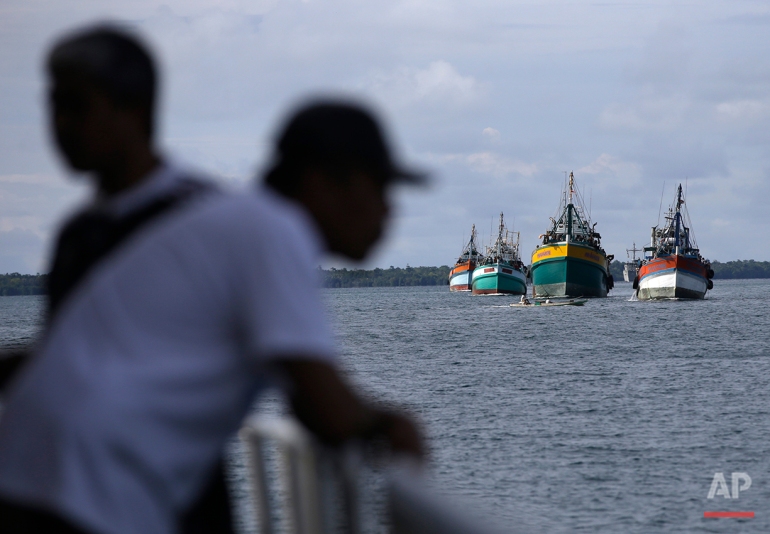
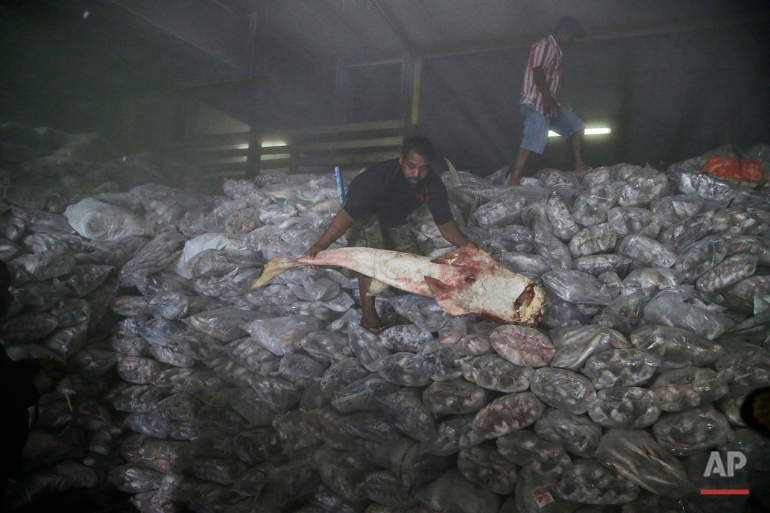
The Burmese fishermen who docked here spent months at sea, pulling up monstrous nets and sorting seafood around the clock. But the relief they felt after touching land was quickly replaced by desperation. They were trapped, held captive by Thai boat captains working for large fishing companies. Some men were locked in a cage for simply asking to go home. Others who managed to run away were stuck on the island, living off the land for a decade or longer. And just off a beach, a jungle-covered graveyard was crammed with the corpses of friends and strangers buried under false names.
When AP reporters first arrived in Benjina in late November 2014, informing the men we were there to tell their stories, they couldn’t believe it. A few wiped away tears as they spoke. Some chased after us on dusty paths, shoving pieces of paper into our hands with the names and addresses of their parents in Myanmar.
“Please,” they begged. “Just tell them we’re alive.”


The long, sometimes dangerous, journey of telling the story of Southeast Asian men held captive on fishing trawlers began in late 2013.
Human trafficking in the global seafood industry had been written about anecdotally, but Associated Press reporters Robin McDowell and Margie Mason were determined to connect the dots in a way that would make the world finally take notice.
Their best bet, they decided, would be to link slave-caught fish to American dinner tables _ and name names. At the start, sources told them it would be next to impossible. The industry was huge, and its practices murky. Fish was transferred between boats at sea. Documentation on land was often done improperly. And tainted and ‘clean’ seafood was mixed together at huge export markets.

Nearly a year into their investigation, they caught a major break. A source pointed them to eastern Indonesia, where they discovered a slave island.
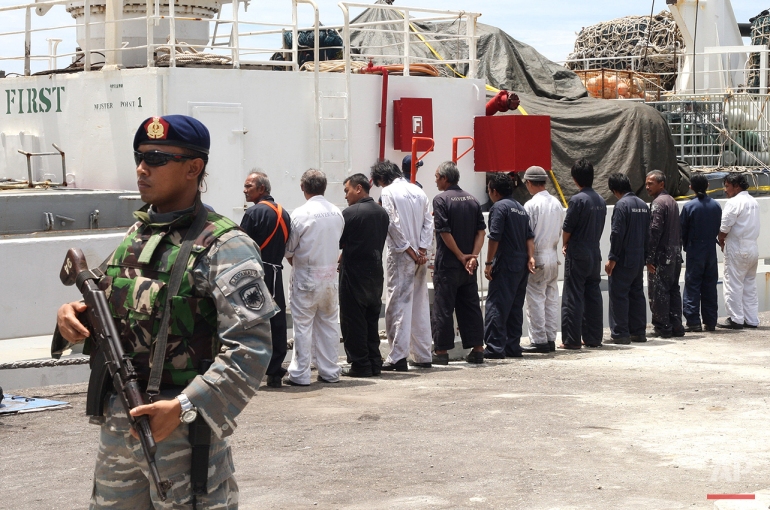
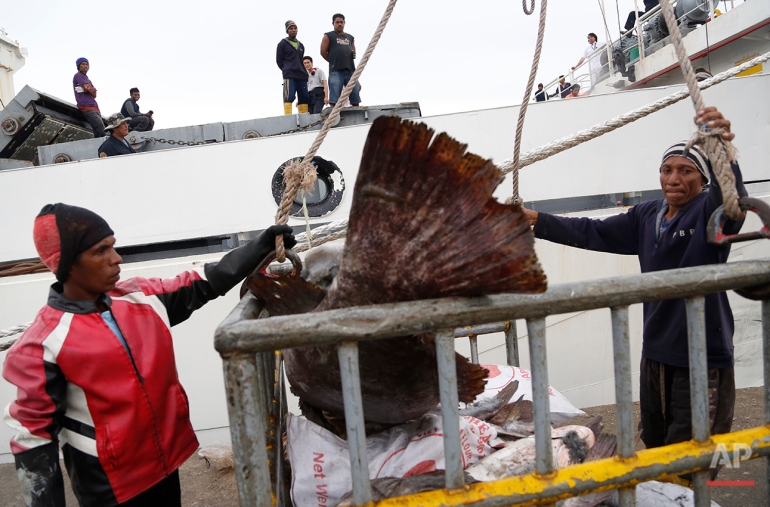
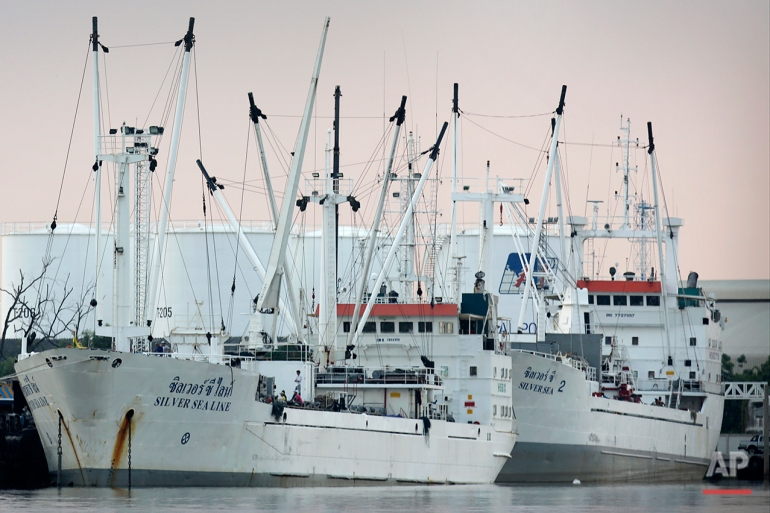
At great risk, McDowell, with the help of Burmese reporter Esther Htusan, filmed a man in a cage, and others pleading for help over the side of their giant trawler. The two also watched as fish was loaded onto a giant refrigerated cargo ship, and then tracked it by satellite to a Thai harbor. They were there with Mason to meet it in trucks, following the catch over several nights through the seedy, mafia-run streets. California-based reporter Martha Mendoza then joined forces to complete the four-woman team, eventually linking the seafood directly to U.S. supermarket chains and retailers, including Wal-Mart and Kroger.
The story captured worldwide attention. It led to governmental and corporate action. More importantly, it resulted in one of the biggest rescues of modern-day fishing slaves, with more than 2,000 men from four countries being identified and repatriated, some returning to homes they hadn’t seen in 20 years.
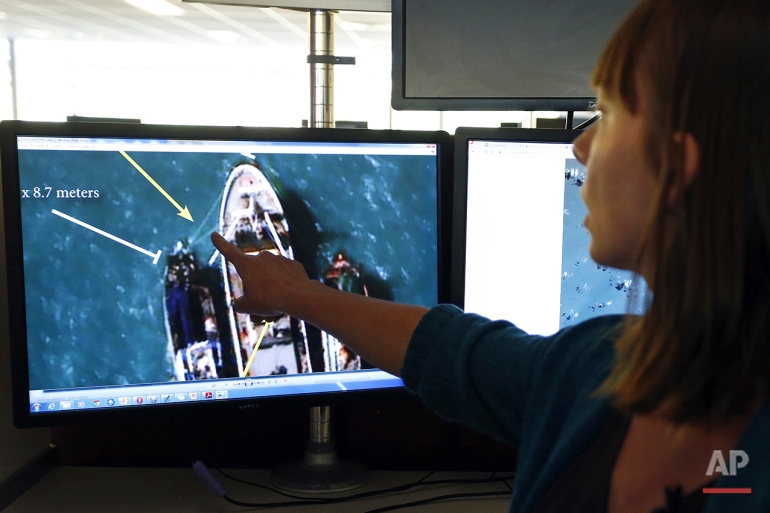

Slave-caught fish and U.S. tables: Making the connection
Each small factory that accepted one of the loads of slave-caught fish raised the question, where does it go next? Pulitzer Prize-winning reporter Mendoza went to work. Her account:
We spent weeks calling distributors, processors, freezers, and visiting Thailand’s largest fish market and talking to security guards and workers to obtain information that linked them to large Thai seafood export businesses.
In California, I began a search of my own, looking through U.S. Customs records to trace the seafood directly to companies familiar to most Americans.
Plugging away at databases that track U.S. imports, I checked to see whether the companies receiving the tainted fish in Thailand were shipping to a U.S. distributor, and whether those deliveries were packaged and branded.

It was relatively easy to determine that cans of cat food labeled Fancy Feast, Meow Mix and Iams came out of Thai processors that bought fish off the boat from Benjina. But the U.S. distributors were more complicated because they are not required to disclose where they sell fish. Thus began my odyssey to dozens of supermarkets in different states to check out frozen and canned seafood. Was it from Thailand? Was it a species we had seen? What brand was it? Who was the distributor? Then it was back to the databases for a potential match.
This became part of my daily life for weeks. I even took my husband on a date night to a local Wal-Mart to search for seafood. One day, driving home from my daughter’s field trip, I pulled into another Wal-Mart, sending out an army of fifth-graders to examine bags of frozen fish and filling my iPhone with photos of labels. On weekends, Mason and I swapped snapshots as we grocery shopped, a continent away from one another.
Eventually, the puzzle came together. With weeks of database tracking, we found seafood from Benjina in the supply chains of supermarkets, distribution centers and restaurants in every state at thousands of outlets. And then, with a videographer and photographer, I headed to Boston for the North American Seafood Expo to talk to companies with tainted supply chains, industry groups and Thai and Indonesian representatives.

The National Fisheries Institute, in a pre-emptive strike, sent a warning to the companies at the show: “Prepare for major AP story on labor abuse in seafood: Association advises members Pulitzer Prize-winning journalist reporting from Boston show floor.”
The warning had an impact. We were followed by men, apparently working for seafood firms, as we worked the floor. Salespeople turned their backs. When we were told to come back later, we simply sat down and waited, sometimes for hours.
Eventually we had given all the subjects of our story an opportunity to respond, and obtained comment on camera from Thai and Indonesian authorities. We were ready to publish.
But there was still one major obstacle left. The men on Benjina identified by name, in photos or in video were vulnerable. And we couldn’t run the story until their safety was guaranteed.


Twenty-two years a slave: One man’s story
After interviewing dozens of rescued slaves, Mason found one with an extraordinary story. She followed him from the island of Tual, Indonesia, where all of the freed slaves were temporarily housed, to his home in Myanmar. Here is her account:


I couldn’t believe it when I met Myint Naing in Tual. He told me he had been in Indonesia since being trafficked in 1993, the year I graduated high school.
He pulled back the hair on top of his head to show me a jagged scar, telling me his skull had been cracked by one of his bosses, simply for asking if he could go home. Later, he asked a second time, and was shackled to his boat with no food or water and told he would be killed. He managed to escape one night and swam to shore. He then hid in the jungle with help from a local family for years.
Myint boarded the first of four planes that took the former slaves back to Myanmar. When he arrived at the biggest city, Yangon, I was there with a team of AP reporters to meet him. We followed him as he boarded an overnight bus with other men from Mon State, and then in a car that took him to the village he’d left behind 22 years ago.


As Myint leaped from the vehicle, we watched what could have been a scene from a movie. First, Myint embraced his sobbing baby sister. Then, a small, frail figure ran toward him. He wailed and then fell to the ground before he was pulled into his mother’s arms.
Htusan and I hugged on the side of the road as we were overcome. This was the true power of journalism, and we all knew it was happening over and over in villages across Southeast Asia. It was amazing to see, but even more amazing because we helped make it happen.

The investigation continues: More to come
AP’s work on the story is unfinished. The release of the first slaves was followed by a four-month quest, using satellites and sources, to find men the reporters knew were still enslaved at sea after their boats fled Benjina.
Nearly two years into the investigation, the impossible question has clearly been answered: thousands of enslaved men have been forced to fish, catching seafood that ends up on U.S. dinner tables. But much more remains to be done. The chance to make a difference is what led us to our profession in the first place, and with the support of the AP, further reporting is already underway.

US Deficit “Mysteriously” Shrank in March

The trade deficit shrank by $6.5 billion in March as imports fell more than exports.
By Patrick Burnson, Executive Editor
May 06, 2016
The nominal trade deficit, the headline number (which is not very informative) has been zigzagging about the -$45 billion mark for the past five years. The real trade in goods deficit (which is informative), has been widening since the second half of 2014, responding to the strong dollar and sluggish growth abroad.
Why did the deficit shrink so much in March? Mostly, it is a mystery to us. It might be that the March seasonal factors for imports are off. It could also be companies adjusting inventories. Whatever the reasons, the drop in imports and the shrinking deficit are one month events, likely to sort themselves out in next month’s report.
Real goods exports fell by $1.7 billion (chained 2009 dollars) returning to a downward trend that started in December 2014. Exports of services, as if immune to the effects of a strong dollar, climbed to its third highest level on record (data start in 1992.)
Real goods imports plunged by a whopping $7.4 billion (chained 2009 dollars), the largest one month drop since October 2008, when world trade was collapsing. The plunge is a headscratcher.  Consumer imports took the brunt, dropping by a record $4.8 billion (chained 2009 dollars; data series starts in 1994), despite the fact that consumer spending, which drives imports of consumer goods, registered satisfactory gains in March.
“Trade was a drag on growth in five of the last six quarters, including the last three,” says IHS Global Insight US Economist Patrick Newport. ” It will remain a drag for at least the next two years, reducing quarterly growth rates by small amounts over a long period of time.”
Newport concludes by noting that this type of drag is preferable to one that slashes growth by a large amount over a short period because labor markets in the US adjust quickly to demand shifts.
“That is why the strong dollar has slowed growth but not job creation,” he says.

Sunday, May 8, 2016

Alternative fuels: Still viable?

Yes, experts agree, if you do the right homework

With national average prices of diesel and gasoline through the first quarter of this year hovering around $2/gal. and ramped-up output from oil-producing countries like Russia and Saudi Arabia helping hold crude in the $30-$37 per barrel range, it’s a different landscape for alternative fuels today than five—or even two—years ago. There’s no question fleets and trucking companies are seeing less financial incentive to consider a switch. Is this still a discussion worth having?
The short answer, as heard consistently from industry experts and fleets at NTEA’s Green Truck Summit in March and elsewhere, is yes. Yes, there are still bottom-line benefits to realize. And yes, the environmental benefits in terms of lower greenhouse gas and carbon emissions haven’t gone anywhere. Nor has the competitiveness of trucking and freight movement, or the public’s perception of greener companies as a potentially valuable differentiating factor to consider.
But the discussion has become more nuanced, and you need to do some homework to go this route. Fleet managers and other executives have a more difficult business case to make for alternative fuels. Among those who’ve made or are making a switch, some elements are consistently present: knowledge of your business, careful partnership and planning, support from leadership, and long-term commitment.
And on that last note, Stephen Latin- Kasper, NTEA’s director of market data and research, quipped that economists “would be crazy” to make predictions right now on oil prices due to volatility in the market, and few expect them to remain where they are for long. Bob Carrick, natural gas sales manager at Freightliner, summed things up this way: “Control your fuel and you will control your destiny.”
Put that together and perhaps the greatest potential benefit of alt fuels emerges. Fuel is one of the largest costs for fleets, and going with something other than diesel or gasoline can offer stability over the long run instead of a fingers-crossing game with the diminishing commodity of oil.
Still switching
Alternative power includes liquefied propane gas (LPG), also called propane autogas; hybrid and fully electric power­trains; biodiesel; and natural gas, which comes as compressed natural gas (CNG) and liquefied natural gas (LNG), the latter being less common as a vehicle fuel because of more complex containment requirements.
Despite the persistently low cost of diesel and gasoline, Fleet Owner over the last several months alone has charted a variety of fleet moves to alter­nate fuels. One of the more widely publicized came from New York City’s 28,000-vehicle-strong municipal fleet across more than 50 agencies, which has long been using biodiesel blends successfully and is looking to increase concentrations to reduce diesel use. And the city is looking to expand its around 300 fully electric vehicles (EVs) by eight-fold in the next 10 years, among other initiatives.
On the other side of the country, also concerning EVs—these being step vans built on theFord F-59 commercial chassis—linen and uniform supply company AmeriPride Services announced it’s moving to convert 20% of its delivery van fleet at its Vernon, CA, facility to all-electric power. Those vehicles have an 80-mi. range with their powertrains, supplied by Motiv Power Systems. 

“A number of customers have made the investment in fuel, and they’ve made the investment in infrastructure. They’re ready to move beyond what have been ‘science projects’ at many of their companies to mainstream adoption.”

- Matthew Godlewski, president of Natural Gas Vehicles for America

“There’s very little maintenance with them,” Shyam Nagrani, vice president of marketing at Motiv, says of the delivery trucks. Nagrani also claims the EVs can be a favorite among drivers.
“Because we put the batteries in between the frame rails, the center of gravity is now very low. So you’ve got a huge truck that handles like a go-kart,” he quips. “And normally, drivers are in an environment where you have this huge diesel engine. It’s noisy; it’s hot; it vibrates a lot. You don’t have any of that. We had a driver tell us his back doesn’t hurt because he’s not stepping on the brake as much” because of  power-regenerative braking, which can help slow the vehicle without a driver having to apply the brakes. At the same time, it also uses the electric motor like a generator to recharge the batteries.
One of the most noticeable uses of alt fuels in heavy-duty trucking has been CNG, often with the Cummins Westport ISX12 G engine that debuted in 2013 and can be spec’d with up to 400 hp. and 1,450 lbs.-ft. of torque. In one instance, FCA Transport, a subsidiary of Fiat Chrysler Automobile NV, recently converted the nearly 180 Peterbilt day cabs in its Detroit fleet to CNG running that engine; the trucks primarily haul 53-ft. dry vans loaded to 80,000 lbs. FCA expects 35% lower net fuel costs and 27% fewer CO2 emissions.
Propane is a big part of the sustainability strategy for Nestlé Waters North America, according to Bill Ardis, national fleet manager, and the lower emissions and quieter-running engines LPG offers are important to the company’s customers, image and values. In March, Nestlé added 155 Class 6 LPG-powered delivery trucks built on a Ford F-650 chassis to the 30 LPG trucks it’s been running since 2014. These new trucks took 18 months to develop in partnership with Roush CleanTech and Mickey Truck Bodies, working around space constraints to fit the necessary LPG tanks.
“Overall, at Nestlé globally, the goal is to get rid of diesel fuel,” Ardis says. The trucks needed to have a certain capacity and still not require a commercial driver’s license to drive, “because it’s very difficult to get CDL drivers,” he adds. The company is saving roughly $1/gal. on LPG even against the low cost of diesel fuel, and it is also considering a larger CDL-required variant of its trucks, likely based on Class 7 Ford F-750s.

Special application: auto haulers
For a closer look at how alternative fuels can work in a complex application, Fleet Owner also spoke with West Warwick, RI-headquartered Virginia Transportation Corp. (VTC), which in April held a ribbon-cutting ceremony officially unveiling its 30 new CNG-powered automotive haulers in Talladega, AL. In the company’s overall fleet of about 260 trucks, these are lowered and modified Peterbilt 365 day cabs with Cummins Westport maximum horsepower/torque spec’d ISX12 G engines, Allison 4000 RDS automatics, fuel systems by Mainstay Fuel Technologies, and carrier bodies by Cottrell.
One challenge with outfitting the fleet for CNG was onboard fuel capacity. “As far as the real estate on an auto hauler, we had none to give up,” explains Wendy Ferguson, project manager. The round-trip route each vehicle covers from Lincoln to Talladega is 46.8 mi., and VTC needed to haul some 175 loads a day. The company consulted with The Pete Store—the Peterbilt dealer in this case—which in turn had worked with and brought in Mainstay.
To make the CNG trucks most cost-effective, the goal was to get four round-trips between fill-ups, explains David Benner, executive manager at Mainstay. “We approached it and customized a solution to give them 69 stored diesel gallon equivalents onboard with two dual side-saddle tanks,” he tells Fleet Owner. Peterbilt lowered the cab and chassis on the 365s, and Fontaine Modification reduced the roof height and installed the fuel system and tanks.
The entire process required some three months of weekly or biweekly meetings, Ferguson recalls, but even more so the supportive attitude of Leo Doire, president and CEO of Virginia Transportation. “There were many challenges, but Leo had the vision. He had faith in the team and knew it was going to work,” she says.
The CNG trucks offer the company lower overall fuel and maintenance costs and greenhouse gas and carbon emissions. “This fleet alone will displace over 475,500 gals. of diesel annually, reduce our CO2 emissions and particulate matter associated with diesel exhaust, and help reduce dependence on foreign oil. This is American-produced fuel,” Ferguson emphasizes. “That’s very important to Virginia Transportation.”
Meanwhile, “VTC does not have one driver who’s complaining,” she adds. There was some initial skepticism, notes Steve Bortle, VTC’s maintenance director; after all, the company’s drivers were used to driving high-horsepower diesels with manual transmissions. With the CNG trucks, “our drivers no longer have that pair of gloves that smells like diesel fuel lying on the floor of the cab. Every time a driver fuels a diesel truck, you get a little bit of diesel residue,” he says.
“With CNG, you just don’t get that,” Bortle adds. “These things are clean. Not only that, they’re like driving a large car—they’re just quiet and very comfortable to drive.”
Details matter
Consider also that alt fuels aren’t merely a discussion of “this fuel vs. that fuel” costs. Technology and the equipment that can accompany an alternative fuel switch can make a real difference in how viable the changeover is. For example, telematics and other truck systems can optimize fuel economy, driver behaviors and more, and today’s advanced automated manual or automatic transmissions can help keep smaller-bore heavy-duty engines like the ISX12 G in the optimal powerband, maximizing their applications and utility. 
Equipment can help address concerns about alt fuels, too. The Environmental Defense Fund, which supports fuels like CNG, has raised red flags about potential leakage from natural gas extraction sites and possibly fueling infrastructure becoming a greenhouse gas in itself. Guarding against that, the Virginia Transportation CNG Peterbilts feature a number of gas “sniffers,” audio and visual alarms, and cutoff valves, for instance.
Chris Hanners, product manager for alternative fuels at Worthington Cylinders, suggests that component choice should be a key part of a fleet’s decision-making process with alternative fuels.
In one example, he argues that a Type III CNG tank such as his company offers, which features an aluminum liner and carbon fiber overwrap, “tends to see superior fast-filling efficiency.” Note that CNG tanks can be filled slowly, perhaps overnight, or “fast-filled” similar to tanking up with diesel or gasoline.
But CNG is in gaseous form, and fast-filling generates heat and pressure quickly. “The pressure can only go so high, essentially along with the curve of the heat,” Hanners tells Fleet Owner. Fill pressure shuts off at 3,600 psi, he explains, and no tank will achieve its full capacity, “but the metal Type III tank liner helps conduct the heat outward and maximize your fill vs. some alternative technologies.” That can mean more range, Hanners contends, “or you may not need as many tanks” to achieve a desired total capacity; the non-permeable metal liner also prohibits seepage.
Or, in another example, a toroidal LPG tank—Worthington also offers those—can be added in a switch to propane and take up just the spare tire space in the case of light trucks. Ease and speed of installation is also a factor: Alliance Autogas used a Worthington toroidal tank at the NTEA conference as part of a kit in converting a 2016 Ford F-150 to LPG in a record time of 1:32:25. Alliance notes that other conversions can take up to seven hours.
Industry leaders at that conference noted that all alternative fuels still can offer cost savings even in today’s economic climate—particularly if federal, state and/or local incentives are available, as is the case with a federal tax credit of about $1/gal. of biodiesel that was reinstated at the end of last year. Or they can offer better long-term cost stability, sourcing fuels and energy domestically and helping support U.S. jobs while reducing smog and greenhouse gas and carbon emissions.
Any alternative fuel switch will require up-front investments. In both the near and long term, however, keep in mind that the GHG Phase II proposed rule issued last year by the U.S.
Environmental Protection Agency sets stricter greenhouse gas emissions standards for medium- and heavy-duty engines and vehicles. And in support of the United Nation’s Paris Agreement in December 2015 regarding greenhouse gas reductions, more than 150 U.S. companies signed the White House’s American Business Act on Climate Change committing to serious reductions of harmful emissions and increases in sustainable energy use. Alternative fuels will be a necessary part of those regulations and commitments.
An encouraging point came from Matthew Godlewski, president of Natural Gas Vehicles for America, and Genevieve Cullen, president of the Electric Drive Transportation Assn.: Fleets have been blazing trails with alt fuels for years. Supporting infrastructure and equipment knowledge is much stronger now than when others took the plunge.
Speaking on natural gas, for instance, “a number of customers have made the investment in fuel, and they’ve made the investment in infrastructure,” Godlewski says. “They’re ready to move beyond what have been ‘science projects’ at many of their companies to mainstream adoption.”  

American Manufacturing Innovations: A Brief History & Current State

american manufacturing innovations
Before we get into the history portion, let's take a quick look at the current state and what trends we see on the horizon.

3D Printing

The hype of 3D Printing hit the proverbial fan around 2013. It seemed as though the future was here and now and that soon we would have a 3D printer on every desk in the coming years. While the hype may have been a bit overexaggerated, the potential for 3D printing was not. That was 2013. The question on everyone's mind now is, "But where are we now?"  Well, we're improving. As technology in this field improves, we are seeing costs decrease across the board making it more available to individuals instead of larger manufacturers and we see production times dropping. We still have a long way to go, but this industry deserves a google alert on the ole' browser. 

The Internet of Things

The term "Internet of Things," coined in 1999, has come a long way since then. At the time, it was more of a daydream or something you would see in the next sci-fi movie. The technology just was there yet. And then 2015 showed up. It was the year that the IoT market finally gained its legitimacy. As the internet permanently permeates our culture with the introduction of smartphones, tablets, wearable devices like Google Glass and the Apple Watch, it was only a matter of time before businesses started seeing the benefits to their company's overall efficiency and integrating the technology into their business. If a company wants to stay competitive, they already have this squarely on their radar. 
What the IoT should help us with next is more access to real-time analytics and business intelligence. Which leads us to our third topic:

Big Data

The cornerstone and unsung hero of the entire business intelligence and predictive analytics world. Big data is here and here to stay. As with 3D printing and IoT, the reason this is such a big deal is that technology has finally caught up with the daydream. Data warehouses now have the ability to store the amount of data that large companies need and database management software like SAP HANA can compile and organize the data at extremely quick speeds. 

What American Innovations Are We Seeing Now?

It doesn't take much to see that the big picture has American manufacturing innovations going in a slightly different direction than we have in the past. To some, this is exciting and allows young makers and innovators to transform the future of our great nation and the world. But what about today? For those that can't see the big picture, you might be worried about lost jobs and blaming trade deals and weak tax laws on companies relocating facilities to other countries. The problem is that the industry, along with technology, is changing: AND THATS A GOOD THING! It is up to us as an American people toeducate ourselves and focus on the increasing skill gap in our industry. The technologies create all sorts of jobs; we just need to learn the skills that qualify us for those jobs. 

American Manufacturing Innovations & Moments

Our goal at Cerasis is to not only talk about how our customers can make transportation management more effectivethrough our blog articles about technology and best practices but also to inform them about their own industry and how they might use this information to better their companies and history is a huge part of that. To quote Winston Churchill, "The farther backward you can look, the farther forward you are likely to see." With that in mind, the following is a timeline of key American Manufacturing Innovations & Moments up to present day. 
america manufacturing innovations

Saturday, May 7, 2016

New Study: 70% of Executives Have Started Digital Supply Chain Transformation

But only 5% are very satisfied with progress so far; Hopes are pinned on the next five years
By Patrick Burnson, Executive Editor
April 06, 2016
Executives see a large gap between the current state of Digital Transformation across their extended global supply chains and what they expect to see just five years from now. These are the results of a global research study, ‘The Current and Future State of Digital Supply Chain Transformation’ conducted by Capgemini Consulting and GT Nexus, an Infor company.
Most research studies conducted on the topic so far have examined Digital Transformation within organizations, or between organizations and their customers. This new research project is the first of its kind that explores the current state and future of Digital Transformation especially between organizations and all of their partners across the extended value chain.
The study surveyed 337 executives from some of the largest global manufacturing and retail organizations across Europe and North America. 

Key findings of the research study include:
Digital Transformation of the Supply Chain is important
·      75% of respondents say Digital Transformation of the supply chain is “important”
·      50% say that Digital Transformation is “very important”
·      70% say they have started a formal Digital Supply Chain Transformation effort
Progress has been slow so far
·      >30% of respondents said they are “dissatisfied” with progress so far
·      Only 5% are “very satisfied”
Key technology enablers have been identified, but are not widely used yet
·      Supply Chain Visibility Platforms/Tools (94%), Big Data Analytics (90%), Simulation Tools (81%) and Cloud (80%) are seen as the biggest technology enablers of Digital Supply Chain Transformation
·      But 48% of respondents admit that right now “traditional” methods such as phone, fax, email are still the dominant ways to interact with supply chain partners
Dramatic changes are expected within just five years
·      Today only 15% of respondents say that the majority of data from the extended supply chain is accessible to their organization. In five years, that number jumps to 54%
·      Today only 23% of respondents say that the majority of data from the extended supply chain is analyzed and used for decision making. In five years, that number jumps to 68%
·      Five years from now, 95% of respondents expect more processes with suppliers to be automated
·      Five years from now, 94% expect to receive more real-time status updates from across the entire supply chain

The expected benefits of Digital Supply Chain Transformation include, but go well beyond cost reductions for logistics, inventory and maintenance, improvements in customer service and higher overall equipment effectiveness. Perhaps more importantly, Digital Supply Chain Transformation is expected to dramatically improve an organization’s agility. Agility is necessary to respond to changing market conditions, to new market entrants that can threaten existing business models or to unexpected supply chain disruptions. Such disruptions have already caused major harm to the financial performances and reputations of countless organization over the years.
Mitigating the impact of these unforeseen disruptions has become a main priority and a major driver behind the need to digitally transform. But according to the study, current levels of collaboration and visibility across the network are still low. That limits agility.

“75% of respondents say Digital Transformation of the supply chain is important, but a massive gap exists today between where companies are today and where they expect to be in just five years from now,” said Mathieu Dougados, Senior Vice President, Capgemini Consulting. “Transformation initiatives inside the four walls of the enterprise pose significant challenges within themselves. But in today’s globalized and outsourced world, Digital Transformation can only be successful if companies approach it with a holistic view of their entire value chain. That value chain can include hundreds of partners. So connectivity between partners, cross-company access to data, and the use network-wide analytics become the key focus areas.”

“Supply chain transformation is a massive undertaking that requires leadership and vision at the C-level, and a holistic transformation approach that fosters automation, connectivity, data sharing and collaboration across the entire value chain,” said Kurt Cavano, Vice Chairman and Chief Strategy Officer at GT Nexus. “This survey showed that manufacturers and retailers clearly have an idea of where they need to be and what digital technologies will get them there in the next five years. But it’s going to be a real sprint given the current reliance on outdated, analogue technologies such as phone, fax and email to collaborate and execute in the global supply chain. Meanwhile, risk of supply chain disruptions runs high, with an expensive cost to pay.”  

Distribution Disruption: Ready or Not, Here It Comes

Disruptive changes in distribution networks are dramatically reshaping current logistics models.
Sometimes it seems like things are changing so fast that we can hardly keep up with what’s going on around us in the world. For example, doesn’t it seem like smart phones and their current operating systems become “old” almost overnight? Can you imagine the impact of these constant changes on one’s supply chain? Well, if you can’t imagine it, you may be in trouble.
Chris Caplice, executive director of MIT’s Center for Transportaion and Logistics, identifies “Four Trends That Could Redefine Distribution in the U.S.” to help us organize our thoughts on the subject so that we can try to anticipate some of this. If we don’t, they can certainly create lots of inefficiencies in our current distribution networks. The four trends are:
Densification of Products—Back in the early 1990s household products companies transitioned to concentrated “ultra” laundry detergents, while portable computer storage has gone from floppy disks to thumbnail drives. This evolution has enabled companies to reduce the number of containers, trucks and railcars used in distribution networks and in some cases, potentially shift to other, faster modes such as air.
Diversification of Sales Channels—Omni-channel retailing has grown as e-commerce has taken off, where traditional retailers bundle online, mobile and traditional channels to compete for sales. This has resulted in omni-channel distribution to support this process. Products can be ordered online and shipped directly to the customer or in some cases “shipped to store” for customer pickup versus the traditional retail model. In some cases, stores have become distribution centers to supply e-commerce orders directly to customers. This has a significant impact on the distribution network structure and capacity.
Decentralization of Production—In the past, economies of scale were key, where massive manufacturing plants supplied your entire customer base. Now, with the global economy, and improvements in technology and processes, production can be decentralized into smaller, regionally-based manufacturing facilities (owned or sub-contracted) closer to population centers. This has had a significant impact on transportation and shipping patterns as well as lead times.
Digitalization of Products—There has been a long trend of movement from physical to information-based products, and not just books, music and movies, as it is now starting to happen to more traditional products. Think of the potential impact on Crayola on their “Color Alive” line of products, where a special app and crayon transform coloring by activating a virtual experience complete with color effects. This could drastically reshape their distribution needs as there becomes more of a reliance on digital technology and less on physical crayons.
So the disruption from these types of changes on our distribution networks and entire supply chains will dramatically reshape our current logistics models. The real question is: Will you be ready for them?