Logistics: Value Networks

a look at key issues challenging logistics executives

Monday, February 27, 2017

Super-smart robots will outnumber humans by FOUR BILLION within three decades, Softbank CEO says

  • CEO Masayoshi Son made the prediction at the World Mobile Conference today
  • Number of  computer chip 'brain cells' will overtake human neurons in 2018
  • And 1 trillion Internet of Things chips are expected in homes by 2040 
  • Concerns have been raised that hackers could cause havoc in homes if they were to access the IoT network
By Reuters and Harry Pettit For Mailonline
PUBLISHED: 07:25 EST, 27 February 2017 | UPDATED: 10:31 EST, 27 February 2017.

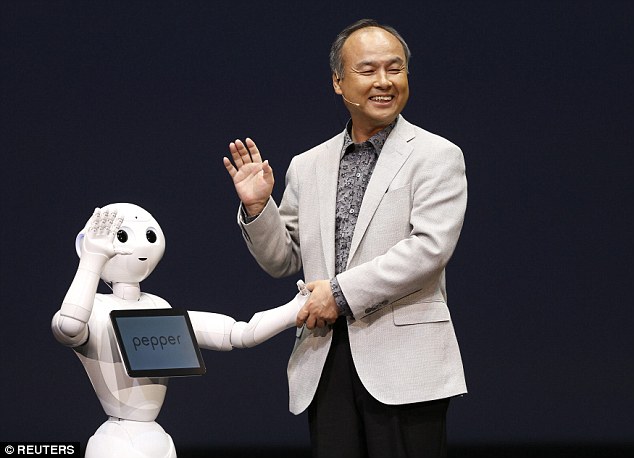
CEO and chairman of mobile company Softbank and its IoT subsidiary ARM Masayoshi Son (pictured here with Softbank robot 'Pepper' in 2014) announced at the World Mobile Congress that ARM will deliver a trillion microchips designed for the internet of things by 2040
Masayoshi Son, CEO of mobile company Softbank, has predicted that there will be more smart robots helping humans than there will be people on Earth by 2040.
The Japanese businessman also claimed that 1 trillion microchips designed for the so-called internet of things (IoT) will be delivered around the world over the next 20 years.
Mr Son, also CEO of IoT software company ARM, made the comments at the World Mobile Congress in Barcelona today.
He went on to say that the number of microchip 'brain cells' will overtake the number of human neurons in 2018.
Scroll down for video 
CEO and chairman of mobile company Softbank and its IoT subsidiary ARM Masayoshi Son (pictured here with Softbank robot 'Pepper' in 2014) announced at the World Mobile Congress that ARM will deliver a trillion microchips designed for the internet of things by 2040

DEFINING THE INTERNET OF THINGS

Although the term ‘Internet of Things’ (IoT) first appeared in 2005, there is still no widely accepted definition.
The phrase 'IoT' often refers to devices or sensors - other than computers, smartphones, or tablets - that connect, communicate or transmit information over the web. 
IoT includes gadgets bought by consumers, as well as products and services designed for businesses to help machines ‘communicate’ with each other.
For example, the term IoT can include the Radio Frequency Identification (RFID) tags businesses place on products in stores to track their inventory, or sensors that monitor electricity use in hotels. 
The Japanese businessman predicted that an army of 10 billion smart robots designed to help humans will grow over the next 25 years.
But Mr Son cautioned that these advances won't come without risks, and addressing cybersecurity issues will have to be part of the equation.
He said: 'There are about 500 ARM chips in a car today and none of them are secure.'
The business giant predicted that 64 per cent of cyber attacks will be through hacking IoT connected objects in the future.
Concerns have been raised that hackers could use IoT devices to attack or spy on users from within their homes.
Last year, for example, hackers attacked websites such as Twitter, Paypal and Spotify by targeting hundreds of thousands of internet-connected devices from millions of internet addresses in one the largest attacks ever seen. 
Now, it appears that a trillion new 'smart' devices are on their way, such as door locks controlled from a smartphone or smart lights that flash when they sense an intruder.
The internet of things (IoT) refers to a smart, connected network of devices that can all 'speak' to one another through the internet.


The phrase 'IoT' often refers to devices or sensors - other than computers, smartphones, or tablets - that connect, communicate or transmit information over the web.
These devices all need microchips to function, and Softbank's semiconductor and software subsidiary ARM plans to deliver 1trillion over the next 20 years, the chairman and CEO of the Japanese company announced on Monday.
The Japanese businessman also claimed that 1 trillion microchips designed for the so-called internet of things (IoT) will be delivered around the world over the next 20 years. Illustrated in this graphic are some of the Internet of Things gadgets that are already in production
Mr Son said the growing number of microchip 'brain cells' opens up a huge opportunity for smart and connected objects.
'This is why I spent $32 billion (£26 billion) to acquire ARM,' Mr Son said, explaining his 30-year-vision of a world where the artificial computer brain will have 10,000 intelligence quotient (IQ) capabilities compared with 100 for the average human.
Jennifer Belissent, an analyst at Forrester Research who attended Son's keynote speech, said the numbers he mentioned were very dramatic.
'The greater connectivity and new artificial IQ capabilities offer so much potential. It sets the scene for a Marvel movie,' she said.
'Now, the key question is how to make that new technology available to everyone.
'It's not the number of new devices that is relevant but what you make out of it in terms of analytical capabilities.'
Faced with a secular decline in average revenue per user (ARPU) and a smartphone market only expected to grow by 5 per cent in the coming years, Mr Son stressed the need for mobile operators to invest in new technology.
Son and Saudi Arabia's sovereign wealth fund have created a technology investment fund that could grow as large as $100billion (£80billion) and become a kingpin in the high-tech industry.
Posted by Unknown at 12:53 PM No comments:
Email ThisBlogThis!Share to XShare to FacebookShare to Pinterest

Saturday, February 25, 2017

Growing Contingent Workforce Has Many Benefits for Employers and Workers

The contingent workforce is expected to accelerate over the next couple of years. In fact, it is estimated that 50 percent of the workforce will be comprised of contingent workers by 2019.
By Tom Clark
February 21, 2017
Editor’s Note: Tom Clark is the Director of Supply Chain & Logistics at Direct Recruiters, Inc.  Tom is a member of Council of Supply Chain Management Professionals and is a certified Lean Six Sigma Black Belt.  He is a Supply Chain Services Management Officer graduate from the US Army Quartermaster Center & School, Fort Lee, Virginia. He also earned his Bachelor of Science in Business Administration from John Carroll University, Cleveland, Ohio with a dual major in Business Management and Logistics. Contact Tom Clark at 440-996-0874 / tclark@directrecruiters.com.
The face of the U.S. workforce is changing. There’s high growth when it comes to temporary workers, contractors, independent consultants, and freelancers. New technologies, cost factors, and a whole new generation of young professionals wanting to work in a gig economy (http://whatis.techtarget.com/definition/gig-economy) are fueling this growth.
The contingent workforce is expected to accelerate over the next couple of years. In fact, it is estimated that 50 percent of the workforce will be comprised of contingent workers by 2019. 
This dynamic shift is causing organizations to explore ways a flexible workforce can help them achieve their goals and derive the many benefits such as:
• Employers have access to niche and specialized skill sets that may not be available in-house, especially when it comes to IT.
• Contingent workers typically do not require as much training since they were hired for work that matches their expertise.
• It’s a way to ramp-up fast to cover short-term projects without having to hire full-time employees.

• Organizations can easily “dial up” or “dial down” staffing as needed without having to pay FTE benefits.
 
• Internal resources are freed-up to focus on higher priority items.
For many professionals, contingency work is very attractive since opportunities are plentiful, the remuneration is desirable and the work can be rewarding. In addition, it meets the needs of many Millennial workers and their desire to be flexible.
Making the move from an employee to a contingent worker takes some preparation.  Here are a few suggestions:
Identify the niche where you have skills and expertise. Know your passion. Also, pinpoint what type of services and advice you can offer that organizations are willing to pay for.
Target your market and location. Determine what type of organization you want to work with and once decided, think about location. Do you want to work remotely or on-site? Are you open to relocation or a commute via airline to and from work?
Build your network and brand yourself. It’s important to start building your network once you’ve decided to be a consultant. A strong contact base will help you connect with the resources needed in order to find work.  Also, position yourself as an expert, someone that an organization cannot do without. Now, combine both a professional network and social network to help you spread with word faster.

Be ready for a trade-off. There’s uncertainty associated with gig work. While there’s flexibility, there may not be enough work for full-time hours or a stable income. You may have to supplement your income with another source.
Decide whether to go solo or engage with a consulting and staffing firm.  If you have the entrepreneurial spirit and want to approach a specific organization directly for a long-term gig, you might want to go solo. However, if you’re open to both short-term and long-term opportunities in various locations, a consultant staffing firm might be the answer.
The rise of a contingent workforce and gig economy will only continue to grow and with it, much opportunity. A consultant or contractor has more freedom than a regular employee to circulate within their professional community and to take more jobs in more challenging environments. For organizations, a contingent workforce means acquiring the right skills and expertise needed without the overhead costs associated with payroll benefits and administration. No doubt, a win-win situation for both.
Posted by Unknown at 9:50 AM No comments:
Email ThisBlogThis!Share to XShare to FacebookShare to Pinterest

JLL Analysts See DC Surge in Midwest

Shortage of DC labor in the U.S. to growth in DC leasing/construction activity in "secondary" Midwestern markets.
By Patrick Burnson
February 24, 2017
While traditional domains for DCs (Central Pennsylvania, Dallas–Fort Worth and the Inland Empire) remain very active, Industrial real estate firm JLL has discovered that there is a growing shift to secondary Midwestern markets.
Indianapolis, Columbus, Cincinnati and St. Louis have all seen a spike in e-commerce deals over the past 24 months.
A new report indicates that each now ranks in the top 10 nationally. Indianapolis, in particular, has seen the e-commerce sector account for 61.2 percent of “big-box” activity during this time frame.
In a nutshell, it links the shortage of DC labor in the U.S. to growth in DC leasing/construction activity in “secondary” Midwestern markets.
While central location is a major factor in the rise of these Midwestern cities, so too are e-fulfillment labor demand and wage implications, says JLL.
In an exclusive interview with SCMR, executives noted that with “big-box” leasing around the country continuing to flourish and unemployment rates steadily reaching new lows, continued wage growth for warehouse associates is expected to outpace many other employment sectors.
This trend, they say, puts upward pressure on overall total landed costs.
“These findings were not much of a surprise,” says Walter Kemmsies, Ph.D.,JLL’s Managing Director, Economist and Chief Strategist. Given the fact that more goods must be held in more locations, we expect to see a shift in logistics.”
Matt Powers, JLL’s vice president of retail ecommerce, agrees, and shared this observation of wages and salaries:
“There’s been a ‘ripple effect’ in compensation for logistics managers,” he says. “As lower-wage workers are becoming better paid, those in management are expecting to earn more, too.”
Having just returned from the annual meeting of The Retail Industry Leaders Association (RILA), both men noted a state of heighted concern about “pure play” e-tailing competition.
“For the first time, we say a heightened awareness among retailers to share more information about their business models, and cooperate to a great extent in the coming years,” says Powers.
Posted by Unknown at 9:47 AM No comments:
Email ThisBlogThis!Share to XShare to FacebookShare to Pinterest

Newest Supply Chain Paradigm Shift Hits Retail

Puga Sankara
BIO
EMAIL THIS
PRINT
COMMENT
 
Puga Sankara, Principal, Smart Gladiator
2/24/2017   
Post a comment
In 1997, I had a half-day training with the leader of the multinational company I had just joined in Bangalore. He started with a story from Steven Covey’s book, The Seven Habits of Highly Effective People about paradigm shift:
One morning on a subway in New York, people were sitting quietly - some reading newspapers, some lost in thought, some resting with their eyes closed. It was a calm, peaceful scene.
Then suddenly, a man and his children entered the subway.  The children were so loud and rambunctious that instantly the whole climate changed.
The man sat down next to me and closed his eyes, apparently oblivious to the situation. The children were yelling back and forth, throwing things, even grabbing people's papers. It was very disturbing. And yet, the man sitting next to me did nothing.
It was difficult not to feel irritated. I could not believe that he could be so insensitive as to let his children run wild like that and do nothing about it, taking no responsibility at all. It was easy to see that everyone else on the subway felt irritated, too. So finally, with what I felt was unusual patience and restraint, I turned to him and said, "Sir, your children are really disturbing a lot of people. I wonder if you couldn't control them a little more?"
The man lifted his gaze as if to come to a consciousness of the situation for the first time and said softly, "Oh, you're right. I guess I should do something about it. We just came from the hospital where their mother died about an hour ago. I don't know what to think, and I guess they don't know how to handle it either."
Can you imagine what I felt at that moment? My paradigm shifted. Suddenly I saw things differently, and because I saw differently, I thought differently, I felt differently, I behaved differently. My irritation vanished. I didn't have to worry about controlling my attitude or my behavior; my heart was filled with the man's pain. Feelings of sympathy and compassion flowed freely. "Your wife just died? Oh, I'm so sorry! Can you tell me about it? What can I do to help?" Everything changed in an instant.
When a paradigm shifts, everything changes. It’s a phenomenon that we are seeing in the brick and mortar commerce supply chain with the increased popularity of online shopping. Electronics OEMs and retailers are going to have to look hard at the tea leaves and react to these changes now, if they haven't already.


Here are some indicators:
  • Kenneth Cole announced that it is closing its outlet stores (except the Bowery, N.Y. and Arlington, Va.) to focus on selling online.
  • Kmart and Sears are closing more than 50 stores in 2017.
  • Macys is closing 68 of stores and laying off 10,000 employees
  • Belk has closures and was sold, in part because they were late to the e-commerce game.
Shippers with powerful brands and products are thinking along the same lines. If more customers are flocking to on-line buying, there’s little need to showcase products in a retail environment. Instead, retailers want to showcase products and take orders online

Whereas Tompkins Associates, a consulting company is starting this new 3PL business called Monarch FX to address the growing business opportunity. Tompkins is putting skin in the game and building an e-commerce fulfillment network to provide “post-click logistics” to retailers. The new venture, of which Tompkins is chairman and CEO, is known as the MonarchFx Alliance, the alliance brings together a group of solution and service providers to offer more competitive distribution and transportation services than retail members could provide on their own. It will include industrial real estate partners who will own the buildings; three 3PLs to operate the facilities; a technology provider (in this case, JDA Software); process design and automated materials handling solutions (Tompkins International and Tompkins Robotics); and two transportation providers, including one last mile delivery specialist for packages, or what Tompkins calls a delivery destination unit (DDU).
This points to a major shift in business moving from the retail store to the back-office warehouse operations. Many people would much rather sit at home and shop through computers, laptops, tablets, or mobile devices, rather than facing the inconvenience of going to a brick and mortar location. That’s going to change the distribution landscape.


Now, one and two unit orders will be downloaded into the distribution center (DC), and the systems that run the DC need to fulfill those orders faster. Amazon DCs are setting the bar, shipping orders in 20 minutes or less, compared to other retailers are running somewhere from five to 10 hours. There’s a  big opportunity for somebody like Monarch Alliance to offer such a service on par in efficiency with Amazon.
So what does this mean to the DC operators and other 3PL service providers? It means a shift in order profile. It means a greater number of smaller orders. Most of all, this new paradigm demands newly-designed DC design, infrastructure, processes, and tools.
This is not the first wave of the shakeout. In 2012 and 2013, Best Buy closed dozens of electronics stores and exited the European market, after they became the best showroom for Amazon. Now,  the focus more on in store services, such as Geek squad; offering mobile device services; and being a knowledge provider and trusted advisor for in-store customers. They have evolved to remain relevant—and that’s important.
Basically, retailers need to provide value added services. Consider Nordstrom’s—a store known for excepting returns at any time, even if they didn’t sell the product.  They know that service is what wins back customers.
Manhattan Associates (MA), a supply chain execution software vendor whose revenue comes predominantly from retailers, also felt the need for new direction based on the changing demadns of customers. MA’s main thriving business is warehouse management systems (WMS), their bread and butter for a long time. However, MA expanded into the retail segment after buying a point of sale (POS) system vendor Global Bay and deploying a distributed order management system. Now, retailers can route e-commerce orders to any store or warehouse within their supply chain network based on inventory availability and geographic proximity. 
Posted by Unknown at 9:41 AM No comments:
Email ThisBlogThis!Share to XShare to FacebookShare to Pinterest

Lack of transparency challenges cold chain, expert says


Lara L. Sowinski | Feb 25, 2017 9:00AM ESTPrint

Following his 30-year career with Maersk Line, including 10 years as the company’s global head of reefer business, Thomas Eskesen established his own advisory firm in 2015. Today, Eskesen Advisory works with clients on a number of issues and strategies related to reefer shipping. Cool Cargoes checked in with him recently to get his views on the current market.
CC: The impact of carrier consolidation and its impact on reefer cargoes is top of mind for many industry executives. What’s your take?
Eskesen: First, I think we need to look at the core fundamentals of what shippers of refrigerated cargoes require: a quality service provider; reliable and consistent services; and ongoing improvements and innovations.
The financial distress of the shipping lines, which is mainly driven by the overcapacity in the Asia dry export trades, means carriers in general struggle to deliver on these parameters.
At the same time, the rapid pace of consolidation we are seeing is long overdue, in my opinion. I think we will eventually look back at developments that occurred in 2016 as a complete industry game changer, many of which we once deemed unthinkable, i.e., the Cosco and China Shipping merger; CMA CGM acquiring APL; the three Japanese carriers NYK, MOL and “K” Line set to merge in 2018; Hapag-Lloyd acquiring UASC; and last but not least, Maersk acquiring Hamburg Sud.
CC: Is there an upside for reefer shippers?
Eskesen: The larger scale will mean more financial stability, which will put the lines in a better position to deliver the essential basic quality and consistency. They will take further costs out and improve efficiencies.
CC: Will we see a hike in prices?
Eskesen: Over time, yes, I believe so, and it may be controversial, but it is in the shippers’ best interest to have healthy service providers who can reinvest in the business, plus reignite innovation. The shipping business is extremely old fashioned, and one needs to invest in digitalization to provide better service to clients. 
Another result of consolidation is that it will lead to bigger and more serious, determined players. Instead of the current behavior, which is more focused on filling slots and growing market share, we’ll begin to see more long-term thinking and an understanding that profit and stability is better than solely building market share and generating price wars.
CC: What is the biggest pain point with refrigerated shipping today?
Eskesen: In February, I attended the world’s largest fruit fair in Berlin. It was clear that the largest pain point yet to resolve is the lack of data and transparency in the process of managing the end-to-end cold chain. This lack of transparency leads to food waste, lack of trust, and eventually added cost to the end-consumer. I welcome the initiative by Maersk Line to be fully transparent with its reefer data, i.e., GPS, power, temperature monitoring, etc. This will set an entirely new industry standard and force other shipping lines that are serious about the reefer business to follow. 
CC: Are there other key trends you think shippers should pay attention to?
Eskesen: Yes, I think many tend to overlook the fact that the world’s refrigerated business is a super-attractive growth market with a strong correlation to population growth and improved wealth in places such as China and India. Specifically, we saw 5.8 percent trade growth in 2016, which is very healthy, so shippers continue to see growth opportunities in new markets, produce varieties, etc. The flip side is that container lines did not have sufficient cash to invest in their reefer container fleets in 2016, so right now we are seeing pretty significant challenges for the carriers to supply containers. That means shippers need to pay extra close attention to who they contract their business with, and ensure guarantees are in place. They may have to pay a premium to get priority treatment, but, then again, the fresh fruit is no good if left behind.
Posted by Unknown at 9:35 AM No comments:
Email ThisBlogThis!Share to XShare to FacebookShare to Pinterest

Friday, February 24, 2017

Prepare To Meet Your AI Overlords

  • Nikki Baird
I thought everybody would have heard of this story by now, but apparently not. So this week, I’m going to tell it here. The lesson is this: for as much as it seems like technology has progressed leaps and bounds even in the last year, we still have a very long way to go. And both as industry participants, and as consumers, we should not be complacent about our progress. But that’s not the only lesson here for retailers. Not by a long shot.
Here’s the story. About a month ago, a woman reported that her six year old daughter had managed to order a dollhouse and four pounds of cookies by interacting with Alexa via the woman’s recently acquired Amazon Dot. The woman said her kids were playing with Alexa by asking and telling knock knock jokes, and then the next thing she knew she had an email order confirmation for a $170 dollhouse and a giant tin of Danish butter cookies. The mother learned a lesson quickly – that when you have young kids, you need to make sure you set a PIN on Alexa’s ordering functionality.
That would be enough education for one day when it comes to artificial-intelligence powered devices, but the story didn’t end there. While the random dollhouse order had originated in Dallas, a San Diego news station ran the story on air, and when it did, prompted Amazon Echos and Dots in viewers’ houses to also order the dollhouse. Which, when you think about it, is both awesome and terrifying.
I have an Amazon Echo. I bought it to see what all this voice interactivity is about. I do not have voice ordering active, in part because I’m just not comfortable with that concept. Buying is visual to me, and I don’t even remotely like the idea of “Alexa, order me a pizza” even when I know I have the default order for pizza set up just how I like it. Voice ordering is the ultimate in convenience over price – it’s so convenient you don’t even care about making sure it’s the right item or what price it is. That’s not for me. Though, retailers should be terrified if that’s where consumers are headed.
But what fascinates me the most about Amazon’s voice ordering system is how my own kids have taken to it. The mother in the story above reports that after asking if Alexa would play dollhouse with her, and Alexa confirmed the order, her daughter told Alexa “I love you!”. Her child is much younger than my two (which are 15 and 12), but both of them seem to have a certain amount of affection for “her” – and they call it “her” – already.
To my teen kids, we don’t own an Echo, we own an Alexa. And they are constantly asking her to tell them the weather, or a joke, or to play a song. My son (the 15-year-old) has the Alexa app on his phone, and gets the emails about what’s new with Alexa. He’s asked for us to download a to-do-list app that Alexa supports so that he can add things he wants to our grocery list via voice, instead of having to type it into the shared list we currently use.
Our Echo sits in our living room. And there have been times when the TV has run an ad from Amazon, where you can tell they are sending some kind of cancelling signal along with the ad, because the Echo will light up at the mention of Alexa, and then turn itself off after a second or two. And there have been times when we have been talking, or watching something, where Alexa thought it had been activated, and suddenly blurted out, “I’m sorry. I didn’t understand the question.” One of us, my son usually, will tell Alexa to stop or shut up at that point.
I don’t think I realized how much this AI tool has wormed its way into our life until I caught an episode of Star Trek: Voyager. BBC America has been running them a lot lately. If you’re not familiar with this corner of the Star Trek franchise, then all you need to know is that one of the main characters is actually an AI – a holographic doctor, to be used in cases of a medical emergency. The ship has no other doctor, so “he” is forced to be on all the time, both teaching people medical skills, and handling the usual batch of red-shirts that just got chewed up by the latest planet. In the episode I caught, the doctor has a new assistant, and she’s appalled at how the crew treat the doctor, “like he’s a piece of furniture or something”. The writers assumed that even though people might be faced with someone who looks real, sounds real, even feels real to the touch, they would still know deep down that it’s not a real person. And thus treat it more like a piece of furniture than a person.
After hearing about the girl who loves Alexa, and watching my own kids readily adapt to calling our Echo “her” – and that’s just a disembodied voice – I have a feeling the human tendency is going to be to relate to anything that is moderately human as human, even when they know it’s not. I am certain that we will have more fun stories of AI-driven, voice-activated devices doing crazy things. But I’m also certain that for the retailers struggling to compete against Amazon, they need to think a lot more about what kind of personality and trust people are projecting on to services like Alexa. Increasingly, they may find they are not competing against some wacky bald guy and an internet behemoth. They are competing against Alexa, my kids’ favorite disembodied voice, who will always tell them jokes and find them the best songs to listen to. And, I guess, order the occasional toy if you’re not careful.
Posted by Unknown at 6:47 PM No comments:
Email ThisBlogThis!Share to XShare to FacebookShare to Pinterest

Our Miserable 21st Century

From work to income to health to social mobility, the year 2000 marked the beginning of what has become a distressing era for the United States
NICHOLAS N. EBERSTADT / FEB. 15, 2017
1.4K
shares
A
On the morning of November 9, 2016, America’s elite—its talking and deciding classes—woke up to a country they did not know. To most privileged and well-educated Americans, especially those living in its bicoastal bastions, the election of Donald Trump had been a thing almost impossible even to imagine. What sort of country would go and elect someone like Trump as president? Certainly not one they were familiar with, or understood anything about.
Whatever else it may or may not have accomplished, the 2016 election was a sort of shock therapy for Americans living within what Charles Murray famously termed “the bubble” (the protective barrier of prosperity and self-selected associations that increasingly shield our best and brightest from contact with the rest of their society). The very fact of Trump’s election served as a truth broadcast about a reality that could no longer be denied: Things out there in America are a whole lot different from what you thought. 
Yes, things are very different indeed these days in the “real America” outside the bubble. In fact, things have been going badly wrong in America since the beginning of the 21st century.
It turns out that the year 2000 marks a grim historical milestone of sorts for our nation. For whatever reasons, the Great American Escalator, which had lifted successive generations of Americans to ever higher standards of living and levels of social well-being, broke down around then—and broke down very badly.
The warning lights have been flashing, and the klaxons sounding, for more than a decade and a half. But our pundits and prognosticators and professors and policymakers, ensconced as they generally are deep within the bubble, were for the most part too distant from the distress of the general population to see or hear it. (So much for the vaunted “information era” and “big-data revolution.”) Now that those signals are no longer possible to ignore, it is high time for experts and intellectuals to reacquaint themselves with the country in which they live and to begin the task of describing what has befallen the country in which we have lived since the dawn of the new century.

II

Consider the condition of the American economy. In some circles people still widely believe, as one recent New York Times business-section article cluelessly insisted before the inauguration, that “Mr. Trump will inherit an economy that is fundamentally solid.” But this is patent nonsense. By now it should be painfully obvious that the U.S. economy has been in the grip of deep dysfunction since the dawn of the new century. And in retrospect, it should also be apparent that America’s strange new economic maladies were almost perfectly designed to set the stage for a populist storm.
Ever since 2000, basic indicators have offered oddly inconsistent readings on America’s economic performance and prospects. It is curious and highly uncharacteristic to find such measures so very far out of alignment with one another. We are witnessing an ominous and growing divergence between three trends that should ordinarily move in tandem: wealth, output, and employment. Depending upon which of these three indicators you choose, America looks to be heading up, down, or more or less nowhere.
From the standpoint of wealth creation, the 21st century is off to a roaring start. By this yardstick, it looks as if Americans have never had it so good and as if the future is full of promise. Between early 2000 and late 2016, the estimated net worth of American households and nonprofit institutions more than doubled, from $44 trillion to $90 trillion. (SEE FIGURE 1.)
Although that wealth is not evenly distributed, it is still a fantastic sum of money—an average of over a million dollars for every notional family of four. This upsurge of wealth took place despite the crash of 2008—indeed, private wealth holdings are over $20 trillion higher now than they were at their pre-crash apogee. The value of American real-estate assets is near or at all-time highs, and America’s businesses appear to be thriving. Even before the “Trump rally” of late 2016 and early 2017, U.S. equities markets were hitting new highs—and since stock prices are strongly shaped by expectations of future profits, investors evidently are counting on the continuation of the current happy days for U.S. asset holders for some time to come.
A rather less cheering picture, though, emerges if we look instead at real trends for the macro-economy. Here, performance since the start of the century might charitably be described as mediocre, and prospects today are no better than guarded.
The recovery from the crash of 2008—which unleashed the worst recession since the Great Depression—has been singularly slow and weak. According to the Bureau of Economic Analysis (BEA), it took nearly four years for America’s gross domestic product (GDP) to re-attain its late 2007 level. As of late 2016, total value added to the U.S. economy was just 12 percent higher than in 2007. (SEE FIGURE 2.) The situation is even more sobering if we consider per capita growth. It took America six and a half years—until mid-2014—to get back to its late 2007 per capita production levels. And in late 2016, per capita output was just 4 percent higher than in late 2007—nine years earlier. By this reckoning, the American economy looks to have suffered something close to a lost decade.
But there was clearly trouble brewing in America’s macro-economy well before the 2008 crash, too. Between late 2000 and late 2007, per capita GDP growth averaged less than 1.5 percent per annum. That compares with the nation’s long-term postwar 1948–2000 per capita growth rate of almost 2.3 percent, which in turn can be compared to the “snap back” tempo of 1.1 percent per annum since per capita GDP bottomed out in 2009. Between 2000 and 2016, per capita growth in America has averaged less than 1 percent a year. To state it plainly: With postwar, pre-21st-century rates for the years 2000–2016, per capita GDP in America would be more than 20 percent higher than it is today.
The reasons for America’s newly fitful and halting macroeconomic performance are still a puzzlement to economists and a subject of considerable contention and debate.1Economists are generally in consensus, however, in one area: They have begun redefining the growth potential of the U.S. economy downwards. The U.S. Congressional Budget Office (CBO), for example, suggests that the “potential growth” rate for the U.S. economy at full employment of factors of production has now dropped below 1.7 percent a year, implying a sustainable long-term annual per capita economic growth rate for America today of well under 1 percent.
Then there is the employment situation. If 21st-century America’s GDP trends have been disappointing, labor-force trends have been utterly dismal. Work rates have fallen off a cliff since the year 2000 and are at their lowest levels in decades. We can see this by looking at the estimates by the Bureau of Labor Statistics (BLS) for the civilian employment rate, the jobs-to-population ratio for adult civilian men and women. (SEE FIGURE 3.) Between early 2000 and late 2016, America’s overall work rate for Americans age 20 and older underwent a drastic decline. It plunged by almost 5 percentage points (from 64.6 to 59.7). Unless you are a labor economist, you may not appreciate just how severe a falloff in employment such numbers attest to. Postwar America never experienced anything comparable.
From peak to trough, the collapse in work rates for U.S. adults between 2008 and 2010 was roughly twice the amplitude of what had previously been the country’s worst postwar recession, back in the early 1980s. In that previous steep recession, it took America five years to re-attain the adult work rates recorded at the start of 1980. This time, the U.S. job market has as yet, in early 2017, scarcely begun to claw its way back up to the work rates of 2007—much less back to the work rates from early 2000.
As may be seen in Figure 3, U.S. adult work rates never recovered entirely from the recession of 2001—much less the crash of ’08. And the work rates being measured here include people who are engaged in any paid employment—any job, at any wage, for any number of hours of work at all.
On Wall Street and in some parts of Washington these days, one hears that America has gotten back to “near full employment.” For Americans outside the bubble, such talk must seem nonsensical. It is true that the oft-cited “civilian unemployment rate” looked pretty good by the end of the Obama era—in December 2016, it was down to 4.7 percent, about the same as it had been back in 1965, at a time of genuine full employment. The problem here is that the unemployment rate only tracks joblessness for those still in the labor force; it takes no account of workforce dropouts. Alas, the exodus out of the workforce has been the big labor-market story for America’s new century. (At this writing, for every unemployed American man between 25 and 55 years of age, there are another three who are neither working nor looking for work.) Thus the “unemployment rate” increasingly looks like an antique index devised for some earlier and increasingly distant war: the economic equivalent of a musket inventory or a cavalry count.
By the criterion of adult work rates, by contrast, employment conditions in America remain remarkably bleak. From late 2009 through early 2014, the country’s work rates more or less flatlined. So far as can be told, this is the only “recovery” in U.S. economic history in which that basic labor-market indicator almost completely failed to respond.
Since 2014, there has finally been a measure of improvement in the work rate—but it would be unwise to exaggerate the dimensions of that turnaround. As of late 2016, the adult work rate in America was still at its lowest level in more than 30 years. To put things another way: If our nation’s work rate today were back up to its start-of-the-century highs, well over 10 million more Americans would currently have paying jobs.
There is no way to sugarcoat these awful numbers. They are not a statistical artifact that can be explained away by population aging, or by increased educational enrollment for adult students, or by any other genuine change in contemporary American society. The plain fact is that 21st-century America has witnessed a dreadful collapse of work.
For an apples-to-apples look at America’s 21st-century jobs problem, we can focus on the 25–54 population—known to labor economists for self-evident reasons as the “prime working age” group. For this key labor-force cohort, work rates in late 2016 were down almost 4 percentage points from their year-2000 highs. That is a jobs gap approaching 5 million for this group alone.
It is not only that work rates for prime-age males have fallen since the year 2000—they have, but the collapse of work for American men is a tale that goes back at least half a century. (I wrote a short book last year about this sad saga.2) What is perhaps more startling is the unexpected and largely unnoticed fall-off in work rates for prime-age women. In the U.S. and all other Western societies, postwar labor markets underwent an epochal transformation. After World War II, work rates for prime women surged, and continued to rise—until the year 2000. Since then, they too have declined. Current work rates for prime-age women are back to where they were a generation ago, in the late 1980s. The 21st-century U.S. economy has been brutal for male and female laborers alike—and the wreckage in the labor market has been sufficiently powerful to cancel, and even reverse, one of our society’s most distinctive postwar trends: the rise of paid work for women outside the household.
In our era of no more than indifferent economic growth, 21st–century America has somehow managed to produce markedly more wealth for its wealthholders even as it provided markedly less work for its workers. And trends for paid hours of work look even worse than the work rates themselves. Between 2000 and 2015, according to the BEA, total paid hours of work in America increased by just 4 percent (as against a 35 percent increase for 1985–2000, the 15-year period immediately preceding this one). Over the 2000–2015 period, however, the adult civilian population rose by almost 18 percent—meaning that paid hours of work per adult civilian have plummeted by a shocking 12 percent thus far in our new American century.
This is the terrible contradiction of economic life in what we might call America’s Second Gilded Age (2000—). It is a paradox that may help us understand a number of overarching features of our new century. These include the consistent findings that public trust in almost all U.S. institutions has sharply declined since 2000, even as growing majorities hold that America is “heading in the wrong direction.” It provides an immediate answer to why overwhelming majorities of respondents in public-opinion surveys continue to tell pollsters, year after year, that our ever-richer America is still stuck in the middle of a recession. The mounting economic woes of the “little people” may not have been generally recognized by those inside the bubble, or even by many bubble inhabitants who claimed to be economic specialists—but they proved to be potent fuel for the populist fire that raged through American politics in 2016.

III

So general economic conditions for many ordinary Americans—not least of these, Americans who did not fit within the academy’s designated victim classes—have been rather more insecure than those within the comfort of the bubble understood. But the anxiety, dissatisfaction, anger, and despair that range within our borders today are not wholly a reaction to the way our economy is misfiring. On the nonmaterial front, it is likewise clear that many things in our society are going wrong and yet seem beyond our powers to correct.
Some of these gnawing problems are by no means new: A number of them (such as family breakdown) can be traced back at least to the 1960s, while others are arguably as old as modernity itself (anomie and isolation in big anonymous communities, secularization and the decline of faith). But a number have roared down upon us by surprise since the turn of the century—and others have redoubled with fearsome new intensity since roughly the year 2000.
American health conditions seem to have taken a seriously wrong turn in the new century. It is not just that overall health progress has been shockingly slow, despite the trillions we devote to medical services each year. (Which “Cold War babies” among us would have predicted we’d live to see the day when life expectancy in East Germany was higher than in the United States, as is the case today?)
Alas, the problem is not just slowdowns in health progress—there also appears to have been positive retrogression for broad and heretofore seemingly untroubled segments of the national population. A short but electrifying 2015 paper by Anne Case and Nobel Economics Laureate Angus Deaton talked about a mortality trend that had gone almost unnoticed until then: rising death rates for middle-aged U.S. whites. By Case and Deaton’s reckoning, death rates rose somewhat slightly over the 1999–2013 period for all non-Hispanic white men and women 45–54 years of age—but they rose sharply for those with high-school degrees or less, and for this less-educated grouping most of the rise in death rates was accounted for by suicides, chronic liver cirrhosis, and poisonings (including drug overdoses).
Though some researchers, for highly technical reasons, suggested that the mortality spike might not have been quite as sharp as Case and Deaton reckoned, there is little doubt that the spike itself has taken place. Health has been deteriorating for a significant swath of white America in our new century, thanks in large part to drug and alcohol abuse. All this sounds a little too close for comfort to the story of modern Russia, with its devastating vodka- and drug-binging health setbacks. Yes: It can happen here, and it has. Welcome to our new America.
In December 2016, the Centers for Disease Control and Prevention (CDC) reported that for the first time in decades, life expectancy at birth in the United States had dropped very slightly (to 78.8 years in 2015, from 78.9 years in 2014). Though the decline was small, it was statistically meaningful—rising death rates were characteristic of males and females alike; of blacks and whites and Latinos together. (Only black women avoided mortality increases—their death levels were stagnant.) A jump in “unintentional injuries” accounted for much of the overall uptick.
It would be unwarranted to place too much portent in a single year’s mortality changes; slight annual drops in U.S. life expectancy have occasionally been registered in the past, too, followed by continued improvements. But given other developments we are witnessing in our new America, we must wonder whether the 2015 decline in life expectancy is just a blip, or the start of a new trend. We will find out soon enough. It cannot be encouraging, though, that the Human Mortality Database, an international consortium of demographers who vet national data to improve comparability between countries, has suggested that health progress in America essentially ceased in 2012—that the U.S. gained on average only about a single day of life expectancy at birth between 2012 and 2014, before the 2015 turndown.
The opioid epidemic of pain pills and heroin that has been ravaging and shortening lives from coast to coast is a new plague for our new century. The terrifying novelty of this particular drug epidemic, of course, is that it has gone (so to speak) “mainstream” this time, effecting breakout from disadvantaged minority communities to Main Street White America. By 2013, according to a 2015 report by the Drug Enforcement Administration, more Americans died from drug overdoses (largely but not wholly opioid abuse) than from either traffic fatalities or guns. The dimensions of the opioid epidemic in the real America are still not fully appreciated within the bubble, where drug use tends to be more carefully limited and recreational. In Dreamland, his harrowing and magisterial account of modern America’s opioid explosion, the journalist Sam Quinones notes in passing that “in one three-month period” just a few years ago, according to the Ohio Department of Health, “fully 11 percent of all Ohioans were prescribed opiates.” And of course many Americans self-medicate with licit or illicit painkillers without doctors’ orders.
In the fall of 2016, Alan Krueger, former chairman of the President’s Council of Economic Advisers, released a study that further refined the picture of the real existing opioid epidemic in America: According to his work, nearly half of all prime working-age male labor-force dropouts—an army now totaling roughly 7 million men—currently take pain medication on a daily basis.
We already knew from other sources (such as BLS “time use” surveys) that the overwhelming majority of the prime-age men in this un-working army generally don’t “do civil society” (charitable work, religious activities, volunteering), or for that matter much in the way of child care or help for others in the home either, despite the abundance of time on their hands. Their routine, instead, typically centers on watching—watching TV, DVDs, Internet, hand-held devices, etc.—and indeed watching for an average of 2,000 hours a year, as if it were a full-time job. But Krueger’s study adds a poignant and immensely sad detail to this portrait of daily life in 21st-century America: In our mind’s eye we can now picture many millions of un-working men in the prime of life, out of work and not looking for jobs, sitting in front of screens—stoned.
But how did so many millions of un-working men, whose incomes are limited, manage en masse to afford a constant supply of pain medication? Oxycontin is not cheap. As Dreamland carefully explains, one main mechanism today has been the welfare state: more specifically, Medicaid, Uncle Sam’s means-tested health-benefits program. Here is how it works (we are with Quinones in Portsmouth, Ohio):
[The Medicaid card] pays for medicine—whatever pills a doctor deems that the insured patient needs. Among those who receive Medicaid cards are people on state welfare or on a federal disability program known as SSI. . . . If you could get a prescription from a willing doctor—and Portsmouth had plenty of them—Medicaid health-insurance cards paid for that prescription every month. For a three-dollar Medicaid co-pay, therefore, addicts got pills priced at thousands of dollars, with the difference paid for by U.S. and state taxpayers. A user could turn around and sell those pills, obtained for that three-dollar co-pay, for as much as ten thousand dollars on the street.
In 21st-century America, “dependence on government” has thus come to take on an entirely new meaning.
You may now wish to ask: What share of prime-working-age men these days are enrolled in Medicaid? According to the Census Bureau’s SIPP survey (Survey of Income and Program Participation), as of 2013, over one-fifth (21 percent) of all civilian men between 25 and 55 years of age were Medicaid beneficiaries. For prime-age people not in the labor force, the share was over half (53 percent). And for un-working Anglos (non-Hispanic white men not in the labor force) of prime working age, the share enrolled in Medicaid was 48 percent.
By the way: Of the entire un-working prime-age male Anglo population in 2013, nearly three-fifths (57 percent) were reportedly collecting disability benefits from one or more government disability program in 2013. Disability checks and means-tested benefits cannot support a lavish lifestyle. But they can offer a permanent alternative to paid employment, and for growing numbers of American men, they do. The rise of these programs has coincided with the death of work for larger and larger numbers of American men not yet of retirement age. We cannot say that these programs caused the death of work for millions upon millions of younger men: What is incontrovertible, however, is that they have financed it—just as Medicaid inadvertently helped finance America’s immense and increasing appetite for opioids in our new century.
It is intriguing to note that America’s nationwide opioid epidemic has not been accompanied by a nationwide crime wave (excepting of course the apparent explosion of illicit heroin use). Just the opposite: As best can be told, national victimization rates for violent crimes and property crimes have both reportedly dropped by about two-thirds over the past two decades.3 The drop in crime over the past generation has done great things for the general quality of life in much of America. There is one complication from this drama, however, that inhabitants of the bubble may not be aware of, even though it is all too well known to a great many residents of the real America. This is the extraordinary expansion of what some have termed America’s “criminal class”—the population sentenced to prison or convicted of felony offenses—in recent decades. This trend did not begin in our century, but it has taken on breathtaking enormity since the year 2000.
Most well-informed readers know that the U.S. currently has a higher share of its populace in jail or prison than almost any other country on earth, that Barack Obama and others talk of our criminal-justice process as “mass incarceration,” and know that well over 2 million men were in prison or jail in recent years.4 But only a tiny fraction of all living Americans ever convicted of a felony is actually incarcerated at this very moment. Quite the contrary: Maybe 90 percent of all sentenced felons today are out of confinement and living more or less among us. The reason: the basic arithmetic of sentencing and incarceration in America today. Correctional release and sentenced community supervision (probation and parole) guarantee a steady annual “flow” of convicted felons back into society to augment the very considerable “stock” of felons and ex-felons already there. And this “stock” is by now truly enormous.
One forthcoming demographic study by Sarah Shannon and five other researchers estimates that the cohort of current and former felons in America very nearly reached 20 million by the year 2010. If its estimates are roughly accurate, and if America’s felon population has continued to grow at more or less the same tempotraced out for the years leading up to 2010, we would expect it to surpass 23 million persons by the end of 2016 at the latest. Very rough calculations might therefore suggest that at this writing, America’s population of non-institutionalized adults with a felony conviction somewhere in their past has almost certainly broken the 20 million mark by the end of 2016. A little more rough arithmetic suggests that about 17 million men in our general population have a felony conviction somewhere in their CV. That works out to one of every eight adult males in America today.
We have to use rough estimates here, rather than precise official numbers, because the government does not collect any data at all on the size or socioeconomic circumstances of this population of 20 million, and never has. Amazing as this may sound and scandalous though it may be, America has, at least to date, effectively banished this huge group—a group roughly twice the total size of our illegal-immigrant population and an adult population larger than that in any state but California—to a near-total and seemingly unending statistical invisibility. Our ex-cons are, so to speak, statistical outcasts who live in a darkness our polity does not care enough to illuminate—beyond the scope or interest of public policy, unless and until they next run afoul of the law.
Thus we cannot describe with any precision or certainty what has become of those who make up our “criminal class” after their (latest) sentencing or release. In the most stylized terms, however, we might guess that their odds in the real America are not all that favorable. And when we consider some of the other trends we have already mentioned—employment, health, addiction, welfare dependence—we can see the emergence of a malign new nationwide undertow, pulling downward against social mobility.
Social mobility has always been the jewel in the crown of the American mythosand ethos. The idea (not without a measure of truth to back it up) was that people in America are free to achieve according to their merit and their grit—unlike in other places, where they are trapped by barriers of class or the misfortune of misrule. Nearly two decades into our new century, there are unmistakable signs that America’s fabled social mobility is in trouble—perhaps even in serious trouble.
Consider the following facts. First, according to the Census Bureau, geographical mobility in America has been on the decline for three decades, and in 2016 the annual movement of households from one location to the next was reportedly at an all-time (postwar) low. Second, as a study by three Federal Reserve economists and a Notre Dame colleague demonstrated last year, “labor market fluidity”—the churning between jobs that among other things allows people to get ahead—has been on the decline in the American labor market for decades, with no sign as yet of a turnaround. Finally, and not least important, a December 2016 report by the “Equal Opportunity Project,” a team led by the formidable Stanford economist Raj Chetty, calculated that the odds of a 30-year-old’s earning more than his parents at the same age was now just 51 percent: down from 86 percent 40 years ago. Other researchers who have examined the same data argue that the odds may not be quite as low as the Chetty team concludes, but agree that the chances of surpassing one’s parents’ real income have been on the downswing and are probably lower now than ever before in postwar America.
Thus the bittersweet reality of life for real Americans in the early 21st century: Even though the American economy still remains the world’s unrivaled engine of wealth generation, those outside the bubble may have less of a shot at the American Dream than has been the case for decades, maybe generations—possibly even since the Great Depression.

IV

The funny thing is, people inside the bubble are forever talking about “economic inequality,” that wonderful seminar construct, and forever virtue-signaling about how personally opposed they are to it. By contrast, “economic insecurity” is akin to a phrase from an unknown language. But if we were somehow to find a “Google Translate” function for communicating from real America into the bubble, an important message might be conveyed:
The abstraction of “inequality” doesn’t matter a lot to ordinary Americans. The reality of economic insecurity does. The Great American Escalator is broken—and it badly needs to be fixed.
With the election of 2016, Americans within the bubble finally learned that the 21st century has gotten off to a very bad start in America. Welcome to the reality. We have a lot of work to do together to turn this around.
1  Some economists suggest the reason has to do with the unusual nature of the Great Recession: that downturns born of major financial crises intrinsically require longer adjustment and correction periods than the more familiar, ordinary business-cycle downturn. Others have proposed theories to explain why the U.S. economy may instead have downshifted to a more tepid tempo in the Bush-Obama era. One such theory holds that the pace of productivity is dropping because the scale of recent technological innovation is unrepeatable. There is also a “secular stagnation” hypothesis, surmising we have entered into an age of very low “natural real interest rates” consonant with significantly reduced demand for investment. What is incontestable is that the 10-year moving average for per capita economic growth is lower for America today than at any time since the Korean War—and that the slowdown in growth commenced in the decade before the 2008 crash. (It is also possible that the anemic status of the U.S. macro-economy is being exaggerated by measurement issues—productivity improvements from information technology, for example, have been oddly elusive in our officially reported national output—but few today would suggest that such concealed gains would totally transform our view of the real economy’s true performance.)
2 Nicholas Eberstadt, Men Without Work: America’s Invisible Crisis (Templeton Press, 2016)
3 This is not to ignore the gruesome exceptions—places like Chicago and Baltimore—or to neglect the risk that crime may make a more general comeback: It is simply to acknowledge one of the bright trends for America in the new century.
4 In 2013, roughly 2.3 million men were behind bars according to the Bureau of Justice Statistics.
Posted by Unknown at 6:33 PM No comments:
Email ThisBlogThis!Share to XShare to FacebookShare to Pinterest
Newer Posts Older Posts Home
View mobile version
Subscribe to: Posts (Atom)

About Me

Unknown
View my complete profile

Blog Archive

  • ▼  2018 (219)
    • ▼  July (17)
      • Nordstrom Local expands its innovative, invento...
      • Shopping struggles: These 11 retailers may not su...
      • The Intelligent Way to Manage Supply Chain Risk –...
      • Amazon ‘Prime Day’ next week could be a boon ...
      • Bullish Growth
      • Retail Innovation Summit 2018—
      • 7 customer service lessons from the best Uber dr...
      • Amazon And Walmart: Digital Native VS Physical Pr...
      • The Semantics of Supply Chain
      • Truck drivers share the 7 most treacherous places...
      • Amazon’s third-party delivery network to redraw...
      • How we see the future of retail delivery – and w...
      • Titans Of China Series - Volume 1: Tencent Jul....
      • Titans Of China Series - Volume 2: Alibaba Jul....
      • Consumers embracing 'digital forward' stores,...
      • MORGAN STANLEY: The truck-driver shortage is get...
      • Emerging technology and supply chain: Breaking th...
    • ►  June (73)
    • ►  May (26)
    • ►  April (32)
    • ►  March (20)
    • ►  February (23)
    • ►  January (28)
  • ►  2017 (743)
    • ►  December (63)
    • ►  November (87)
    • ►  October (60)
    • ►  September (48)
    • ►  August (38)
    • ►  July (18)
    • ►  June (54)
    • ►  May (58)
    • ►  April (102)
    • ►  March (48)
    • ►  February (57)
    • ►  January (110)
  • ►  2016 (1225)
    • ►  December (64)
    • ►  November (88)
    • ►  October (49)
    • ►  September (72)
    • ►  August (72)
    • ►  July (99)
    • ►  June (106)
    • ►  May (85)
    • ►  April (91)
    • ►  March (136)
    • ►  February (195)
    • ►  January (168)
  • ►  2015 (1299)
    • ►  December (146)
    • ►  November (122)
    • ►  October (151)
    • ►  September (92)
    • ►  August (128)
    • ►  July (111)
    • ►  June (120)
    • ►  May (66)
    • ►  April (118)
    • ►  March (81)
    • ►  February (75)
    • ►  January (89)
  • ►  2014 (627)
    • ►  December (116)
    • ►  November (109)
    • ►  October (77)
    • ►  September (186)
    • ►  August (139)
Picture Window theme. Powered by Blogger.