Friday, May 27, 2016

THREE THINGS TO KNOW ABOUT ALIBABA IN 2016
As the e-commerce giant continues to expand in China and beyond, here are three things you need to know about it in 2016.

Globalisation

Cross-border imports: Tmall Global brings international brands that don't have presences in China to Chinese consumers. Costco, Macy's, Chemist Warehouse, LG Household & Health Care and Matsumoto Kiyoshi have storefronts on Tmall Global. Recently, Waitrose also started selling its products through Royal Mail's Tmall store. In Q1, Tmall Global's GMV grew over 180% year-over-year and Tmall will continue to build the cross-border platform.
International Expansion: Alibaba completed the acquisition of Lazada, a company that operates e-commerce platforms in Indonesia, Malaysia, the Philippines, Singapore, Thailand and Vietnam, with local language websites and mobile apps in each of the six markets. The acquisition will facilitate Alibaba's expansion into Southeast Asia, including potential cross-border opportunities introducing Chinese merchants and international brands to Southeast Asian consumers.

Mobile First

Mobile revenue from its China commerce retail business increased by 182% from 2015 to RMB50,337 million (USD7,674.6 mn) in fiscal year 2016, representing 63% of its China commerce retail business, compared to 30% in 2015. Mobile GMV (Gross Merchandise Volume) accounted for 73% of total GMV of its China retail marketplaces in Q1 2016 and mobile monthly active users reached 410 million by March 31, 2016.
With the increasing adoption of mobile devices as the primary method of accessing the marketplaces, mobile has become the focus for both marketing and sales.

Investing in logistics to serve rural China

Cainiao Network continues to expand same-day and next-day delivery services in urban areas while Rural Taobao service stations is covering over 14,000 villages as of the end of March 2016, providing purchasing and delivery services. As the demand from rural areas continues to increase, more infrastructure in supply chain will be put in to address the vast consumption needs.
A SNEAK PEEK INTO WALMART'S FIRST SHOPPING CENTER IN CHINA
As part of Walmart's commitment to the Chinese market, its first shopping centre will debut this Saturday.

The Mall

The community shopping centre 'The Mall' is designed, is entirely built and managed by Walmart and covers an area of 110,000 sq. m in Zhuhai, a key city in the Pearl River Delta region, south China. Besides Sam's Club, The Mall also hosts 68 restaurants and shops, including Starbucks, Uniqlo and Decathlon, targeting affluent local shoppers. It provides 1,800 free parking space, many more than the average in shopping centers.
The first Sam's Cafe has also been introduced in the Sam's Club store. Hot dogs, chicken wraps and pizza will be served to a maximum of 200 people in this 430 sq. m area.
There are two other 'The Mall' shopping centers under construction in China.

Walmart in China

Walmart operates more than 400 stores in China and has announced plans to open 30 more in 2016. As commercial rents rise rapidly in China, having its own property is a step towards better cost control and incremental revenue from the rent.

Amazon plans three new fulfillment centers


Amazon.com Inc. is supporting continued growth in the West and Midwest with fulfillment centers launching in the cities of Tracy and Eastvale, California, and Joliet, Illinois.

The new West Coast facilities will increase Amazon’s California presence to nine fulfillment centers, 9 million sq. ft. of operations and approximately 14,000 full-time hourly associates. Amazon currently fulfills customer orders at its existing seven Amazon fulfillment centers in the state, located in Tracy, Patterson, Moreno Valley, Redlands, Rialto and San Bernardino. The company also operates sortation centers in San Bernadino and Newark.

Both new California facilities are approximately one million square feet in size and will each employ hundreds of full-time associates. At the Eastvale location, Amazon associates will pick, pack and ship smaller customer items, such as books, electronics and toys. At the Tracy facility, the second in the city, associates will pick, pack and ship larger customer items, such as big-screen televisions, sports equipment and patio furniture.

“We are excited to continue our rapid growth in California in order to serve customers with superfast shipping speeds and vast selection,” said Akash Chauhan, VP of Amazon’s North America operations. “Since we first broke ground in California four years ago, we have found a network of support from community leaders to statewide officials, a dedicated workforce and fantastic customers.”

In addition, Amazon plans to open its second fulfillment center in Joliet, Illinois. The company will create more than 2,000 full-time jobs at the facility in addition to the 1,500 full-time employees currently working at its existing Joliet facility.

“We have found an abundance of talent in Joliet and we are excited to bring a new fulfillment center to the city and create 2,000 great full-time jobs with benefits,” said Chauhan. “This community and the elected officials throughout the city and state have been very supportive of Amazon and we thank them for helping make this possible.”

Amazon employees at the new 700,000-sq.-ft. Joliet fulfillment center will pick, pack and ship smaller items to customers like books, toys and electronics.

Amazon reportedly operates nearly 100 fulfillment centers across the U.S. The company also recently announced it would open its sixth Texas fulfillment center in Dallas, as well as two new fulfillment centers in New Jersey, in Florence and Carteret.

Dollar stores escape the retail blues


The nation’s top two extreme-value discounters aren’t feeling the retail malaise that affected department stores and many specialty retailers in the first quarter.  

Rivals Dollar Tree and Dollar General Corp. on Thursday both reported better-than-expected first quarter profits amid increases in traffic, higher spending and lower costs. Summing up a sentiment widely voiced by industry experts and analysts, Dollar Tree CEO Bob Sasser said his company is “part of what I consider, in this economic environment, the most attractive sector in retail."

Dollar Tree
Dollar Tree posted first quarter net income of $232.7 million, up from $69.5 million in the year-ago period. (Dollar Tree completed its $9.1 billion purchase of Family Dollar last July.) Excluding a one-time tax benefit and acquisition-related costs, Dollar Tree earnings for the quarter totaled 89 cents a share, beating Wall Street estimates by 8 cents.

The company hiked its full-year earnings per share forecast to between $3.58 and $3.80, from $3.35 to $3.65.
 
Dollar Tree’s consolidated net sales in the quarter, ended April 30, increased 133.6% to $5.09 billion from $2.18 billion last year, helped by its Family Dollar acquisition. Sales fell short of Wall Street analysts.   

Same-store sales rose 2.3%, driven by increases in both customer transactions and average ticket.

“I am very pleased with the company’s performance in the first quarter,” Sasser said. “Through what continues to be a challenging economic environment, we delivered sales (at) the mid-point of our guidance range, and earnings that exceeded the high end of our guidance range.”

The CEO said the chain has gotten off to a successful start to 2016.

“We remain on schedule with our integration of Family Dollar; we are on track to achieve our stated synergy targets; and we are part of what I consider, in this economic environment, the most attractive sector in retail,” he stated. “Looking ahead, we are committed to growing and improving our Dollar Tree and Family Dollar businesses to better serve more customers, while delivering long-term value to our shareholders."

During the quarter, Dollar Tree opened 171 stores, expanded or relocated 66 stores, and closed 19 stores.
   
Additionally, as part of its re-banner initiative, the company opened three former Family Dollar store locations as new Dollar Tree stores, converted 126 Deals stores to Dollar Tree stores and converted nine Deals stores to Family Dollar stores.

Dollar Tree operated 13,997 stores in North America as of April 30.

Dollar General
Dollar General Corp. reported net income of $295 million, or $1.03 a share, in the first quarter, up from $253 million, or 84 cents a share, last year.
 
Sales rose 7% to $5.27 billion from $4.92 billion, short of analysts’ estimates of $5.28 billion.
 
Same-store sales rose 2.2%.

"We remained keenly focused on ensuring the effectiveness and efficiency of every aspect of our business as we delivered both gross margin expansion and selling, general and administrative expense leverage," said CEO Todd Vasos. "This balanced performance contributed to operating profit improvement of 12% and diluted earnings per share growth of 23%. We are confident in our opportunities for growth and remain committed to creating sustainable long-term shareholder value."

As of April 29, Dollar General operated 12,719 stores in 43 states.

Wednesday, May 25, 2016


A Wal-Mart's Advantage: Blending The Clicks With The Bricks


|
9 comments 
|
 About: Wal-Mart Stores, Inc. (WMT), Includes: AMZN

Summary

Wal-Mart has a cost-efficient way to compete with Amazon online.
This way enables WMT to transfer shipping costs to consumers and optimize on its empty miles.
And by utilizing its vast store network and robust logistics, Wal-Mart will be able to have a competitive advantage over Amazon online.
Such news and realizations should be able to bolster investor conference in WMT and support the stock price upside momentum.
Thesis
The new trend of buying online and picking up in-store will greatly benefit retailers with robust logistic and vast store networks like Wal-Mart (NYSE:WMT).
Out of the major online options (Home delivery, in-store pickup, drive-through pickup, curbside pickup, virtual supermarket and automatic subscription), buying online and collecting in-store will be Wal-Mart's great competitive advantage over rival Amazon (NASDAQ:AMZN).
Wal-Mart's service has great potential. It will attract many consumers because it is free and flexible to consumers' busy schedules. Also, it offersWal-Mart a cost-efficient way to scale online operations because of its vast store and logistic networks, and because consumers take over the delivery costs and risks. Also, it will allow Wal-Mart to achieve significant cost savings as it optimizes on empty miles. Plus, with the click and collect system, Wal-Mart has the potential to truly become a one-stop shop both online and offline.
Introduction
At first, the fear was that everything was going to move entirely online, but that is not the case. Consumers are actually seeking for an intersection between the clicks and the bricks.
The Nielsen Global E-commerce and the New Retail Survey polled 30,000 online respondents in 60 countries to understand how digital technologies will shape the retail landscape of the future. The results were eye-opening. It found that more than half or 57% of global respondents are willing to use the "click and collect" services in the future: 57% for in-store, 55% for drive-thru and 52% for curbside pick-up.
But Nielsen is not the only company to do that research. According to the International Council of Shopping Centers' Holiday Consumer Purchasing Trends Study, nearly one-third of shoppers opted to buy products online and pick them up at the store.
These results favor a bullish case for Wal-Mart. Because it is the major retailer best positioned to benefit the most from this trend.
Benefits for Wal-Mart have already started to manifest. Based on a CNBC report on data derived from Slice Intelligence, which scans more than 3 million email receipts, WMT was the most used option for consumers who bought products online and picked them up in-store.
Wal-Mart's Grocery
(Source: Wal-Mart Grocery)
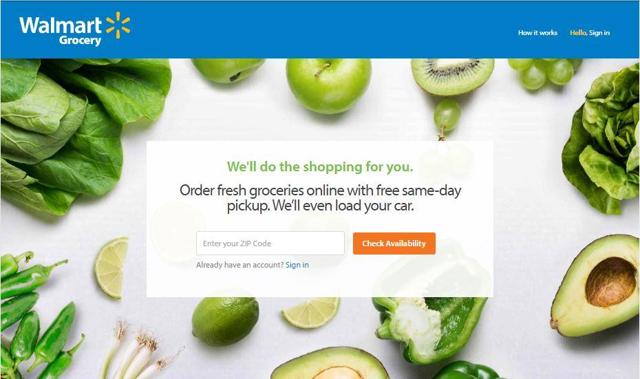
WMT's new pickup and delivery service enables consumers to place orders online at walmart.com/grocery, choose a time slot, and orders can be loaded directly into consumers' cars at a local Wal-Mart, or in some markets, consumers can have their order delivered right to their doorstep.
With Wal-Mart, consumers can get their orders as fast as same day. Wal-Mart offers 2-4-hour windows for both pickup and delivery. Unlike delivery, pickup is always free, and Wal-Mart does not charge any monthly or annual subscription fees for this service. Making it both convenient and cost-efficient for the consumer.
By the end of this month, Wal-Mart will be offering a free grocery pickup service in ~30 locations. 90% of WMT's customers are repeat users and more than 90% of the online baskets ordered include fresh grocery items (dairy, produce or meat).
Wal-Mart's Size Advantage: Vast Store And Robust Logistics Networks
While Amazon is trying to establish more physical stores, Wal-Mart is already ahead in the bricks-and-mortar space. This is important for WMT because it has been finding a way to have a competitive edge over Amazon, and this might be it.
"We're definitely going to open additional stores; how many we don't know yet," Bezos said at the meeting according to a report from The Wall Street Journal. "In these early days, it's all about learning rather than trying to earn a lot of revenue."
Wal-Mart is better positioned to deliver a cost-efficient blend of an online experience with in-store pickup because of its vast store network. Wal-Mart has an average of ~92 stores in every state, and it is within 15 miles of 90% of Americans. According to the book, "Business Ethics in the 21st Century," 90% of all Americans live within 15 miles of a Wal-Mart. Furthermore, Wal-Mart has 11,527 total retail units, 4,601 in the U.S., 6,274 international (it is in 28 countries) and 652 are Sam's Club.
In addition, Wal-Mart has a robust logistic network and distribution centers that support scaling its online operations. The company has over 150 distribution centers. Each distribution center being more than 1 million square feet in size and ships over 200 trailers daily. With each distribution center capable of supporting 90 to 100 stores in a 150+ mile radius. Wal-Mart's robust logistic network with already established distribution centers better positions the retailer to quickly deliver to consumers at a lower cost.
Margin Expansion By Reducing "Empty Miles"
Wal-Mart has the potential to reduce "empty miles" driven and thus optimize its logistic capacity while growing sales. This can happen because as Wal-Mart scales up its online operations, it will be able to have trucks at full capacity deliver to areas in close proximity. This will reduce the chances of having a lot of "empty miles."
This is important because scaling its online operations will only make Wal-Mart's logistic network more efficient and more cost-effective. This will happen because it can use the same infrastructure, trucks and drivers to move more products. Thereby growing its top line while minimizing any cost increments. For example, last year "Wal-Mart logistics hauled over 161 million more cases while only increasing miles by 24 million, compared to last year." Consequently, Wal-Mart managed to improve efficiency of its truck fleet by 87.4% in 2014 compared to 2005. Implying that scaling its online operations will ensure that WMT is optimizing the use of its robust logistics network. Thus, creating value by reducing the "empty miles" driven.
The Trend Favors The Click And Collect System
As the willingness to use digital retailing options becomes more mainstream, the demand for online grocery shopping will become more significant.
There are a few catalysts that will help make the click and collect system more mainstream. First, consumers today are seeking fresh, natural and minimally processed foods with ingredients that have medicinal properties and that help promote good health. Meaning that collecting the produce at the store will ensure that the products are not damaged and reduce the chances of someone returning fresh produce. This is because they can check the products when they come and collect. In addition, as children born in the digital edge finish college and star families, the use of e-commerce will likely become more mainstream. This trend will also help the click and collect system to take off.
This trend is not unique to Wal-Mart. Other retailers such as Macy's (NYSE:M), Home Depot (NYSE:HD) and Kohl's (NYSE:KSS) have already attested to its potential to increase sales.
Macy's was one of the first retailers to introduce the buy-online-and-pickup-in-store option. Macy's has continued to say that buying online and picking up in-store is a service that its consumers "love and are using often." Macy's CEO said that the service is "an appointment to come in. She is going to buy. She's already made the decision. And when she does, she doesn't know this, but she's going to spend about 125% of what she intended to spend, that's just been the track record."
In addition, during Home Depot's recent great quarter, the sales potential in buying online and picking up in-store was reiterated. The company witnessed online sales growth of 21.5% for the quarter. Home Depot acknowledged that a significant portion of its sales growth is coming from the intersection of online and in-store sales.
There are also the additional purchases consumers made at Kohl's when they purchased online and came to pick-up their merchandise in-store. In November of last year, Kohl's said that 20% of the time, shoppers made additional purchases when they came to collect merchandise in-store.
I bring all these stories up to show that shopping online and picking up in-store has already taken off. The service is working from department stores to furniture stores. Consumers love the idea. There is a proven demand for it, and it is a great idea. But more than being a great idea, it is a competitive advantage for Wal-Mart over Amazon.
Conclusion
There are a few shortfalls with Wal-Mart's grocery. For instance, alcohol products may not be available for pickup at certain times and certain locations. Also, delivery is only available in select markets. Besides consumers might face additional costs if they forget to pick up their purchases. This happens because Wal-Mart reserves the right to charge a restocking fee for missed deliveries. In addition to that, the disadvantage of services such as click and collect is that they might reduce potential sales from impulse buying.
But there are greater opportunities for Wal-Mart. The company is in the best position to leverage its distribution network further. WMT can truly become the ultimate one-stop shop because it can be able to collect products it does not have in-stock from other retailers so that consumers come and collect everything at Wal-Mart.
Most importantly, it is a cost-efficient way for Wal-Mart to expand online because consumers take over the cost of getting the items from the store to their homes. If you aim to be a low-cost retailer, you will need to take up some shipping costs. For example, in FY2015, Amazon incurred over $5 billion in shipping costs. Thus, Wal-Mart will be able to avoid such exorbitant costs by transferring the cost to consumers and by optimizing its empty miles. Overtime, the click and collect system should be able to bolster investor confidence in Wal-Mart's online growth prospects.

Foxconn replaces '60,000 factory workers with robots'


Workers at a Foxconn factoryImage copyrightGETTY IMAGES
Image captionWorkers have complained in the past about conditions in Foxconn's factories

Apple and Samsung supplier Foxconn has reportedly replaced 60,000 factory workers with robots.
One factory has "reduced employee strength from 110,000 to 50,000 thanks to the introduction of robots", a government official told the South China Morning Post.
Xu Yulian, head of publicity for the Kunshan region, added: "More companies are likely to follow suit."
China is investing heavily in a robot workforce.
In a statement to the BBC, Foxconn Technology Group confirmed that it was automating "many of the manufacturing tasks associated with our operations" but denied that it meant long-term job losses.
"We are applying robotics engineering and other innovative manufacturing technologies to replace repetitive tasks previously done by employees, and through training, also enable our employees to focus on higher value-added elements in the manufacturing process, such as research and development, process control and quality control.
"We will continue to harness automation and manpower in our manufacturing operations, and we expect to maintain our significant workforce in China."
Since September 2014, 505 factories across Dongguan, in the Guangdong province, have invested 4.2bn yuan (£430m) in robots, aiming to replace thousands of workers.
Kunshan, Jiangsu province, is a manufacturing hub for the electronics industry.
Economists have issued dire warnings about how automation will affect the job market, with one report, from consultants Deloitte in partnership with Oxford University, suggesting that 35% of jobs were at risk over the next 20 years.
Former McDonald's chief executive Ed Rensi recently told the US's Fox Business programme a minimum-wage increase to $15 an hour would make companies consider robot workers.
"It's cheaper to buy a $35,000 robotic arm than it is to hire an employee who is inefficient, making $15 an hour bagging French fries," he said.

Railway route to be key conduit

Updated: 2016-05-24 07:13

By Yang Ziman in Beijing and Yuan Hui in Hohhot(China Daily USA)


Cargos from 47 Chinese cities and regions will be exported to Russia and to other countries in middle and eastern Europe through the newly opened Chifeng-Manzhouli-Europe railway route.
The first train on the route set off from the Chifeng Bonded Logistics Center, Inner Mongolia autonomous region, on May 17, bound for Russia.
It carried 1,100 tons of lysine, widely used as feed supplement for poultry, swine and other livestock and is also used in pharmaceuticals, dietary supplements and cosmetics.
Trains with speeds up to 120 kilometers per hour will set off regularly on the railway line, cutting traveling time by 15 days compared with sea transportation, according to an official from Manzhouli Customs.
Fan Yefeng, general manager of Manzhouli Yilituo Logistics Ltd, said that in view of Manzhouli's geographical advantages, his company is trying to build a comprehensive trading platform for exporting electromechanical devices, petroleum equipment and auto parts and importing grain, oil products, flour and water.
"These railway lines will provide us a broader perspective, with an expected business volume reaching 500 million yuan ($76.4 million) in the coming five years," he said.
"Today we have seen Russian grain and oil products entering some of Beijing's supermarkets. Maybe next year you can easily get water from Baikal Lake, bread made of Russian flour and Russian cooking oil at stalls next to the subway station," Fan added.
Manzhouli is a hub for China's inland railway network that extends into west Siberia in Russia. On the border, it is also China's biggest inland port to that country.
From 2011 to 2014, the city had total freight exchange volumes of nearly 300 million tons, of which about 70 percent comprised trade between China and Russia.
In the first three months, Manzhouli saw 220 cross-border trains with 12,995 standard containers.