Tuesday, September 26, 2017

Taking stock of the freight brokering business


As October and November roll in and many freight brokers apply for their yearly bond renewal, it is time to look back to what has happened in this past year. The new US administration, challenges by Uber Freight and Convoy, and the recent catastrophic hurricanes are just a few of the changes, challenges, and disruptions the trucking and freight industries have faced.
So what is the overall pulse of the freight brokering industry, and where may it be headed?
Even as the trucker shortage still looms large, freight brokers are increasing at a steady pace. A total of 17,723 active licensed brokers were registered at the end of August, based on data by My Carrier Resources.
This marks an increase of about 1,000 freight brokers per year. Based on this trend, by the end of 2017, there should be close to 18,000 registered freight brokers in the United States.
The reason for the increase in brokers is, of course, the increase in freight to be moved. According to the American Trucking Associations, the freight industry is set to grow 2.8 percent this year, and another 3.4 percent per year on average through 2023.
Its Freight Transportation Forecast 2017-2028 predicts that trucking will continue to own the largest share of the freight market, although it may decline slightly with pipelines and rail intermodal chipping off a few small bits.
While truckload tonnage is also expected to grow steadily over the next several years, less-than-truckload will be ahead of it — even if marginally. According to the ATA, this indicates the continuing trend of shorter lengths of haul, which have dropped from 800 miles on average in 2000 to 530 miles in 2016.
There have been few highly important legislative changes for freight brokers over the past few months, but one does warrant attention.
The new food safety rules, part of the US Food and Drug Administration’s Food Safety Modernization Act (FSMA), came into effect earlier this year. It is important that freight brokers know these rules apply to them in many ways. Brokers are considered equivalent to shippers and need to comply with the same requirements shippers are subject to.
Although the Final Rule on Sanitary Transportation of Human and Animal Food came into effect on April 6, 2017, for most brokers, shippers, and carriers it will come into effect a year later on April 6, 2018. Only the largest shippers, carriers, and brokers in the industry are currently required to comply with the rule, whereas smaller businesses still have time to align themselves with the rule’s requirements.
Generally, the rule addresses four areas of the food transportation market that need to improve to guarantee better sanitary conditions of food shipments and, ultimately, greater safety for the final recipients of such food.
These areas include:
  •  the improvement and compliance with new conditions of the equipment used to transport foods
  •  the transportation operations themselves, including the handling and storage
  •  the proper training of staff to uphold certain sanitary conditions when handling food
  •  the keeping of records showing the implementation of the requirements

URS still not fully operational

Despite the initial push of the Federal Motor Carrier Safety Administration (FMCSA) to make the Unified Registration System (URS) available to all applicants for a broker, forwarder, or carrier license this year, this has been postponed indefinitely. Some progress has been made, however, as since the beginning of the year, new applicants for licenses have been able to go through the licensing process entirely by using the URS.
For current holders of a broker license who need to renew the required freight broker bond and license, this means following the standard procedure known to them already. Unfortunately, whether the URS will become available for all license holders, whether new or old, anytime soon is not clear.

Uber issues a challenge to brokers … or does it?

Uber made headlines when it launched its service Uber Freight in May. Talk of Uber “disrupting” the industry immediately surged, although this may not be as simple as it sounds to some. While Uber may truly present new and unique challenges to the market — thanks to its technological know-how and competitive pricing — freight brokers will hardly go down without a fight.
Yet, the appearance of Uber Freight and Convoy, another on-demand trucking company, certainly raises questions for the future of the freight brokering industry. What freight brokers are now called to do is to team up with their partners, look for, and adopt solutions that help them improve their operations, and possibly even automate some.
Instead of Uber taking the industry by a storm, what seems more likely to happen is for the i

What U.S. Retail Can Learn From Europe

  • Written by  Andrew Morris, Egremont Group
0aaAndrew Morris Egremont GroupThere was a time when the mighty shopping mall conquered all. But U.S. retail has reached a tipping point. As more chain stores such as Sports Authority and American Apparel close, consumer apathy towards the once shiny malls is increasing and new thinking about the delivery of the retail experience is needed to encourage spending and bring the excitement back.


Understanding Diversity

There’s an emerging trend amongst larger U.S. retailers to look beyond domestic borders towards the European market to refine their offering and create a more relevant proposition for the customers. Europe’s multinational retailers have had to deal with multiple languages, needs and tastes for as long as they have existed. Cultural diversity is embraced and exploited to deliver products that are both exotic and appealing — Ikea and Tiger Stores have ridden the wave of Scandinavian chic to roll out huge store expansions at a time when many other companies are shutting their doors. So why is this relevant in the U.S.?
The sheer scale of the USA means that America should not be viewed as one market; the diversity of population, climate and culture makes it virtually impossible to have just one retail offering across the U.S. Yet this is too often what boardrooms decide should happen. Head offices in one large city dictate all stock decisions and store layouts and roll this out across a huge network, offering the same range across the whole of the U.S. — with only very little tailoring to the client base in which it operates.
The whole concept of format development and offering a configuration and product to suit the environment is much more advanced in Europe. One brand will often have several formats across its portfolio; Tesco, for example, offers Tesco Extra, Superstores, Metro, Express and One Stop, along with other international variations — an idea which is only really coming to life in recent years in the U.S.
This is why regional players are winning in the U.S. market — the growth of Publix and Wegmans is remarkable. They have an almost fanatical following and they have fully tailored their offer to the vicinity in which they operate — Publix (Southeast U.S. and Florida), Wegmans (Northeast U.S.). One size really doesn’t fit all, and they understand this.
The other way to “think European” is to acquire European leadership from across the pond. It’s no accident that Walgreens Boots Alliance, Crate & Barrel and South Eastern Grocers have all tapped talent from overseas to inject new strategic thinking into their organizations. The highly diverse customer base served by European retailers requires a laser focus on customer insight. While the U.S. is world famous for its service offering, if the customer is not understood then how can the offering be aligned?
This new breed of European leader has a reputation for straight talking, hands on working and customer focus. They have founded their reputations in the relatively small yet extremely diverse European market and the success of the companies they led within Europe is often due to their nimble attitude — quick to change in the face of new competition and brave expansion across languages and borders. This agility allows them to succeed across local and national variances, and it is these skills that are directly relevant to the diversity of the U.S. market, which they are bringing to our shores.

Ownership

This new breed of leaders who have cut their teeth in the European retail sector have also had to contend with a sharply different ownership structure than is common the U.S. The more developed private equity market in Europe has an insatiable appetite for growth and acquisitions, often finding themselves on a trajectory that would make the heads of some U.S. financial officers spin. Things are simply done faster and with more hunger; it can be an energizing and challenging environment.
Nor do publicly owned retailers in the UK and Europe get off lightly either. They are driven by the need to return shareholder value and profits — and not just at a board level. This spirit typically permeates the whole business from top to bottom, meaning that stores invariably know what metrics and levers to pull to drive strategy.
Cross cultural strategies like these can bring enormous benefits but can also be fraught with difficulties. It’s more than just putting the right executive in the right role; a vast amount of work has to be done to align the whole organization around this change of approach so that everyone understands each other — you’ve heard the phrase “two nations divided by a common language” haven’t you?
So whilst the U.S. has a reputation for great service in its stores, the European experience is often better — delivering authentic service to drive performance — by being motivated by the right things. These are tough times for U.S. retailers, and the fresh perspective of the European retail experience could be just what is needed to revive the industry in the face of ever fiercer competition.

Supply Chain Best Practices: 5 Keys to Running a Synchronized Supply Chain

supply chain best practices
Editor Note: Today’s Blog is from Darren Palfrey, the CEO at Gravity Supply Chain who shares the 5 supply chain best practices to keep your supply chain synchronized.
In today’s fast-paced society, businesses can’t afford to slip up when it comes to their supply chain. Consumers expect nothing less than perfect order fulfillment: the right products delivered to the right place, right now, in perfect condition, at the lowest price. Failing to meet perfect order fulfillment can lead to catastrophic costs for your business. You’ll have to go through the entire process again in hopes of getting it right, and even then, the customer may not be willing to give your company a second chance.  
The problem is that we don’t live in a world of perfection. No one is perfect, so of course, no business is perfect, and it naturally follows that no supply chain is perfect. There’s no way to avoid every mistake, and inevitably, some part of your supply chain will not go according to plan. But in business, you don’t have the luxury to say, “I’m sorry, we messed up. Nobody’s perfect.” If you lose one customer due to a mistake in their order, that’s bad enough. If they leave a bad review of your business, you might lose countless potential customers. So, while you’ll never be able to truly deliver perfection every time, it’s important to add some supply chain best practices to keep your supply chain as organized and in sync as possible to ensure that you come as close as possible.  
Think of it like an old, wooden warship. There are many different elements to make sure the ship sails, and it needs a sizable crew to handle all of those elements. A ship needs sailors, carpenters, gunners, people to handle the rigging, someone to keep stock of the supplies, a Captain, and several hands to keep the ship clean. It’s a vast crew, but if they don’t all work in tandem, the ship won’t sail properly, and it will be vulnerable to storms and attacks. Your supply chain is the same way. One link out of sync is all it takes to weaken your business. 

When it comes to staying on top of your supply chain, here are 5 supply chain best practices to live by: 

1.Maintain Open Communication and Visibility

The first of the supply chain best practices is to make sure that everyone involved in the process knows exactly what’s happening so they can track the progress in real time. That means open communication with your manufacturers, suppliers, all of your shipping destinations, and your customers. A lack of communication can lead to things being done twice or not being done on time at all. The more visible your supply chain is, the less mess you’ll have to clean up and the less you’ll have to stress about the process. The less you have to stress about the process, the more you’ll be able to produce. It’s a win for everyone. 
The best way to do this is with a centralized system of communication between trading partners. Make sure all of your relevant contacts can be found in one database, rather than having to scramble from platform to platform in hopes of keeping track of everyone. A centralized communication system will lessen confusion and help everyone to stay on top of their tasks and their progress much more quickly. 

2.Take it One Step at a Time

We live in a world of instant gratification, and much of a business’s value is found in how quickly they’re able to deliver a product to a customer. Because of this, it’s tempting to try to hurry the process along, but as always, rushing leads to mistakes. You’ll find that your supply chain is much more efficient if you take things one step at a time and set realistic expectations for the time it will take. And, as stated above, keep everyone informed of those expectations so that there’s no confusion.  
Mistakes from trying to rush the process will slow you down in the end. If you find an effective method for picking up the pace of the supply chain, by all means, use it. But don’t try to do everything at once.  

3.Have Clearly Defined Management

Who collects the data to inform the supply chain? Who performs quality control on the orders before they’re sent to their next destination? Who informs the manufacturers when a new order has been placed and who manufactures those orders? Your supply chain could be quite expansive, and that’s usually a sign of success, but don’t forget that too many cooks can spoil the broth. Similarly, trying to manage and oversee every aspect yourself might lead you to miss some important details. 
The solution? Make sure every link in the supply chain is a trusted source with a clearly defined role and is carefully managed within itself. Assign quality control at specific stops in the supply chain to make sure everything’s running smoothly, and then move on to the next step. If each specific portion of the supply chain is trusted and well managed and your communication is strong, it makes it easier for you to manage the whole. 

4.Measure Your Performance As You Go

Tracking your performance as you go may seem tedious to those who just want to get the job done, but it will save you from any unpleasant surprises at the end of the year. Keep a regular account of your performance, the amount of times you got it right as well as the amount of times you got it wrong.  
A Gartner/AMR study shows that retailers typically pay anywhere between $585 and $1,000 per vendor in supply management costs. If you are regularly turning out perfect order fulfillment, this could be a worthwhile investment. However, if your supply chain is not in sync, this could be costing your business dearly. Measuring your performanceand the performance of your trading partners on a monthly basis will allow you to know what parts of your supply chain are working and what isn’t, so you can cut loose anything that’s dragging you down. 

5.Mistakes Will Happen. Have a Plan

This is the painful one, but as we mentioned, no one is perfect and it’s impossible to avoid every mistake every time. Eventually, one of your customers is going to receive the wrong invoice or the wrong product. Maybe the product will be damaged, or maybe it will be late. How you handle a complaint from a customer will determine your ability to keep their business.  
First, make sure that they know that their input is valued, not by offering some automatic “Thank you, we value your input,” message but by responding promptly, apologizing, and letting them know that you are taking steps to do better in the future. Next, make sure to promptly offer a solution to the problem. If the product is broken or misplaced, typically the best thing to do is to offer them a replacement and/or a refund. If they were overcharged, let them know as soon as possible that you will refund the difference, or go the extra mile and refund the product. Whatever you do, do it as promptly as possible. The cost of a refund or replacement product is small compared to the cost of a lost customer or a bad review.  
Ultimately, it all comes down to having a team of trading partners you can trust who are excellent at their clearly defined roles and keeping open communication in real-time. Using these supply chain best practices will help your supply chain run smoothly, which aids in perfect order fulfillment and customer satisfaction. 

Sunday, September 24, 2017

Investments in Talent Improve Costs

 
Lora Cecere is the Founder of Supply Chain Insights.  Opinions expressed by Forbes Contributors are their own.
BRISTOL, ENGLAND – NOVEMBER 19: A skilled fitter works on the spoiler of a A400M at the Airbus aircraft manufacturer’s Filton site on November 19, 2015 in Bristol, England. The site at Filton’s main role is the designing and manufacture of wings, fuel and landing gear systems for all ranges of Airbus aircraft currently employing over 4,000 people. It is estimated another 100,000 jobs are generated in the UK by Airbus wing work, both directly as well as indirectly through an extended supply chain of over 400 companies. (Photo by Matt Cardy/Getty Images)
Supply chain processes are relatively new. The processes are evolving. While the practices of finance are over 200 years, in contrast, supply chain as a cross-functional practice (the combination of make, source and deliver) was only defined in 1982. In a recent study, our goal was to understand the impact of process and technology choices on balance sheet performance. We analyzed the impact of 150 factors on 493 financial metrics for the period of 2004-2016.  This included responses to 3604 questions by 1063 individual respondents in 40 studies representing 756 unique companies.
This was tough work. It took us four months. The results?  There is no correlation between technology choices and balance sheet results. Despite all the ads at airports and pretty powerpoints by consultants, we cannot find support for the claims of “Best Run Companies Use Technology X” or “Manufacturing Companies Using Consulting Services With Company Y Have Better Results.”  …or a single instance of Enterprise Resource Planning (ERP) drives better results. Across the industry, we find that companies think that they are managing costs and inventory better through technology investments, but they are not. Through graphing the financial metrics, we find that 90% of companies are stuck at the intersection of operating margin and inventory turns. With rising complexity, they are unable to make improvements in a balanced scorecard.
What made a difference? The answer is simple. Empowered talent. As shown in Figure 1, we find companies managing talent better than their peer group have a significant advantage in managing costs.
Figure 1. Results of Correlations
Correlations to Balance Sheet Results
So what are the characteristics of companies managing talent better than their peer group?  What are the gaps to close? There are  six: belief in the company, appreciation for work, the need to be a part of a talented team, admiration for leadership, training and professional development and flexible work schedules. Empowered workers make a difference. With the flurry of M&A, industry consolidation, outsourcing, and downsizing, the gaps for North American manufacturers are increasing.
Figure 2. Talent Gaps
Talent Gaps
Overall, 69% of supply chain professionals are satisfied. Baby boomers are happier than Gen X or Millennials. Employees working for technology providers or academics are more satisfied that employees working for manufacturers. This is a warning for manufacturing companies. The gap is significant.
More insular companies–those that do not encourage networking, training, professional experiences–tend to score lower on employee satisfaction. So, if you are working on improving the satisfaction of supply chain employees, consider the elements on the word cloud from the survey open-end responses.
Figure 3. Word Cloud of Open-End Responses
Word Cloud of Open End Responses
Most companies have an endless cycle of cost cutting. The cost cutting is more severe in the back office than the front office teams of sales and marketing. Companies are often so busy pinching pennies that they miss the greater opportunity. With slowing growth, as companies end the year, many teams face draconian cost-cutting efforts. When faced with these choices, just remember that empowered employees drive a competitive advantage. Our take? Talent matters.

Here's how Amazon may have led to Toys "R" Us' demise

US Ecommerce Payments VolumeBI Intelligence

Toys "R" Us filed for Chapter 11 bankruptcy protection in the US and Canada on Monday, Forbes reports.
The proceedings will not include the company’s European, Asian, or Australian operations, and stores in the US and Canada will remain open.
The children’s toy retailer was burdened with a hefty $5 billion of debt, which became difficult to pay down as online competitors drew in more customers. Same-store sales in its latest quarter fell 4.1% year-over-year (YoY), and resulted in $164 million in losses.
Toys "R" Us’ latest efforts to reform its in-store and online shopping experiences weren’t enough to avoid bankruptcy.
  • The company tried to revamp stores to enhance the in-store experience. It created Nerf target practice areas, and allowed customers to fly drones, hoping the interactive atmosphere would boost foot traffic and sales.
  • It also price-matched online holiday deals from Amazon and other e-tailers, in an attempt to win back customers from its online competitors.
The company also added extensive omnichannel options to afford shoppers more flexibility in their shopping experience. The retailer provides four omnichannel shopping methods in all stores — click-and-collect, ship-to-store, reserve online and pay in-store, and ship-from-store. These options have been popular among customers, as omnichannel now contributes 42% of the company’s e-commerce net sales, versus 22% in 2012, when it first introduced these services.
However, Toys "R" Us may have set itself back when it signed a 10-year contract to be the exclusive vendor of toys on Amazon in 2000. Amazon began to allow other toy vendors to sell on its site in spite of the deal, and Toys "R" Us sued Amazon to end the agreement in 2004. As a result, Toys "R" Us missed the opportunity to develop its own e-commerce presence early on.
Target inked a similar deal to allow Amazon to run its e-commerce operations, but after it ended the partnership, it promised to shore up $2.5 billion per year to boost its own online site. Toys "R" Us has not been as committed — it only recently announced plans to revamp its site, which it established in 2006, and pledged a mere $100 million to its e-commerce efforts over the next three years. As this example shows, overlooking the importance of an online presence could prove a disastrous move for retailers, especially as digital sales are estimated to reach 15% of all retail sales by 2021.
Jonathan Camhi, research analyst for BI Intelligence, Business Insider's premium research service, has laid out the case for why retailers must transition to an omnichannel fulfillment model, and the challenges complicating that transition for most companies. This omnichannel fulfillment report also detail the benefits and difficulties involved with specific omnichannel fulfillment services like click-and-collect, ship-to-store, and ship-from-store, providing examples of retailers that have experienced success and struggles with these methods. Lastly, it walks through the steps retailers need to take to optimize omnichannel fulfillment for lower costs and faster delivery times.
Here are some of the key takeaways from the report:
  • Brick-and-mortar retailers must cut delivery times and costs to meet online shoppers’ expectations of free and fast shipping.
  • Omnichannel fulfillment services can help retailers achieve that goal while also keeping their stores relevant. 
  • However, few retailers have mastered these services, which has led to increasing shipping costs eating into their profit margins.
  • In order to optimize costs and realize the full benefits of these omnichannel services, retailers must undertake costly and time-consuming transformations of their logistics, inventory, and store systems and operations.

Saturday, September 23, 2017

L.L.Bean Beats Amazon.com, Once Again, For Best Customer Service

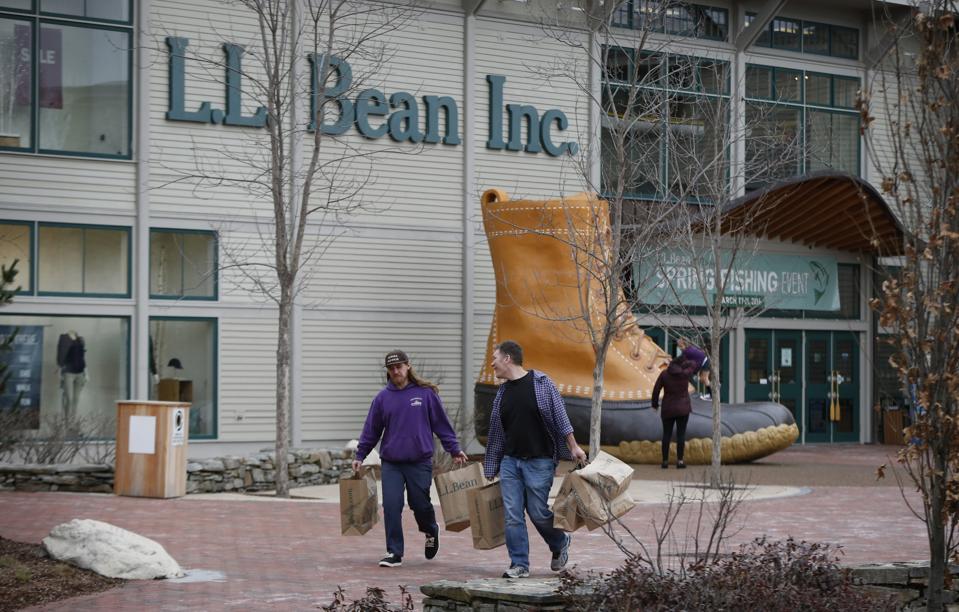
L.L. Bean retail store in Freeport, Maine. (AP Photo/Robert F. Bukaty)
L.L.Bean continues to claim a rare retail bragging right: a first place finish over Amazon.com.
For the third year in a row, the outdoor outfitter has been named Customer Service Champion over the online behemoth in Prosper Insights & Analytics’ annual review of service excellence among retailers. The latest list of Customer Service Champions was developed from write-in votes from more than 6,500 U.S. adults in September 2016 and weighted by each retailer’s relative size in annual revenues as well as its fan base, as defined by a retailer’s “promoters” (per the Net Promoter Score*). Lands’ End, Fingerhut, and Kohl’s follow L.L.Bean and Amazon, respectively, to round out the top five. Others joining this year’s list of 25 retailers range from department stores (JCPenney, Nordstrom) to big box specialties (Best Buy, Lowe’s) as well as grocers (Publix, Wegmans), discounters (Target, Walmart), and a warehouse club (Costco).
2016 Customer Service Champions, Top 5
The definition of customer service can take on varied meanings depending on the shopper, which is what makes the “whys” behind consumers’ nominations so important. Text analysis of more than 3,000 responses received for the top 25 retailers revealed ten keywords shoppers used to describe why their retailer delivered service excellence (in rank order): helpful, returns, easy, quick, problems, shipping, friendly, price, knowledgeable, and selection.
Members of the Millennial (born 1983 to 1998) and Gen X (1965 to 1982) generations were most likely to refer to the term helpful when describing a Champion, while Boomers (1946 to 1964) preferred returns. The youngest generation also honed in on quick – not too surprising, given that this tech-enabled generation has come to expect near-instantaneous gratification when purchasing products and services or receiving assistance. In addition to returns, Boomers gravitated toward easy, clearly illustrating that this generation seeks a service experience that removes the risk and anxiety from purchases, particularly as their transactions grow increasingly digital. Gen X-ers were more likely than average to hone in on words like shippingprice, and selection to verbalize their thoughts, so it appears that cost-conscious convenience appeals to this generation, currently in their prime child-rearing, career-driven, and multitasking years.
Key terms used to describe how retailers delivery excellent customer service.
Read below as consumers articulate specifically why each of the top five retailers is deserving of “Champion” status.
1) L.L.Bean: With other retailers now trying to stay afloat against Amazon.com’s advances, L.L.Bean has continued to distinguish itself by staying true to its roots: providing legendary customer service, through Guaranteed to Last™ products as well as helpful, knowledgeable, and accessible associates.
Comments from L.L.Bean shoppers.
2) Amazon.com: In what seems like just a few short years, the dot com has cultivated a trusting, captivated, and loyal shopper following, all with few physical touchpoints. The secret to Amazon’s success? Customers cite free shipping, low prices, and an A to Z catalogue of merchandise available – with Prime memberships adding the cherry to the top of a great experience.
Comments from Amazon.com shoppers.
3) Lands’ End: Like L.L.Bean, Lands’ End managed to attract its own loyal following of shoppers without ubiquitous brick-and-mortar locations. For more than half a century, Lands’ End has been backing its selection of quality-oriented merchandise with its satisfaction-focused return policy, which has certainly helped take some of the risk out of buying from the retailer’s nontraditional sales channels.
Comments from Lands’ End shoppers.
4) Fingerhut: As a first-time Champion, Fingerhut certainly makes an impact in fourth position. With many consumers still operating tight budgets, shoppers feel that Fingerhut understands tough financial situations by offering credit and payment installment plans for items that would otherwise be out of their reach.
Comments from Fingerhut shoppers.
5) Kohl’s: As the highest-ranking department store in our 2016 Champions list, Kohl’s managed to delight its customers in a way that competitors were unable to match this year. Here’s the secret: Kohl’s shoppers LOVE a great deal.
Comments from Kohl’s shoppers.