Friday, May 26, 2017

12 Leadership Lessons to Learn From the Navy SEALs

Take a few tips from some of the bravest folks around.
CREDIT: Getty Images 
Forever on the lookout for the keys to leadership, the ability that some people have to guide others to reach their goals and be successful together, I was eager to share with you the 12 keys to leadership from the book Extreme Ownership, how US Navy SEALs lead and win by Jocko Willink and Leif Babin.
Jocko and Leif were SEALs (Sea, Air and Land), the US Navy military elite and led American and allied soldiers during the battle of Ramadi in Irak.
The crucial interest in leadership of an elite unit stems from the fact that once on the ground, these professionals have to lead men in an environment where the slightest mistake can have life-threatening consequences. Despite enormous stress and stakes that few would withstand, these men and women work as formidably efficient teams. I bring to you here the 12 keys to the "Extreme Ownership" programme that Jocko and Leif extracted from their highly skilled military experience and adapted to the business world where they now work as leadership consultants.

1. Extreme Ownership

For Jocko and Leif, there is no two ways about it... take full responsibility for what is happening or has happened. If a member of a team has not understood one of his instructions, the team leader cannot blame him. It is his role as a leader to make sure that his team members understand his instructions. Likewise, if he himself doesn't understand the data he has received, he will take responsibility and ask his superiors for explanations rather than say it wasn't properly explained from the beginning. In a business, if a client has decided to change his supplier and has turned to the competition... There is no point in saying it isn't one's fault but what are the lessons to be learned. An employee hasn't understood instructions? He is not to be blamed, as a supervisor, it is my job to check he has understood what is expected of him! My boss doesn't give me enough time to develop my career? It is my responsibility to go up to him and draw his attention to the matter.
The advantage of "Extreme Ownership" is that it generates dynamism. It pushes you to act and it is thus no longer possible to wallow in complaints and criticism.
How to apply "Extreme Ownership?" Count the number of times you put the blame on somebody else or an external circumstance, and instead of complaining, actively look for how you could solve the problem.

2. There is no such thing as a bad team, just bad leaders

One of the main characteristics of SEALs is their ability to work as a team. Indeed, there is nothing worse for a SEAL than to be individualistic or perceived as such. Lone individuals cannot survive in the extreme conditions of Special Forces operations. This is why when selecting candidates, an enormous amount of energy is used to stimulate teamwork. But as much as it is important to work as a team, it is equally important to have a good leader heading these teams. You have certainly noticed how a good leader can help a team evolve towards success whereas a bad one can make it lose.
CREDIT: Courtesy Author
 
Jocko and Leif tell of teams systematically failing the SEALs' rigorous tests of BUDS (Basic Underwater Demolition Seal Training) when led by an incompetent leader. But when a better leader took over, these teams suddenly started winning endurance or speed races.
When a team is malfunctioning, there is no point in blaming the people in it. One must always look to the leader's abilities.

3. Believing is the first step

When they first realised that their SEALs team would have to take barely out of school Iraki soldiers onto the field, Jocko and Leif were appalled. Not only did it seem ridiculous to pair up elite soldiers with beginner soldiers, it also risked being extremely dangerous. Some of these Iraki soldiers were known to desert at the first shot fired or even to shoot themselves by accident.
It was thus of course difficult to stand in front of their team and present the plan.
Indeed it is difficult to 'sell' a plan to one's team, if one doesn't first believe in it oneself. The worst thing to say would be 'it isn't me, the order comes from above'. Jocko and Leif took the time to meet with their superior to better understand the context of the decision. The reasoning behind it was simple, the Iraki army would have to take over in the near future if the SEALs were ever to go home. This explanation gave Jocko and Leif the ability to better convince their team to accept this decision and the extra risks, because their leaders 'believed' in the interest of their mission.
If you want to maintain leadership of your team, never give the impression that you don't understand or don't approve of a decision 'from above.' If you don't understand the reasoning behind a strategy, go find the information so that you too can 'believe' and trust the decision taken by your hierarchy.

4. Beware of your ego

Can you imagine a worse place than a battlefield to be faced with a colleague who is a show off, knows everything and won't take any advice? This unfortunately also exists in the army, the difference being that a soldier or officer who believes they can learn nothing from a man who's been on the field for longer, never mind his grade, risks his own death or that of one of his team. Jocko and Leif have been confronted to a series of individuals who, due to their rank, their experience in the army or their age, believed they had nothing to learn. This put them in dangerous situations that could have been avoided with a bit of wisdom.
Ego can be a dangerous thing. Even in business. Whatever your experience, age or position, if you have the impression you know everything, or feel you don't have to listen to advice, it may be high time for a slice of humble pie. If not, life and circumstances will show you. Contrary to popular belief, you will not lose credit in the eyes of your team if you admit you don't know everything. Indeed, this will only reinforce your position as leader.

5. Cover and move

In SEALs lingo, 'Cover and Move' means that before you move on the field, whether bullets are raining or not, you always have to ensure that part of the team or another team ensures cover for the team that is moving. Just as, when walking, you wouldn't lift a leg before putting down the other. This, as you can imagine entails being able to work as a team and with other teams with flawless communication and trust. Each team is engaged in the mission either when moving or when covering the moving team. United in the one perspective, accomplishing the mission, the objective being to ensure the security of every member of the operation.
CREDIT: Courtesy Author
 
Once again, it is essential here to understand the notion of teamwork and to develop trust in each of its members. And this trust must extend out from the team to the other departments of a business that interact to accomplish its designed mission.

6. Keep things simple

A while ago, I read « complexity is the enemy of execution ». An exceptionally interesting sentence I thought and very true. Indeed, the simpler a plan, an instruction or a strategy is to understand, the more we are inclined to act. Inversely, the more it is complex and obscure, the more suspicion will take over and less one will be inclined to act. It is obvious that in commando operations, everybody has an interest in understanding properly how things are supposed to happen.
In business, faced with over-complicated processes, cryptic marketing strategies or over-elaborate price charts, it is often best to simplify, even if some precision is lost in the process. At least, the people confronted with the strategy, the process or the chart will be able to make a decision and act.
In the lobby of the Apple designer, John Ive, it is said that there hangs the following slogan: simplicity, simplicity, simplicity.
7. Setting up priorities and acting on them
Be it in business or in Special Forces military operations, there are times when human beings may feel submerged by demands, challenges and uncertainties. The most important thing is to remain focused, calm and to be able to stop to consider the options at hand. Everything cannot always be done or resolved immediately. But rather than remain in uncertainty and indecision or be submerged by challenges, one should be able to take a short break, take a step back and determine the most important priority to be taken into account at this moment, set up a plan to resolve the problem and act until this problem is resolved. Then move on to the next challenge.
This simple technique musn't of course replace the ability to keep an overview of the situation but when stress is sky high and that confusion has taken over, it is very efficient to be able to identify and resolve each problem individually and by order of importance.

8. Decentralising command

One of the main characteristics of the SEALs units is to often operate in hostile territory in total secrecy and perfect autonomy. Unlike conventional force units, which move in large numbers and in broad daylight, a mission can be carried out by four to six men moving soundlessly by night
It is then difficult in the case of enemy contact or complications, to communicate swiftly and efficiently with the chain of command to adapt the mission to the new circumstances. Infiltrated men will thus have to make their own decisions. Decentralising command means that the mission and its limits have been formally defined by senior officers who have an overview of the mission, but the details of execution are left to the people on the field who are in contact with its reality. These highly trained men are aware of their responsibilities and have a clear idea of what is expected of them. They are authorised and able to make their own decisions.
This metaphor of decentralised command perfectly illustrates the need to develop an organisation that works Top-down but also Bottom-up. As Frédéric Laloux states in his book "Reinventing Organizations." Even if many organisations are able to set up a structure with leaders who send their instructions downwards, it is rarer to find examples of businesses that are able to let their employees on the field make important decisions for the execution of the global mission. Yet it is often the most efficient way to get concrete results and especially a genuine commitment from collaborators. Indeed, how can one expect an employee on the field to feel motivated and committed if he has no leeway and only gets orders from above.

9. Plan

It is obvious that everything cannot be organised and planned in advance and that the saying "no plan resists the first contact with the enemy," regularly makes total sense for men in the SEALs units. However, the more precautions are taken to anticipate problems and mishaps, the higher the chances of success. It is thus the leader's responsibility to plan for a maximum numbers of scenarios and alternative plans so as to adapt to a situation that can change at any moment. "If this happens, then we do that, if that plan doesn't work, then we move to this other plan". These plans must be clearly explained to all members of the team and the leader must ensure that everyone understands all aspects of the various options.
CREDIT: Courtesy Author
 

10. Leading downwards and upwards

Here is a notion which, I think, has a lot of potential in our organisations and businesses. Close to the concept of "Bottom-up Top-Down" and "Extreme Ownership," "Leading downwards and upwards" implies that if a plan, a decision or a strategy decided by the senior management doesn't make sense or cannot work on the field, the people on the field pluck up the courage to contact their leaders or officers requesting to consider the reality they face. All too often, an unpopular decision will be criticised or even mocked by people on the field but little will be done to for the matter to be brought to management for a reality check. Once again, the advice is not to complain but to act, to discuss with the hierarchy and to do everything to establish communication and mutual understanding. As much as the leader must ensure that his employee has understood the aim of the mission and its objectives, the person who carries out the task must just as much make sure that his superior is aware of the various difficulties that can crop up and all this with the greatest mutual respect.

11. Indecision and uncertainty

For a SEAL, there is nothing worse than indecision. When the situation is beyond tense and people risk their lives, it is not possible to remain paralysed and not take any decisions. It is sometimes possible in everyday life to tell oneself that faced with a lack of information, concrete facts or simply uncertainty, we will wait to see how things pan out. In the Special Forces however, this is rarely possible. There is real danger in letting a situation degenerate due to a lack of firmness and decisiveness.
Jocko and Leif, both well versed in decision making and maximum risk, recommend to make a decision rather that 'wait and see'. Often a situation in everyday life will follow the same pattern and degenerate due to a lack of decision. Sometimes these decisions are difficult to make, such as firing a person who has become toxic for the company and his team. However, the more one waits, the more the situation degenerates and more everybody suffers from it.
I wish to add that indecisiveness is a great friend of lack of confidence. Somebody who can make decisions is not necessarily somebody who knows more than the others. Often he just knows that if he has made the wrong decision, he will find the way to rectify the situation. Singularly, for those who lack self-confidence, the simple fact of getting used to making decisions as often as possible (starting with small things), will enable them to progressively assert themselves. Indeed, most of the time, the decision taken will end up being the right one and if such is not the case, the person will find the way to rectify things while realising that he has more abilities than he or she thought she had.

12. Discipline brings freedom

Here is a notion that seems counter-intuitive to say the least. And yet Jocko and Leif use their elite military experience to put across that the more a plan is studied with discipline and detail, the easier it will be to react faced with an unexpected situation. The more a SEAL trains carrying all his gear, the more easily he will move in a real situation. The more the rules of engagement or the instructions for a mission are known and clear, the more the men on the field will be able to make their own decisions. In another category, musicians would also say that the more they rehearse, the more they know their instrument and the freer they feel to improvise, whatever the context.
Discipline and commitment require personal investment and effort from the onset, but this investment will liberate the person ready to put the hours in.
No need to say that in the kind of job and conditions that Jocko and Leif have experienced, indiscipline is not tolerated considering the consequences it can lead to.
Indiscipline generally sets in progressively and if it is not stopped, it often degenerates and creates situations that can be costly for people and teams as much in the military as in private life.
I have here tried to put through my understanding of the 12 keys to leadership of the exceptional men that are Jocko Wilinck and Leif Babin. I hope you will also find food for thought and tools that will help you in developing your company or organisation.

DHL software tool predicts supply chain risks

"Supply Watch" product analyzes online data and social media posts with machine learning algorithms.
 
German transport and logistics giant Deutsche Post DHL Group has launched a software tool that can predict supply chain risks by using machine learning algorithms to analyze online data and social media posts, the company said Wednesday.
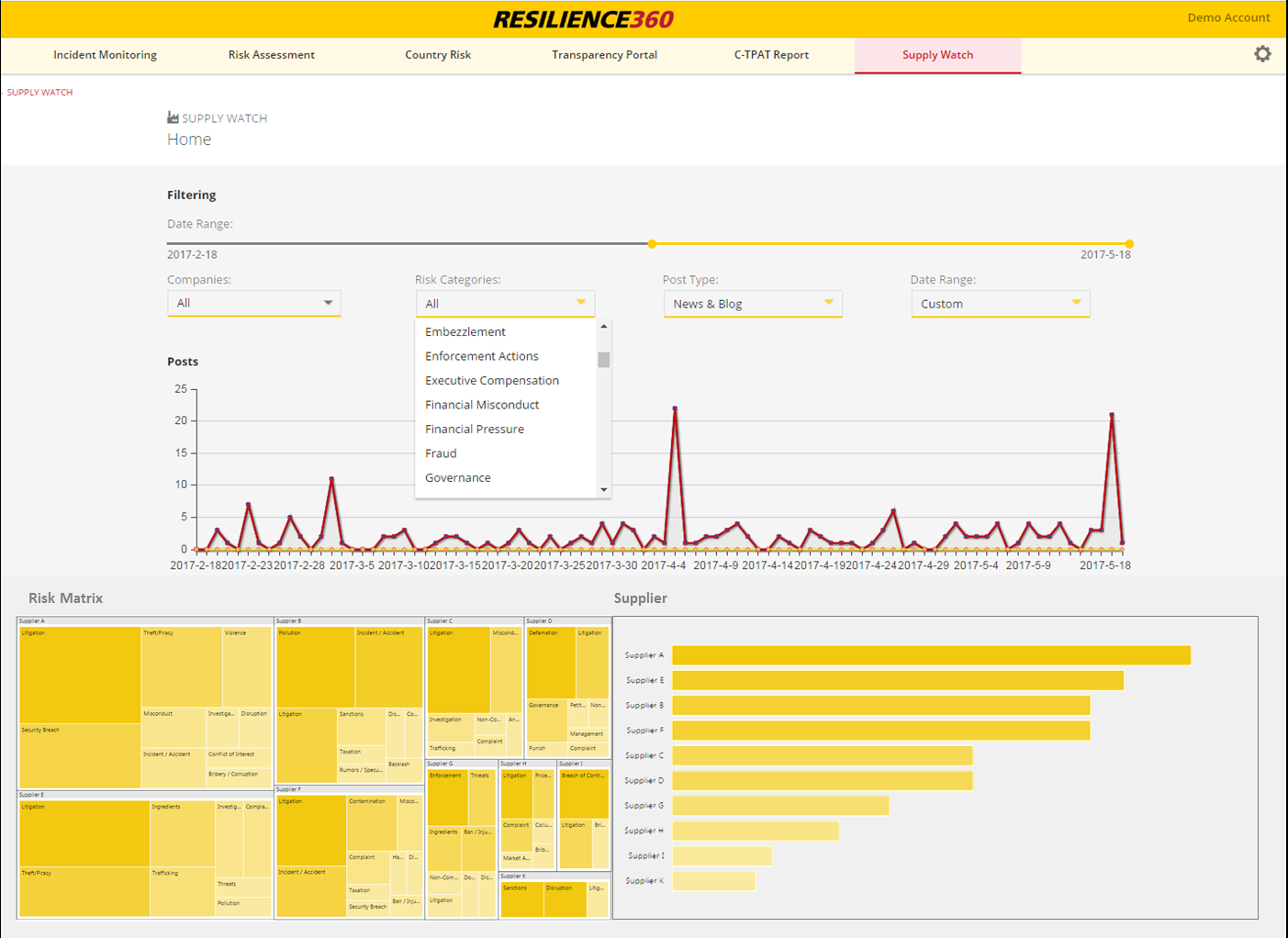
The Supply Watch product can operate as a standalone tool or as an extension of DHL's Resilience360 supply chain risk-management platform, a data-mining tool that allows users to assess hot spots in their supply chains, visualize the potential risks, and mitigate potential disruptions by adjusting factors such as production schedules, marketing budgets, or inventory positions.
Both platforms can detect disruptions in a company's supply base—such as the 2016 bankruptcy of Korean container line Hanjin Shipping Co. Ltd. or the recent global "WannaCry" ransomware attack—before they cause financial losses or long-lasting reputational damage, DHL claimed.
To detect potential supply chain disruptions, Supply Watch monitors 140 categories of risk, including financial indicators, mergers and acquisitions, environmental damages, supply shortages, quality issues, and labor disputes. The system works by using machine learning (ML) and natural language processing (NLP) technologies to analyze the data from up to 30 million posts from more than 300,000 online and social media sources, DHL said. It searches for danger signs from sources such as crime, labor breaches, quality defects, and supply chain perils such as shortages, capacity constraints, and delays.
The early alerts allow supply chain managers to "focus on early risk mitigation and auditing activities of their most relevant suppliers and third parties," Tobias Larsson, head of Resilience360, DHL Customer Solutions and Innovation, said in a release. "The insights and transparency customers gain through Supply Watch are another example of how digitalization can benefit end-to-end supply chain operations, through building resilient supply chains and enabling businesses to be more competitive."

Thursday, May 25, 2017

Older Americans Are More Millennial Than Millennials

To understand both changes to the workforce and changing attitudes toward work, don’t watch young people. Watch their parents (and uncles, aunts, and grandparents).
Four elderly people sit on a bench
Mike Blake / Reuters
Young people are the supposed vanguards of a new economic age. Unlike their parents, young people are said to value happiness over money. They prefer gigs over jobs. They prefer flexibility and meaning rather than status and hours at work. Rather than attach themselves to a single company, they are ushering in an economy of coffee-shop “creatives,” hot-desking between WeWork-style shared work spaces in pursuit of their individualistic dreams.
But there is another generation of U.S. workers with those non-monetary values and gig-style jobs. It’s not America’s youngest workers, but rather America’s oldest.
There is little question that an aging workforce—and an aging country—is one of the most important features of the modern economy. By 2024, one quarter of the workforce will be 55 and over—more than twice what the share was in 1994. And as they extend their working years, sometimes by choice and sometimes by necessity, it’s older Americans who are quietly adopting Millennial stereotypes, far more than actual Millennials are.
First, consider the gig economy, which is often framed as a Millennial counter-revolution to the failures of the traditional economy. In fact, the gig economy is full of older workers. People over the age of 65 are four times more likely to be self-employed than those under 34, and are more likely to work part-time jobs, too, according to the Bureau of Labor Statistics.
One of the most important trends in the workforce in the last decade has been the rise of “alternative work arrangements,” like freelancing or part-time work. These jobs, which often lack benefits like health care, have grown significantly in the last decade, long before Uber, Airbnb, and Lyft took off. Workers between 55 and 75 years old are 70 percent more likely to be in such alternative arrangements than 25-54 year-olds, according to the economist Jed Kolko. According to internal Uber data, half of its drivers are over 40.
One can see the same trend in part-time work. According to a survey from the Shift Commission, a joint venture between Bloomberg Tech and New America (and whose working sessions on the future of work I attended), older people are much more likely to stitch together income from multiple sources. More than 60 percent of workers under 34 derive income from a single source—as one would from earning a salary from one company. But almost three quarters of workers over 65 make money from more than one source, not counting Social Security. Gigs, freelance positions, and part-time jobs, although often hailed as the province of Millennials, are actually dominated by older workers.
Second, far more than Millennials, older workers value meaning over money. The Shift Commission asked workers if they most valued money, happiness (“doing things I enjoy”), or meaning (“doing things I feel are important”). Younger people tended to say that making money was the most important part of a job. Nobody rated happiness less important than 18-to-24-year-olds; the highest rating from people older than 65. The primacy of meaning—“doing things I feel are important”—was lowest for 25-to-34-year-olds and highest, again, for senior citizens.
This doesn’t prove that young people are greedy, or that older workers are wise. It suggests, rather, that generational stereotypes of carefree youths overlook the fact that young people can often be the most desperate to earn money, particularly since so many are graduating from college in debt or starting off in low-paying jobs.
Third, many writers—including myself—have predicted that if automation begins to eat away at the labor demand, it will sooner affect young workers, whose menial jobs are often routine, and, therefore, most easily replaced by a machine or algorithm. But it’s older workers whose jobs are most at risk of disappearing, according to Kolko. Thirteen percent of workers over 55 are in occupations that the BLS projects will shrink in the next decade, compared with 9 percent of workers under 35.
Finally, there are several cultural shifts that are purportedly Millennial-driven where older consumers are actually leading the charge. Take, for instance, the rise of restaurants. In October last year, the Wall Street Journal reported that grocers are struggling as Millennials move away from supermarkets and club stores and spend more money in restaurants. But since the early 1990s, the group that has most shifted its food spending toward restaurants has been senior citizens.
Perhaps it’s not surprising that older workers are better archetypal Millennials than Millennials themselves. The stereotype of the carefree freelancer who values meaning over money seems like it would most apply to somebody who’s not desperately poor, yet is anxious enough about their financial condition to work several jobs to make extra cash. Middle-class workers about to enter retirement after decades of steady employment, yet without adequate savings, would seem to fit that description—at least as well as young people trying to get their start.
One should always be careful not to oversell generations, which are, by definition, extremely broad swaths of tens of millions of people with diverse wealth, education, and living conditions. Still, when economists and marketers want to understand changing attitudes toward work and life, they often focus on Millennials. It’s tantalizing to say that, because something new is happening, the newest cohort must be responsible for the change. But many of the trends ascribed to Millennials are actually better fits for their parents.
EFFINGHAM, Ill. — The vast Petro truck stop here is a neon-lit, blacktop oasis at the crossroads of America. It beckons big-rig drivers with showers, laundry machines, a barber shop, even a knife store. “Professional drivers only,” reads the sign above the tables of the Iron Skillet restaurant, where truckers sit mostly alone, carrying the solitude of their jobs into an otherwise social setting.
Driving a long-haul tractor-trailer is as commonplace as the items that drivers carry, from blue jeans to blueberries, from toilet paper for Walmart to farm machinery bound for export. There are 1.7 million men and women working as long-haul drivers in the country. Yet truckers — high up in their cabs — are literally out of view for most Americans.
At a moment when President Trump has ignited a national discussion of blue-collar labor and even climbed into a truck during a White House event, trucking, which was once among the best-paying such jobs, has become low-wage, grinding, unhealthy work. Turnover at large for-hire fleets hauling freight by the truckload — the backbone of the industry — runs an astonishing 80 percent a year, according to a trade group. Looming over the horizon is a future in which self-driving trucks threaten to eliminate many drivers’ livelihoods.
Still, trucking continues to draw plenty of newcomers, reflecting the lack of good alternatives for workers without a higher education (one survey found that 17 percent of truckers had less than a high school diploma). Some have lost better-paying manufacturing jobs in the continuing deindustrialization of America. Others have spent years knocking on the door of the middle class in minimum-wage jobs in fast food or retail. To them, trucking is a step up.
Over two days recently, The New York Times spoke to truckers at the Petro stop, which sits at the intersection of Interstate 57, between Chicago and Memphis, and Interstate 70, between Indianapolis and St. Louis. These interviews were edited and condensed. The maps show drivers’ routes in picking up and delivering their loads.
(The Times also wants to hear what long-haul truckers wish car drivers knew and see how they have made the inside of their cabs into a home. Share your stories.)
 
Photo
 

‘The Clock’s Ticking, the Clock’s Ticking’

Greg Simmons, 54, Hastings, Fla. Driving 27 years.
Assumption, Ill.
Travel back to Florida for delivery
Effingham, Ill.Start and end Panama City, Fla. 
We’re throwaway people. Nobody cares about us. Everybody’s perception of a truck driver is we clog up traffic, we get in the way, we pollute the environment.
We’re just like cops. Everybody needs us, but nobody wants us.
Before trucking, I did electronics, but there was no pay in it. What I did not know is, when you do this for a living, you can’t go to night school and train for something else. This sucks up so much of your time.
Truckers are paid mostly by the mile, not the hour. Federal rules say they can drive 11 hours within a 14-hour window, and then they must stop for a 10-hour break. Many resent the 14-hour rule.
Everybody’s constantly looking at the clock. If you get caught in a traffic jam for four hours, that’s four hours of your productivity gone. Or if you go to pick up a load and these people take five and a half hours to load you, they’ve killed five and a half hours of your day. The clock’s ticking, the clock’s ticking. Got to go, man, got to go! The 14-hour rule has created an unnatural amount of pressure. For the young fellows, after two or three months, they say the hell with this.
Why do you keep driving?
Because at 54 years old, nobody wants me. I can’t retrain for anything else. For older people, you kind of get trapped. For every one that does well, there’s 30 that it destroys.
 
Photo
 
Ayisha Gomez

‘I Told Her That I Would Do Whatever It Took’

Ayisha Gomez, 39, Riverside County, Calif. Driving three years.
There were a lot of women in my training class. There were a lot of younger, I would say girls, going through. I think it’s women trying to prove themselves. And there are so many of us who are single mothers and the work that’s out there, we just can’t support our families.
Ms. Gomez said she worked for AutoZone for about eight years before becoming a truck driver. Women make up 5 percent of truckers.
My daughter got accepted to U.C.-Davis, and she wasn’t going to go because we couldn’t afford it. I told her that I would do whatever it took.
It is very stressful being away from home, being out of contact with people.
I was driving cross-country and stopped in Texas to pick up a cousin of mine. Her sister was having a baby. I said, “I’ll take you home to California.” We hardly talked at all on the trip. You forget how to communicate with people. You’re by yourself constantly. There’s nobody to talk to except when you’re picking up or dropping off a load.

 
Are you in a romantic relationship at home?
Yes. He is my high school sweetheart. We got back in touch with each other and things are falling in place. But it’s hard on him because he doesn’t understand what goes on out here. He’s always watching the weather and the news, and calling to tell me there’s a storm coming up, please be careful. He’s worried about me being at truck stops and rest areas at night. He doesn’t want me coming in in the evenings to take showers.
Do you feel in danger as a woman?
In the beginning, I noticed I got a lot of dirty looks from men. You hear remarks under their breath when you’re coming through the truck stops. I don’t hear it anymore. I’ve learned to tune everybody out. I don’t pay attention to anybody around me. I’m always aware of my surroundings, I notice what people are wearing, what they’re looking at, but if you are passing me, it looks like I’m always looking down at the ground.
Ms. Gomez explained that her first year was the hardest because she was required to drive for the large freight company that trained her, which paid a low mileage rate. Since the trucking industry was deregulated a generation ago, drivers’ pay has fallen. Truckers earn on average $43,600 a year, less than in 1980 when adjusted for inflation. Many work the equivalent of two full-time jobs. Now Ms. Gomez drives for a small mom-and-pop company, which pays better than the industry average.
Did you think of quitting that first year?
No. I’m not a quitter. It was very hard. My daughter kept me going. She wants to be a social worker. My oldest son has been in trouble since he was about 15. He’s currently in prison. He got sentenced to 21 years for attempted murder. Now, he is part of a gang. He’s got tattoos all over him. I’m so disappointed.
When all of this happened, my daughter went through a really hard time. I sat down and had a long talk with her. She decided she wanted to work with youth and try to help before they end up like her brother.
Trucking is not a career for me. I’m only doing this as long as I have to in order to get all of my daughter’s student loans taken care of. She’s on her third year. I’ll be doing it for a few more years.
Photo
 
Photo
  
Photo
 
Michael Gallant

‘Something I’ve Always Wanted to Do’

Michael Gallant, 22, Biddeford, Me. Driving eight months.
Start Defiance, Ohio Effingham, Ill. End Edwardsville, Kan. 
Truck driving is something I’ve always wanted to do since I was a little kid. I love it. There are some times when it’s kind of a crappy job, but other times it’s great. Over all, I’m very happy with my job. I wouldn’t change a thing about it.
I worked at a garden center for four years before this. I was making 12 bucks an hour. Kind of at the bottom of the pile.
I got my C.D.L. [commercial driver’s license] relatively quickly, in Springfield, Mo. I took a Greyhound bus all the way from Portland, Me., to Springfield, Mo. That was 45 hours. Wasn’t exactly fun.
At the minimum I try to stay out for at least four weeks. I’m the type of guy — when I start going, I like to work and work and work. I’m single, no kids, no debt to my name.
Do you worry, as a young driver, that self-driving trucks could take over the industry?
That’s a touchy subject. I haven’t really thought too much on it. I think it’ll be a little while until we get to that point. You’ll still need a driver to make sure that nothing goes wrong with that truck. I don’t see it all becoming autonomous.
Photo
 
Ron Carrabis

‘Any One of My Grandkids Do It, I’ll Kill ’Em’

Ron Carrabis, 70, Las Vegas. Driving 30 years for the same company.
Start Pittston, Pa. End Jean, Nev.
Effingham, Ill. 
My kids all grew up with me driving a truck. A lot of missed football games, a lot of missed school plays, birthdays, anniversaries. It’s very hard on your home life if you don’t have an understanding woman. My wife and I have been married 44 years. But there’s other drivers out here that have been married two, three and four times.
Mr. Carrabis retired over the weekend.
We have a motor home sitting in our driveway that every time I come home, it goes, “C’mon.”
Would you recommend trucking to a young person?
Any one of my grandkids do it, I’ll kill ’em.
Photo
 
Photo
  
Photo
 
Patricia Moore

‘My Last Husband Hated Me Being a Truck Driver’

Patricia Moore, 60, Oak Grove, La. Driving 15 years.
I haven’t been married in over 10 years. My last husband hated me being a truck driver. He used to fight with me on the phone out here on the road. I loved it when I had no signal.
It was either my job or his alcohol, and I picked my job.
What’s the best part of being a trucker?
A paycheck.
A friend of mine said, “If you’re out here on the road, how come you don’t make more money than you make?”
Everybody paints this as glamorous. Yeah, we get to see the country. At 65 miles per hour from the Interstate.
How is your health?
Horrible. They can’t figure out what’s wrong with my stomach. We eat a lot of junk food. Like last night I ate Subway. It’s junk. In 15 years, I’ve gained 70 pounds.
I’ve also got hurt on my job, tore my knee tugging trailers and all that. Dollying up a trailer, I tore up my rotary cuff.
It’s always go go go, no time for yourself. You might get home at 2, 3 o’clock in the morning. If I get home on Friday, most of the time I got to get back out on Sunday. Sometimes I wear my uniform to church because I got to go straight to my truck.
Do you have a retirement plan?
What’s retirement? Sounds boring. I’m single, I have no money saved up, I’ve lived paycheck to paycheck. My fault. I didn’t think about retirement growing up. This is the first time I’ve ever made decent money in my life.
Last month, Ms. Moore quit long-haul trucking and moved to Midland, Tex., to be closer to a son, where she now drives an 18-wheeler that services the oil fields of West Texas. In a phone interview, she said the job allows her to return home every night, and has other benefits.
I bettered myself — almost doubled my salary. I bought me a brand-new car, a 2017 Chevrolet, two days after I hit this town. My health is also better. I’ve lost some weight. I cook my own food now.
Photo
 
Wayne McLaurin

‘It’s Pretty Lonely’

Wayne McLaurin, 46, St. Louis. Driving five years.
Start Portage, Wis. Effingham, Ill. End Atlanta 
I was a customer service rep in St. Louis. When the recession hit, there was no jobs to be found. The only thing that was in the newspaper at that time was nursing and truck driving. Within five weeks, you can be on the road and have a career. I’ve been doing it ever since.
I stay away two to three months at a time. It’s pretty lonely. It’s tiring. It’s depressing, you know what I mean? My whole thing is to try to get away from trucking, whether it be real estate, maybe an owner-operator, something like that. In order to get out of the business, you’ve got to have something to fall back on.
Are you saving money?
Yes. I want to walk away this year with about $25,000 to $40,000.
In the beginning, it was fun, like the young fellow over there. [He pointed at Mr. Gallant across the restaurant counter.] But the older I got, it was like, you need to do something else. You can’t do this forever.
The best thing about it, to me, is you don’t have anybody looking over your shoulder telling you what to do. You don’t have a boss. You have to be able to be disciplined enough to do your job, and they trust you to do that. I love that about it.
When I was a little younger, it was all about getting an opportunity to be out in different cities, seeing things I’d never seen before. But now, O.K., it’s time to settle down.
Do you have time for a personal life?
I don’t have a personal life. I don’t have a girlfriend. And it sucks, it really does. I think about that. When I was a little younger, I always had a relationship. Now doing this, I’m like, why? I realize I’m never in one place at one time.
Photo
 
Photo
 
Continue reading the main story
 
Photo
 
Daniel McMillan and Susan Zimmerman

‘Freedom. Oh My God, I Cannot Tell You.’

Daniel McMillan, 33, and Susan Zimmerman, 48, Danville, Va. Driving two years.
Start West Memphis, Ark.Effingham, Ill End New Carlisle, Ind.
Susan: We met working at McDonald’s. Trucking was my dream first. I raised my daughter and she was going to college, I needed to better myself. Working for McDonald’s for 10 years, trying to raise your child on a McDonald’s wage, you could only rely on tax season to get her stuff. Daniel encouraged me to go get my C.D.L.
Daniel: She came back and picked me up. I jumped on her truck and she trained me. Then I got my C.D.L.
Susan: I’ll drive eight hours and he’ll drive eight hours, and then we shut down. Now we’re owner-operators. We are a company.
People say it’s lonely on the road, but it must be different for a couple.
Daniel: We have friends that were truck drivers, their home life fell apart.
Susan: Their spouses cheated.
Daniel: Children going crazy, going to jail.
What’s the best part of trucking?
Daniel: Freedom. Oh my God, I cannot tell you.
Susan: Beautiful sunny days.
Daniel: You get your crappy days, don’t get me wrong. But we woke up in Laredo one time, it was 79 degrees in the morning. You got to trade the good for the bad.
Most people think trucking is old rednecks going down the road. But it’s very diverse. We’ve seen whole families out here.
Susan: Speaking for myself, there’s not many disappointments of the job. Every day, you wake up somewhere different. You have sunrises and sunsets. Yeah, it’s the same sun, but it’s different everywhere — the colors, the textures.
We get to see our daughter three times a year. We get loads to Florida, where she’s in college. We shut the truck down and get a rental car and go hang out with our daughter.
She gets scholarships because she’s a great student. But then you have to send money because they have to live.
Are you engaged?
Susan: Yes
Do you have a date?
Daniel: September of 2018.
Susan: We were going to get married this year, but my daughter needs a car.
 

Wednesday, May 24, 2017

This Off-Price Retailer Is The Antithesis Of Amazon

|
7 comments
|
 About: TJX Companies Inc. (TJX)Includes: AMZN

Summary

The TJX Companies, Inc. is the leading off-price specialty retailer of apparel and home fashions in the U.S. and worldwide.
This well-managed company is ranked second for margin of safety on the Main Street 20 Watchlist.
But the retailer generated just 1% of revenues from online sales in fiscal 2017.
Shouldn’t we buy Amazon instead and be done with it?
Welcome to the 19th installment of the "Main Street Value Investor (MSVI)" series, the off-price retail edition, exclusively on Seeking Alpha (subscribers to the MSVI Member Forum got the first look at this research).
The TJX Companies (TJX), the global storefront powerhouse we know as T.J. Maxx, Marshalls, and HomeGoods in the U.S., derives just 1% of its net sales from online purchases. In the evolving world of retail, defined by the hyperbolic growth of online sales at Amazon.com (AMZN), we believe TJX has earned its stellar reputation with price-conscious shoppers that prefer to browse at a neighborhood storefront that he or she has come to know and trust.
However, to ultimately satisfy device-dependent customers, TJX needs to grow its online presence. Nonetheless, as value investors, we prefer the microeconomic metrics and multiples of TJX over the macroeconomic popularity of AMZN despite its astronomical valuation worthy of a Blue Origin spaceship.
Gentlemen Prefer Bonds; We Prefer the Yields of Stocks
Marilyn Monroe in Gentlemen Prefer Blondes (20th Century Fox, 1953)
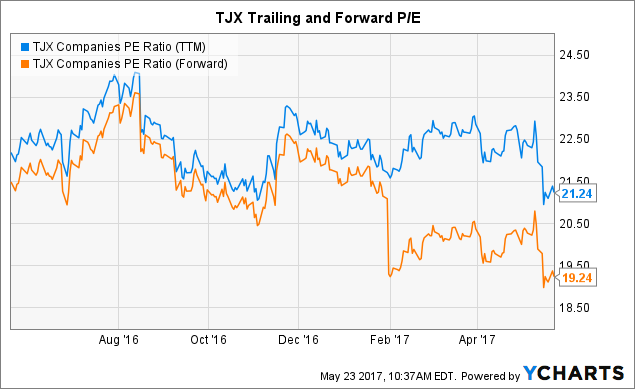
TJX is a large-cap stock in the specialty retail industry within the consumer discretionary sector. As of this writing, its market capitalization was an approximate $48 billion. TJX’s price-to-earnings ratio (P/E), or current stock price relative to earnings per share for the trailing 12 months, is approximately 21 times versus about 20x for the specialty retail industry as a whole. In comparison, the consumer discretionary sector is trading at ~24x P/E against ~22x for the Standard & Poor's 500 Index.
Our perpetual skepticism in forecasting aside, the forward price-to-earnings ratio for TJX is approximately 19 times compared to about 21x for the consumer discretionary sector and ~18x for the S&P 500. The current and trailing P/E ratios for TJX appear in-line relative to the specialty retail industry, the consumer discretionary sector, and the market as a whole.
As of May 16, 2007, The TJX Companies' earnings per share (EPS) was $3.52 annualized, netting a 4.74% earnings yield, i.e. EPS divided by the most recent stock closing price. We view earnings yield as the equivalent of a stock’s equity bond rate or how a company’s earnings compare to the 10-year treasury rate. As of the market close on May 19, 2017, the 10-year Treasury was yielding 2.12% or less than half of TJX’s earnings yield.
As of this writing, TJX is paying a moderate 36% of its EPS to shareholders in an annual dividend of $1.25 per share paid quarterly, resulting in a 1.68% dividend yield. Although relatively modest in the case of TJX, we enjoy the compensation of dividends in the short-term, as we patiently wait for the compounding of the stock price over the long-term.
According to TJX investor relations – a relatively easy to read and follow IR site - the company has increased its dividend rate for 21 consecutive years. TJX is planning between $1.3 and $1.8 billion of share repurchases in 2017. Through its share buyback program, TJX had repurchased over $18 billion of stock since 1997.
When executed with consistency and forethought, dividend increases and share buybacks return long-term value to the patient owners of a company’s stock.
Modest Advertising Spend; Less Reliance on Fads
An understanding of a company's goods or services and its competitive advantages is essential to the Main Street value investor. To own a company, we must first understand the business that generates the numbers that comprise the stock's analysis.
The TJX Companies is the leading off-price retailer of apparel and home fashions in the U.S. and worldwide. The company generates $33 billion in revenues from more than 3,800 stores in nine countries and three e-commerce sites.
TJX divides itself into four main business segments: Marmaxx and HomeGoods, both in the U.S., TJX Canada, and TJX International.
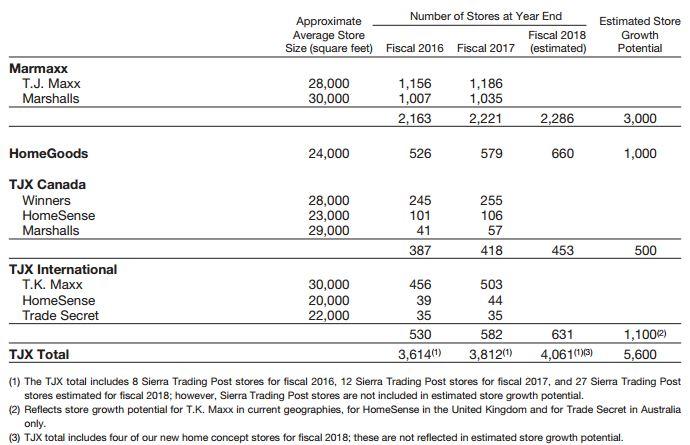
Store Growth by segment, fiscal 2016 and 2017 actual plus fiscal 2018 estimated:
(Source: The TJX Companies)
The Intrinsic Value of a SEC Filing
We sourced the above chart from the company’s Form 10-K Annual Report filed with the Securities and Exchange Commission (SEC) for the fiscal period ending January 28, 2017.
I challenge readers that may be inclined to skip annual reports and other SEC filings to find organizational, product, regulatory, and financial facts about the company that you were previously unaware of, as I often do. To be sure, these documents are largely avalanches of legalese and numbers crunching, but deep dives will often uncover slices of information that bring us virtually inside the company's hallways.
In reviewing The TJX Companies' most recent 10-K annual report, we discovered that:
  • Net sales from e-commerce amounted to 1% of total sales in fiscal 2017 (page 26.)
  • Selling, general, and administrative expenses increased to 17.4% of net sales in fiscal 2017, up from 16.1% in F2015 (page 27.)
  • The effective income tax rate for F2017 was 38.3%, signaling an excellent margin expansion opportunity if corporate income tax rates are lowered by Congress (page 28.)
  • Advertising spend was only 1.2% revenues in F2017; a testament to the brand recognition and location dynamics of TJX stores (page F-11.)
For Retailers, a Narrow Moat is Better than None
Within investing parlance, an economic moat is the subjective measure of the competitive advantages of a company's goods or services in the marketplace. A wider moat creates a barrier to entry for potential competitors. Amazon notwithstanding, in the highly competitive specialty retail space, wide moats are uncommon. The TJX Companies' narrow moat is perhaps wider than most retailers, at least for now. According to Morningstar analyst Bridget Weishaar:
Through its off-price retailing model, we believe TJX has achieved significant bargaining power with suppliers. The company offers wholesalers, department stores, and specialty stores the opportunity to clear excess inventory at very favorable terms to the supplier. These stipulations include a willingness to purchase less-than-full assortments of items, styles, and sizes as well as quantities ranging from small to very large. Because TJX is the largest off-price retailer and has international operations, it is uniquely positioned to manage large volume and disperse merchandise across a geographically diverse network of stores and to target specific markets.
Although we believe these competitive differences will continue to benefit TJX for at least another decade, we do think they will eventually erode as current competitors increase in scale and invest in more efficient inventory management systems. Additionally, we cannot rule out the threat of new competitors emerging either through traditional or online storefronts. As such, we assign TJX a narrow moat versus a wide one.
To be sure, the TJX portfolio of consumer-favorite store brands that span several age groups are less susceptible to the specialty retail industry’s reliance on teen fads. Thus, the stock is an ideal complement to a buy-and-hold value investor’s commitment to a diversified portfolio of high quality, customer and shareholder-friendly companies.
Superiority in Buying, Inventory, and Management
Ernie Herrman, CEO and President (Courtesy of the The TJX Companies)
When considering the worthiness of a company's inclusion in the Main Street Value Investor Model Portfolio, the emphasis is placed on actual growth metrics as opposed to speculative forecasts of what may or may not occur with future revenues, earnings per share, free cash flow, or dividend growth. We look for positive, trailing five-year increases in revenue, earnings, cash flow, and dividends. As defensive investors, we prefer companies that are already growing, not just promising to grow.
In the most recent five-year period, The TJX Companies’ compounded annual revenue and earnings per share growth rates were 7.43% and 12.34%, respectively. Although in the single digits, the top-line increase is relatively high for an S&P 500 company. Plus, we welcome the double-digit bottom-line growth from any company, big or small.
TJX’s most recent five-year compounded annual dividend growth rate was a shareholder generous 21.1%. Ultimately, dividends keep us compensated in the short term as we wait patiently for capital appreciation of the company's stock over the long term.
Returns on Management
We want to own companies with efficient and transparent management that leverage returns for customers and investors. Led by company veterans, Executive Chairman Carol Meyrowitz and Chief Executive Officer Ernie Herrman, the leadership team and ~235,000 other employees of The TJX Companies are serving customers in nine countries. The group is delivering a trailing 12-month operating margin (EBIT or earnings before interest and taxes) at a competitive 11.37% of revenue, yielding a net profit margin of 6.96%, i.e. trailing 12 months of income after taxes divided by sales. We prefer double-digit margins preceded by a “2” or higher, but understand that low double-digit and single-digit operating and net profit margins are typical in the retail space.
From TJX’s cash flow statement for the fiscal year ending January 28, 2017, we are cautiously optimistic of the increase in five-year average growth in total cash from operations from $3.0 billion in 2013 to $3.6 billion in 2017. TJX’s modest annualized trend in generating cash is further tempered by the company’s recent 8.91% cash flow margin, below our minimum threshold of 10%. Cash flow margin is operating cash flow divided by sales, each measured over the trailing 12 months. Again, we are reminded that retail operations are not typically cash cows because of margin squeezes from inventory costs and pricing competitiveness.
At MSVI, we prefer highly profitable, cash-generating companies that provide margins of safety in a literal sense. Although TJX is growing sales and converting those revenues into free cash flow for potential reinvestment into store growth and shareholder payouts, the growth is nonetheless modest.
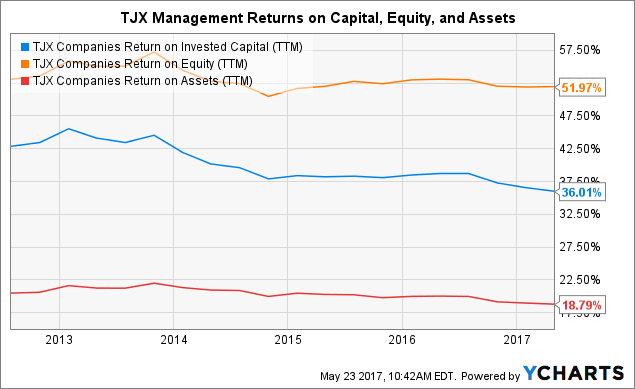
As does Warren Buffett, we place a premium on the return on invested capital (ROIC) or how well a company is allocating its financial resources to generate returns for the business. We target companies producing 12% or higher in ROIC. TJX’s ROIC at the time of this writing was an impressive 36.01%.
The return on capital is only as good as the company’s weighted average cost of capital (WACC). When a business's cost of capital increases, this typically translates to an inverse decrease in valuation and an increase in risk. At just 5.25% WACC, as of this writing, TJX is generating returns on invested capital that are close to seven times the company’s average cost of that capital.
Stock buyback manipulation notwithstanding, the return on equity (ROE) - or how well the company generates net income as a percentage of total equity in the stock - is another excellent measure of management effectiveness. Since we seek a minimum of 15%, we view TJX’s most recent ROE of 51.97% as net positive to the buybacks, and then some.
With a global store footprint and an inventory intensive operation such as TJX, we also want to take a peek at return on assets (ROA) -- i.e., management's ability to use the company assets to generate earnings. As of this writing, the company was leveraging assets at an impressive 18.79%.
Fundamentally, The TJX Companies is a global off-price specialty retailer with $33 billion of modestly growing, new store-dependent annual worldwide sales that are netting single-digit operating margins typical to retail. The company's management team is driving a decent earnings yield and consistent dividend payouts to shareholders.
Where TJX stands out from the crowd are its highly efficient proprietary inventory control systems, superior buyer network, and returns on management that any industry would covet, never mind the pennies on the dollar retail space.
You Get What You Pay For
Determining the attractiveness of a stock's price based on valuation multiples relative to a company's fundamentals is a primary tenet of the Main Street Value Investor's search for stock investing nirvana or alpha.
As of this writing, TJX appears a fairly priced stock of a fundamentally sound company in the context of its stable margins, steady cash flow, and consistent dividends. Current valuation indicators are arguably in the bearish to bullish range depending on an investor's multiple of choice.
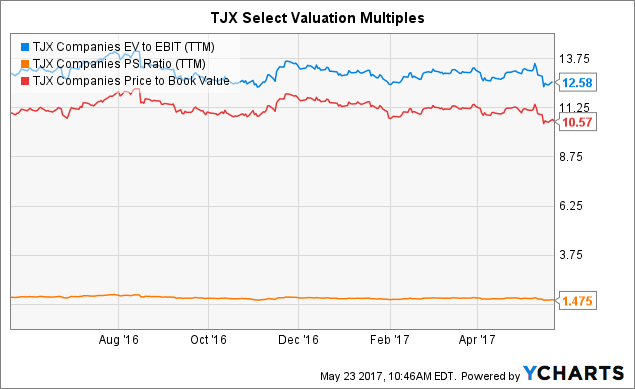
TJX was recently trading at 12.58 times enterprise value to operating margin (EV/EBIT). In general, less than 12 times reflects a reasonable stock price. EV/EBIT is a useful indicator of whether the stock is overbought or oversold in the market. TJX appears trading closer to a market perform level.
The price to sales ratio for TJX was 1.48 times, as of this writing. We interpret <2.00x as a good value when measuring a stock price relative to its revenue stream. TJX’s peers in the specialty retail industry were trading at a slightly lower ratio of 1.05x. However, TJX is in line with the consumer discretionary sector which had a P/S of 1.46x versus 2.05x for the S&P 500.
TJX appears expensive to its competitors when considering its price-to-book or P/B ratio. As of this writing, the stock is trading at 10.57 times its net asset value. We focus on fundamentally sound companies selling at a P/B ratio of less than 2.00 or at least below the industry average. In the case of TJX, its P/B is trading at a premium to the 3.43x of its specialty retail peers.
Some investors prefer a measurement of tangible book where intangible items such as patents, intellectual property, and goodwill are absent from the denominator. As of this writing, price to tangible book for TJX was 10.98 times, reflecting a $196 million of intangible assets on the company’s balance sheet as of April 29, 2017.
Accounting for intangible assets is more often an exercise in balance sheet bloat, and we note TJX’s apparent limited reliance on stating such assets which are down from close to $350 million at the company in 2016.
The price-to-earnings growth ratio (PEG) is a favorite among Wall Street’s growth and momentum crowds. As value investors, we are more cautious based on the projection nature of PEG as opposed to actual trailing results. Nonetheless, PEG can provide a substantive peek into a stock's price worthiness. We prefer a PEG ratio below 2.00, and TJX was recently trading at a bullish 1.54 times based on a five-year growth projection. The specialty retail industry was trading at an identical 1.55x PEG.
The overall bearish market consensus toward on-ground retail may be the driver behind the value-oriented price to growth prospects at the specialty retailers, including TJX.
We also measure cash flow multiples as a reliable predictor of the intrinsic value of a stock price. TJX's price-to-cash flow ratio (P/CF) was 16.19 times compared to 5.91x for the specialty retail industry as a whole. At MSVI, we look for stocks trading at a single-digit P/CF or at least significantly below the sector or industry average. Perhaps TJX is reminding us that it is not the value trap as are several of its peers.
TJX is trading at reasonable valuations when measured against enterprise value, trailing sales, and projected earnings growth, but arguably expensive in terms of book value and cash flow. Overall, the stock’s current price appears reflective of TJX’s strong performance as an industry standout of off-price retail apparel and home goods.
For investors seeking a more attractive stock price based on valuation multiples, TJX may need an external black swan event or another short-sighted internal micro occurrence such as the quarterly earnings miss that occurred on May 16, 2017. The stock dropped over 4% after missing Q1 analyst consensus revenue estimates coupled with senior management providing less than expected near-term profit guidance.
We follow the glorified quarterly Wall Street game of "hit or miss" for primarily one reason: to discover valuation opportunities in the stocks of quality companies. Paraphrasing Warren Buffett, active investors on Wall Street are ultimately serving the patient investors on Main Street.
That written, we do not know what the price will be one, three, or five years from now, never mind next week.
Above Average Company in a Below Average Industry
Happy customer at a T.K. Maxx in Austria (Courtesy of The TJX Companies)
A company's balance sheet liquidity -- e.g., current assets divided by long-term debt (CA/LTD), was a favorite of the father of value investing, Benjamin Graham. Higher than 1.50 is ideal, as we want to own businesses that theoretically can pay down debt at least one and a half times using liquid assets.
Our most recent measure of The TJX Companies' CA/LTD was a solid 3.39 times. In simple terms, the company could pay off its long-term debt obligations more than three times over using liquid assets such as cash and equivalents, short-term investments, accounts receivables, and inventories.
Current ratio (CR) is another simple but telling measure of a company's financial stability. CR is current assets divided by current liabilities, thus the higher above 1.00, the better. TJX’s most recent quarterly balance sheet had a CR of 1.64, demonstrating that liquid assets are more than adequate in funding near-term liabilities, such as accounts payables, accrued expenses, debt service, and income taxes.
The MSVI Model Portfolio ranks TJX’s overall market risk profile as average. We like profitable, dividend paying, narrow to wide-moat companies with low volatility - e.g., TJX's beta at 0.84 is less volatile than the S&P 500 at 1.00 - that have the free cash flow and liquidity to pay its bills, both short and long term. TJX entices us with its earnings per share and dividend growth, balance sheet liquidity, and management returns on capital, equity, and assets, but gives us pause when analyzing its revenue growth; operating, net profit, and cash flow margins; and valuation multiples.
The question begs: does any margin of safety exist in the stock of a company that is the undisputed leader in off-price retail, but carries the typical small margins, is storefront as opposed to online dependent, and has mixed valuation indicators?
Margin of Safety
A stock's "margin of safety" is an estimate of the difference between the intrinsic value of the stock and its current market price. Some professional value investors prefer to calculate a margin of safety with discounted free cash flow projections. For example, Morningstar recently published its view of TJX’s "fair value," at $86.00 per share, about a 14% premium to the stock price as of this writing.
These types of overly sophisticated margin of safety or intrinsic value measurements are what allegedly justify the high fee structure of Wall Street. However, we are suspect of the projection nature of these formulas. If we have to start predicting future cash flows, interest rates, and capital expenditures, haven't we become more a speculator and less an investor?
At Main Street Value Investor, we take a modest and frankly realistic approach to estimating margins of safety. We prefer to measure intrinsic values in a broader sense as opposed to Magic 8 Ball specificity. Wall Street, in general, continues to regurgitate intricate, assumptive financial models of predominantly pie in the sky price targets. If those models consistently worked, wouldn't we all be overnight stock market millionaires?
To the contrary, the MSVI Margin of Safety calculation (MoS) follows a concept created by infamous value investor and author Joel Greenblatt that looks for cheap stocks with good earnings yields (EY), ROIC, and cash flow margin (CFM). We simply add the sum of EY, ROIC, CFM, and the reciprocal EBIT/EV, and weigh against CA/LTD to determine the overall profitability, management effectiveness, cash flow, market valuation, and financial stability of the company.
We believe our Greenblatt-based calculation of margin of safety is a useful measure of a company's intrinsic worth based on current and trailing indices as opposed to assumptive future cash flows and other crystal ball projections.
In contrast to the one-year get in and get out laddering approach of Greenblatt's theory - similar to the Dogs of the Dow philosophy - we measure MoS for longer-term value investing as opposed to shorter-term value trading.
As of this writing, the Main Street Value Investor margin of safety rating for TJX reiterates a bullish view based on our expanded formula.
TJX: EY of 4.74% + ROIC of 36.01% + CFM of 8.91% + EBIT/EV of 7.92% = MSVI MoS of 57.58%.
  • 32.00% and higher MoS is interpreted as bullish.
  • 20.00% to 31.99% MoS is interpreted as neutral.
  • 19.99% or lower MoS is interpreted as bearish.
As of April 30, 2017, TJX held the second highest margin of safety rating of all the stocks in the Main Street 20 Watchlist. Johnson & Johnson (JNJ) was number one on the Watchlist on that date. When bordering on any tier, we weight holdings against CA/LTD to make the final MoS determination. Because of the company's strong balance sheet, TJX needs no such tie-breaker.
It is important to stress that our measure of margin of safety is a screenshot of our research and not a buy, hold, or sell signal.
We own common shares for the long-term benefit of partnering with a company that supports its customers with in-demand, useful products or services, rewards its employees with sustainable career opportunities, and compensates its shareholders with positive returns protected by world-class internal financial controls.
However, attempting to predict explicit future prices or percentage gains and declines is a Wall Street game that we respectfully choose to avoid on Main Street.
Hedge Funds are Shopping Elsewhere; Do We Care?
Paid for by capital gains and dividends, or investor fees? (Bykst/Pixabay)
As Main Street value investors, we do not interpret market consensus as a definitive buy or sell signal, but a suggestion to perhaps run the other way. However, evaluating the Wall Street consensus on a stock is an entertaining if not serious dive into a contrarian's treasure trove.
According to data miner TipRanks, the Wall Street analysts' consensus on TJX based on the models of nine analysts is bullish with a price target of $83.63, a 11% upside to current trading levels.
The financial blogger consensus, including contributors from Seeking Alpha, is bullish per TipRanks. At MSVI, we place most weight on the blogger consensus as it tends to be more of a Main Street view, although we are mindful that many bloggers focus on fundamentals, growth, and dividends, not necessarily value.
Short interest, or the percentage of shares that are traded based on a bet the stock price is poised to drop, was bullish for TJX at 1.3% of shares outstanding as of this writing. We think of short interest as the hedge fund consensus since the Wall Street money manager elite executes a significant shorting of stocks. Per TipRanks, hedge fund holdings of TJX had decreased in the most recent quarter, suggesting a bearish view.
A unique contribution of the Main Street Value Investor series is the measurement of employee satisfaction, including the rank and file's evaluation of the CEO. Although gathered from non-scientific data of the all-too-biased Internet, we believe a snapshot look at employee morale is worth the peek to quantify a company's cultural dynamic.
According to Glassdoor, approximately 1,400 alleged present and former employees of The TJX Companies that submitted online reviews have collectively rated the company 3.4 out of 5 stars. The most-cited positive comment is "best work-life balance in retail." The most mentioned drawback is "hard to progress down a visual merchandising career path." Welcome to the American workplace. Nevertheless, 3.4 is a relatively average score on Glassdoor.
Based on 68 reviews, TJX employees give CEO Ernie Herrman an 84% approval rating. Ernie took over the CEO role in January 2016, thus the small sample size. Nevertheless, anytime a company CEO is respected - or disrespected - by those that work within the same culture as him or her; we take notice.
Satisfied employees’ producing quality products and services typically translates to loyal customers and sustainable profitability.
Why Not Buy Amazon Instead and Be Done with Retail?
Amazon is arguably the undisputed king of retail having achieved this status in just 20 years with legendary growth led by founder and CEO, Jeff Bezos.
However, does that mean we should forsake all traditional retailers as dinosaurs-in-waiting and allocate our retail sector investment dollars, if any, to Amazon?
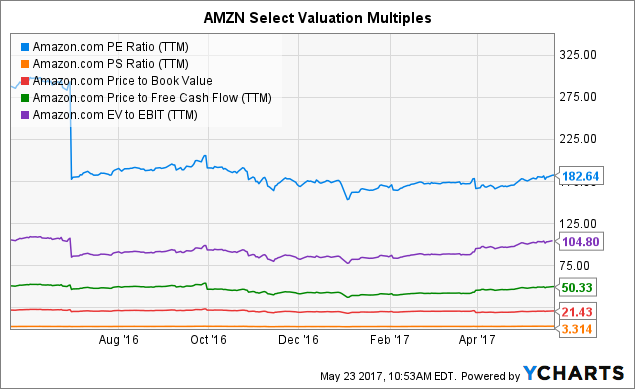
As value investors, the answer lies in the numbers, specifically valuation and margin of safety. As of this writing, AMZN is trading at 182.64 times earnings, 3.31 times sales, 21.43 times book, 50.33 times free cash flow, and 104.80 times EV/EBIT. How much is that doggie in the (device) window?
To be sure, the speculative PEG ratio of AMZN is at a value investor-friendly 1.41x. But that makes sense for a growth company, although virtually all other valuation metrics put Amazon literally in the cloud.
Amazon’s MSVI margin of safety rating works out to an EY of 0.01% + ROIC of 6.83% + CFM of 7.71% + EBIT/EV of 0.01 = MoS of 14.56% weighted against a CA/LTD of 5.13 times. Despite the company’s solid balance sheet, AMZN’s margin of safety is as bearish as a stock price gets at Main Street Value Investor.
No doubt, had I accidentally stumbled upon Amazon during its IPO or the post dot-com crash, I would be singing its praises from an infinity pool overlooking the Caribbean. Then again, you can bet that all of my other accidents that actually lost money on similar speculative trades would be kept secret just as my bad night at the casino.
Readers may justifiably present better retail alternatives to TJX. From our long-view value investor perch (at a desk not an infinity pool by the way) we think TJX remains best in class from the retail sector.