Thursday, March 1, 2018

How Supply Chain Control Towers Provide Visibility and Collaboration with Trading Partners

The benefits of implementing a control tower on a network are striking, companies that have complex, global supply chains are especially well-suited to multi-party networks, and it is well worth learning about them and examining all your options.

What Can a Supply Chain Control Tower Do For Your Operations?

Nucleus Research has published its Control Tower Value Matrix 2017, which gives a detailed insight into the current state and value of control towers.
The report breaks down vendor offerings by functionality and usability, providing a matrix by which to evaluate control tower solutions currently on the market.

What is a Control Tower?

In the Control Tower Value Matrix 2017, Nucleus Research defines control towers broadly as tools that “deliver visibility…. [and] provide capabilities like collaboration with trading partners and functionality that enables supply chain planners to automate processes and controls.”
That covers quite a range and reflects how far control towers have come in recent years, and the many types that are available.
The Control Tower Value Matrix provides a useful breakdown of the various types available from 13 different software vendors.

Types of Supply Chain Control Towers

Visibility
At their most basic, they provide a global (or near global) view of the supply chain.
Control Towers originally arose due to the need to gain visibility over the increasingly complex and fractured supply chain. Control towers attempted to give a single version of the truth across functional boundaries, and across suppliers, contract manufacturers, transportation carriers, and third-party logistics.
But what use is it watching something go wrong if you can’t intervene to fix it?
Actionability
Control towers have evolved to incorporate tools that allow supply chain managers to not only monitor, but also to intervene and correct those issues. However, this has typically been limited to those parts of the supply chain under a company’s direct control.
Collaboration
The next stage of development is cross-organizational collaboration, across multiple tiers of customers, suppliers, and logistics service providers. This enables supply chain managers to not just address issues directly under their control, but to work with business partners to solve a much broader range of problems that occur in all parts of the supply chain.
Automation
Control towers are now automating many functions that previously required human intervention. For example, orders can be automatically created when a stock item reaches a predetermined value. There are many such tasks that can be automated, and freeing up people to work on more valuable tasks.
“By reducing the level of human intervention required, vendors are allowing supply chain managers to divert their attention to more value-add tasks rather than daily maintenance of exceptions.” (Control Tower Value Matrix 2017, Nucleus Research)

What Does a Control Tower Do for You?


Combine all these levels (and more), and the value control towers provide to companies is significant.
Many companies are still struggling to achieve end-to-end visibility in their supply chains. Control towers provide that and more.
The value of a control tower varies widely based on the degree to which it maximizes the value of each of the four stages: visibility, actionability, collaboration, and automation.  And to a large extent, that realization of full potential depends on the foundations upon which the control tower is built.
In The Rise of Supply Chain Control Towers, I explained the flaws in traditional control towers that are built on a hub-spoke model. I won’t rehash that here, but simply put, such point-to-point models, offer limited opportunities for visibility and optimization due to disparate systems; and such connections are cumbersome to implement and maintain.
Control towers that are built on solid foundation of real-time data shared across a multi-party network offer much more potential for savings, speed, agility, and resilience.
“Nucleus found multi-enterprise supply chain network solutions to be a source of risk mitigation for companies that have successfully deployed them, with improved visibility, coordination, and optimization.” The Real Value of Value Networks, April 2017, Nucleus Research
Real-time networks eliminate information delays; provide end-to-end visibility, and better optimization thanks to fresh, big-picture data that reflects the reality of the supply chain now. They also provide the full context for better decision making, including providing actual data on orders, inventory, shipments and capacity constraints across all nodes of the network.
Control towers on multi-party networks can thus deliver significantly higher value than traditional control towers that patch together enterprise systems. When Nucleus Research surveyed 30 customers on multi-party networks they found those companies enjoyed a number of competitive advantages, including but not only:
  • Increased inventory turns between 10-75 percent, average 56 percent
  • Reduced safety stock holdings, 10-55 percent, average of 38 percent.
  • Reduced stock outs and material shortages by 15-90 percent, average of 76 percent fewer stock-outs and material shortages
  • Reduced expedite costs by average of 54 percent
Source: The Real Value of Value Chain Networks, R63, April 2017, Nucleus Research
So the benefits of implementing a control tower on a network are striking. Companies that have complex, global supply chains are especially well-suited to multi-party networks. Nucleus Research’s Control Tower Value Matrix covers a lot of vendors and a lot of types of control towers, and it is well worth learning about them all and examining all your options.

Fashion Icon Designs Supply Chain Solution

0
As its main distribution center neared capacity, fashion company Michael Kors redesigned operations without cramping its style by fashioning a digital model of its supply chain.

MORE TO THE STORY:

With annual growth rates of 30 to 40 percent for several consecutive years, Michael Kors Holdings Limited knew its central distribution center would soon reach capacity. The fashion company needed to determine how to address that milestone amid forecasts for a growth slowdown as it matured.
Michael Kors had several options, but which one made the most sense? Should it expand the company's central U.S. distribution facility? Add a new distribution center closer to many of its wholesale and retail customers on the East Coast? Or expand its distribution center bypass program and ship more goods directly to customers from the West Coast port of entry?
To get the information needed to choose an option, and to build supply chain decision-making internally as a core capability, the New York City-based fashion icon turned to LLamasoft, a supply chain design software company in Ann Arbor, Michigan. Working with LLamasoft to create a digital model of its supply chain allowed Michael Kors to test scenarios before selecting a solution based on current and forecasted specifics.
 Advertisement
Michael Kors, a $4.7-billion global fashion luxury group, is known for its women's and men's accessories, footwear, ready-to-wear apparel, eyewear, and fragrance products. The company operates in three segments—retail, wholesale, and licensing—through a global distribution network focused on company-operated retail stores, upscale department stores, specialty stores, and licensing partners.
In November 2017, the company acquired Jimmy Choo PLC, the glamorous, high-end footwear brand made famous by "Sex and the City."
Third-party contractors located primarily in Asia manufacture products to Michael Kors' specifications. Goods sourced from 17 countries ship out of 22 ports of origin to the West Coast. Its distribution center is 30 miles from the port in Whittier, California.
A few years ago, when the company's long-range forecast generated concerns that the distribution center wouldn't be able to handle projected growth, it began gathering information that would guide identifying a solution.
"We did a traditional supply chain network optimization study, looking at our end-to-end processes and distribution center capacity," says Peter Hunnewell, global operations director, supply chain strategy for Michael Kors. "That helped us triangulate when we would hit capacity."
The next step was exploring the best total cost solutions.
"We looked at what was happening with the business," he adds. "We were becoming increasingly focused on lead times and discussing how we could leverage our retail assets for omnichannel distribution." This was happening, he says, while shifting from a high-growth period to a more mature business model where growth was leveling off.
Hypothesizing solutions is one thing, but making an informed decision about which one makes the most sense and is the least risky is another.

MODEL OF EFFICIENCY

To guide the decision-making process, the company brought in LLamasoft and its supply chain software solutions, Data Guru and Supply Chain Guru, to create a digital model of its supply chain.
"Our initial goal was to solve this problem, but we also wanted to work together to create a sustainable core competency so that when conditions changed again, Michael Kors would be able to examine the possibilities without outside help," says Toby Brzoznowski, LLamasoft's co-founder and executive vice president.
The process started with identifying and assessing available data, a classic supply chain modeling challenge.
"Companies have information and data about their business and supply chain, but it's not usually at their fingertips or in one place," says Brzoznowski. "It's in their enterprise resource planning, transportation, point-of-sale, and other systems. To do a detailed supply chain analysis, you need to bring all of it together."
"Data integration was by far the most challenging part of this process," adds Hunnewell. "We had several different data sources and not a lot of resources internally to support us. LLamasoft's services team showed us how to sort through the data."

TURNING TO A GURU

After inventorying available data, Hunnewell and a team that included Michael Kors' IT department used Data Guru to consolidate and "harmonize" the data so it was useful. To do that, data coming from different sources and in several formats is run through Data Guru's universal translator. That process produces a single, usable format. The data is fed into a structured database—a consolidated supply chain data center—that the modeling software, Supply Chain Guru, can use.
Next, they connected the two systems so that harmonized data was automatically fed into the modeling software. Designed to represent the apparel company's business model, that component incorporates all of Michael Kors' product information and demand, facilities, and customer locations. With the system complete, strategists began using the software's analytics tools to demonstrate how various scenarios designed to optimize capacity, inventory placement, and transportation routes would impact the supply chain.
In the case of Michael Kors's distribution challenge, solutions tested included expanding its current Southern California facility, opening a new distribution center on the opposite side of the country, and shipping more goods directly to customers from the port of entry. In addition to helping uncover the optimal solution, the system can also identify when that solution is no longer the right choice.
"The system gives users the ability to mitigate risk," Brzoznowski says. "If demand doesn't grow as anticipated over the next three years, or if costs change or there's a new point of entry, they can add those 'what if' questions and get information that will guide their decision-making."
So which option did Michael Kors finally select after running various scenarios?

OPTIMIZED BY DESIGN

The company decided to ship more goods directly to customers from the port of entry. This strategy helps the fashion brand minimize distribution costs and speed product delivery by reducing the number of touches associated with orders in two ways.
First, contracted manufacturers now package shipments in a way that's more closely aligned with customer orders. When goods arrive in the United States, orders destined for certain customers bypass the distribution center and go to a nearby deconsolidator.
"This approach reduces the number of times the goods are handled," Hunnewell says. "The deconsolidator can put products on a pallet and then on a trailer to get them to stores more quickly than when the process starts at the distribution center, where goods will first be unpacked and shelved."
In addition, when goods packed in full cases for customer orders arrive at the deconsolidator, nothing needs to be broken down before it's shipped.
Michael Kors is seeing other applications for the new system, as well.
"We're not only using it to integrate Jimmy Choo's supply chain into ours, we're also using it to evaluate how we might structure an omnichannel solution," Hunnewell explains. "We foresee using it for forecasting plus demand and capacity planning, too."
"That's our goal," says Brzoznowski. "We wanted to give Michael Kors a competitive advantage through supply chain design, and this is now a core capability for the company."
0

Retail defaults in 2018 could outpace last year

Forget Amazon: Alibaba Is The Horse To Bet On In This Race

|
32 comments
|
 About: Alibaba Group Holding Limited (BABA)Includes: AMZN

Summary

Alibaba is often referred to as the Amazon of China.  This is inaccurate.
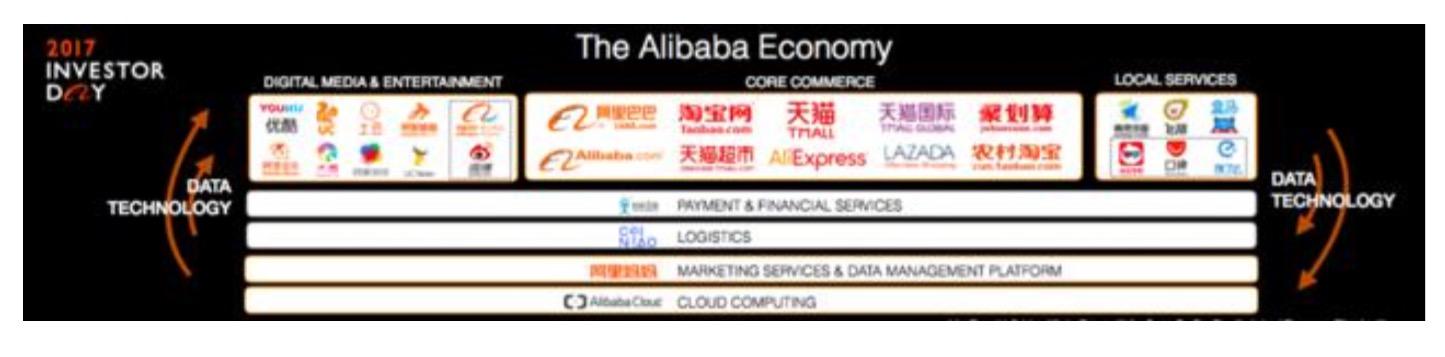
Alibaba's "Alibaba Economy" vision makes it much more than an e-commerce powerhouse -- which also happens to be true.
Jack Ma is building a dynamic technology firm whose growth could be just getting started.
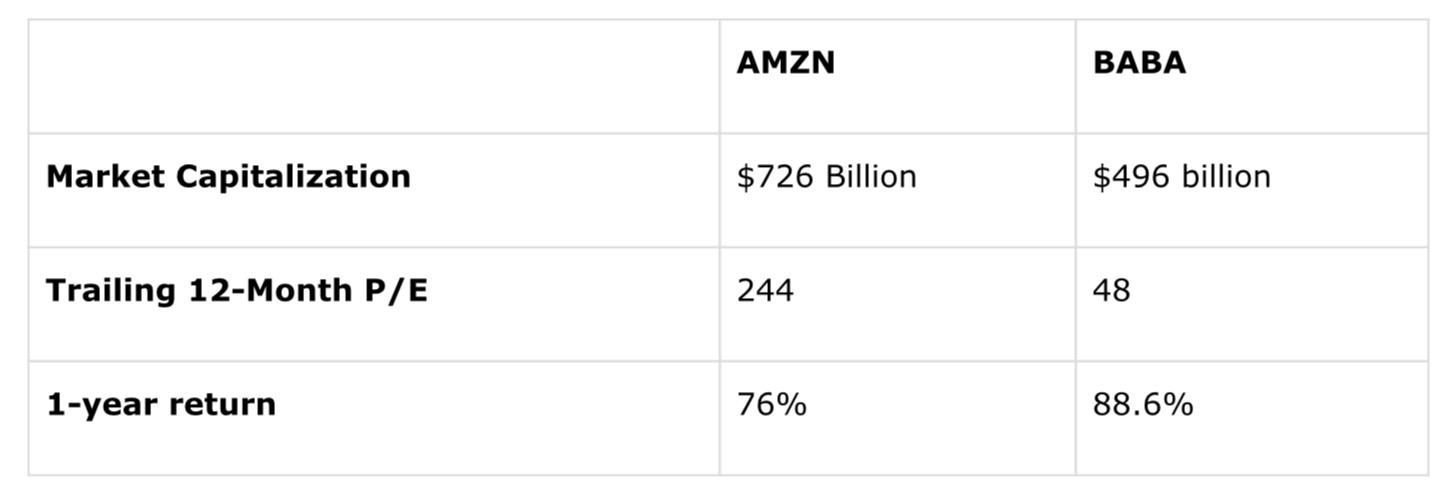
Yet despite its long history of blistering success, Alibaba (BABA) is not only a threat to Amazon (AMZN), but it has built a growth engine that is superior. True there are differences between their business models. And direct apples-to-apples comparison is tricky. But Alibaba's low-inventory model, compared with the capital-intensity of Bezos & Co., make it hard to ignore. It's also why BABA's outperformance of AMZN's meteoric share price performance isn't surprising:
Source: Yahoo Finance.
Amazon's future may appear bright, but it may be eclipsed by Alibaba's awe-inspiring business model. The following factors, in my opinion, are going to be the critical differentiators for Jack Ma's e-commerce giant in the years ahead.

Going beyond e-commerce

Alibaba, like its rival Amazon, is evolving into a technology company that happens to facilitate e-commerce. It has moved to become the sole technology infrastructure provider to small businesses, especially in China. Alibaba is expanding its capabilities across the commerce technology spectrum. From its sales platforms to payments and even logistics, Alibaba 'does it all'. Planting the seeds to become one of the global tech giants of the 21st century.
On the consumer side, Alibaba possesses a vast data pool to understand the needs of its customers better. Connecting with them on multiple touch points. BABA has also managed to stay ahead of the curve in mobile, reaching out via video sites, social media, location app, browser, media and more.
Alibaba has a lot of balls in the air, all with the goal of creating an 'Alibaba Economy'.

Getting in on the payments game

Alibaba has announced that it will buy a 33% stake in privately held Ant Financial. The move is yet another addition to the Alibaba economy. Spreading its dominance into the Asian fin-tech market. The value of this investment can't be overstated, as Ant has been investing in payment and financial technology start-ups at a blistering pace.
For example, Ant Financial recently picked up stake in Paytm, which is the #1 digital payments app in India. Paytm is also happens to be the 3rd largest e-commerce marketplace in India. Paytm's valuation has grown threefold since its subsidiary Ant Financial picked up in February 2015.
True, Payments have not yet proven to be cash rich model for a majority of the fin-tech startups. But for Alibaba, it presents a sustainable moat to promote and cross-sell a broader basket of products and services. Ant Financial may one day go public, and there are rumors that it could fetch an individual valuation of approximately $100 billion.

Cloud Momentum

The success of Amazon Web Services is hard to ignore. It is the cash cow that fuels Amazon's relentless expansion. Anyone who is remotely familiar with tech industry would know how Amazon's cloud (known as AWS) emerged as the game-changer as it toppled giants such as IBM and Microsoft. Alibaba is doing the same in China, and it has ambitions to take its cloud business global and challenge the incumbents including AWS.
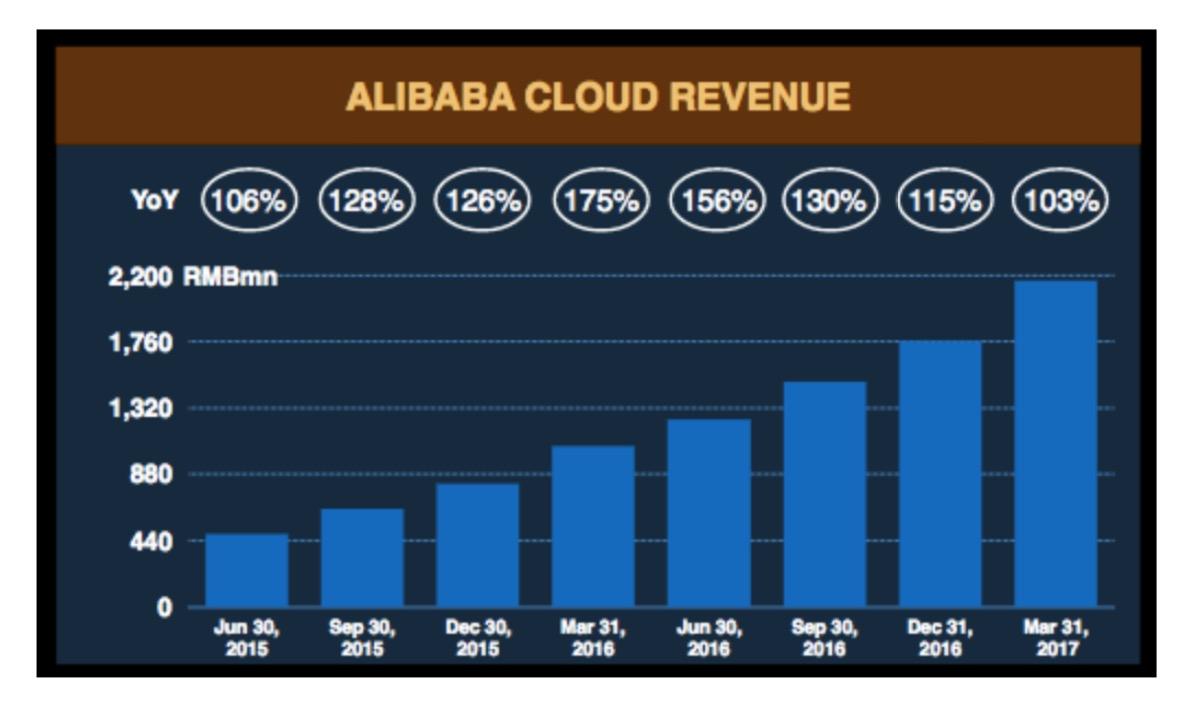
First, Alibaba is the #1 cloud platform provider in China and is nearing 1 million paying customers. The division, like AWS, as exhibited stratospheric growth:
Source: Alibaba Investor Day Presentation.
It is this division that should have AMZN investors particularly nervous. Should Jack Ma enter the cloud services industry state-side, watch out.

Visions of R&D

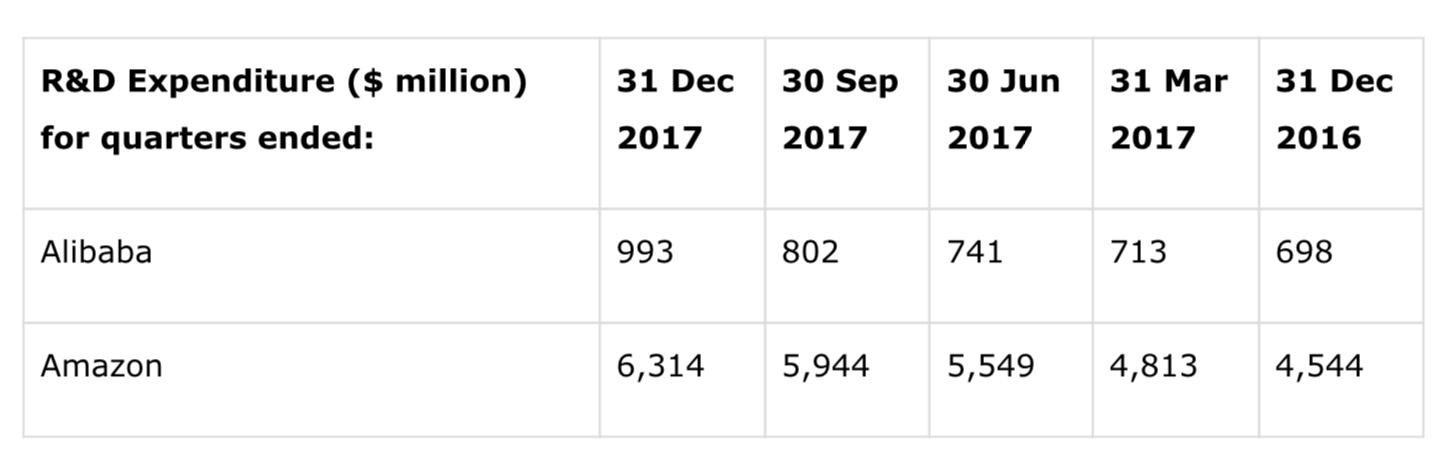
Amazon is one of the biggest Research and Development spenders in the U.S., even ahead of Google. Alibaba's R&D investments, if viewed in absolute terms, lag far behind Bezos & Co. However, that may not last forever. As a percentage of net revenue, Alibaba outspends mighty Amazon in investing for the future.
Alibaba has planned to invest $15 billion in R&D over the next three years -- $5 billion per year. All the more impressive is that this represents a significant jump from 2017's $3.2 billion in R&D spending.
Amount in USD Billions
(12 Months Ended Dec 31, 2017)
AlibabaAmazon
R&D Expenditures
3,24922,620
R&D Expenditures (as a % of Revenue)
11.6%10.0%
Source: Yahoo Finance.
As are many tech firms, Alibaba is investing huge sums to develop machine learning and artificial intelligence systems that aim to understand consumer spending better and make them buy more. While these technologies have yet to yield their potential, they have already started paying off. The intelligent personal recommendations on Alibaba's Taobao app are driving strong growth in user engagement and conversion.

What investors need to know

Alibaba is frequently referred to as "China's Amazon." But this doesn't fully represent reality. There's something much bigger going on at the house the Jack Ma built.
Alibaba has delivered growth while simultaneously yielding profits - something Amazon has long been criticized for failing to deliver. They rarely compete, with each staying in their respective corners, but it's worth wondering who would win in an all-out battle. The four little-known assets laid out above, and Alibaba's exceptional cash-flow generation, make it the odds-on favorite. That its shares trade for just 28x forward EPS estimates, far more rational when compared with Amazon's mirage-like 97x forward multiple, makes Alibaba the horse to bet on.