Tuesday, October 10, 2017

Is There More To Amazon’s New Delivery System Than Meets The Eye?

|

Summary

Amazon decides to piggyback on third-party warehouses’ storage and delivery systems.
Benefits to the company.
The data-gathering element not many are taking into consideration.
Potential impact on FedEx and UPS.
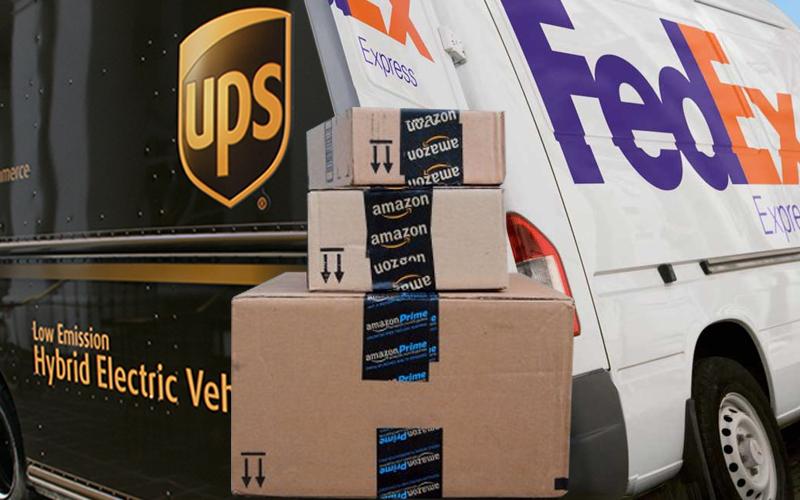
Source: supplychain247
Some of the reasons behind Amazon’s (AMZN) decision to test a new delivery system by taking more control by using existing warehouses from third-party merchants are readily apparent, including better serving customers in the busy holiday season, cutting costs, opening up more space in its fulfillment centers and streamlining its operations.
What’s not so obvious is where this could take the company in the years ahead if it’s successful in providing excellent customer delivery service of the last mile, where the success of implementing its two-day promise is determined.
A secondary factor will be how it may impact existing delivery businesses like FedEx (FDX) and UPS (UPS), which provide much of the delivery services for Amazon at this time, in the latter part of the delivery process.

What Amazon is attempting

Although many have reported the news that Amazon is rolling out a new delivery service, in fact, it launched it in India a couple of years ago, partially because the infrastructure would have been hard to build out under existing conditions and the numerous existing businesses were the most efficient way to go because of existing facilities.
For some time, Amazon has been quietly marketing the service to its partners in anticipation of a larger rollout in the U.S. in the not-too-distant future.
Amazon is realizing it wouldn’t be cost-effective or efficient to attempt to build more warehouses or fulfillment centers in order to better deliver on its promise of two-day delivery. Working with third-party vendors that already have the facilities makes a lot of sense, and will allow the company to implement the plan much quicker.
Citing an unnamed source, Bloomberg said the service will be called Seller Flex and a testing period on the West Coast is already underway, and it will be rolled out on a larger level in 2018.
Another value associated with the effort would be for more products to be made available for two-day delivery, while shrinking the number of products at its existing warehouses.
Amazon’s role in this will be to manage the process of picking up packages at third-party warehouses that sell products on Amazon.com and delivering them to the homes of customers. Basically, Amazon is making the decision on how a package will be delivered, rather than those selling the merchandise.
The bottom line is Amazon is transitioning from a centralized delivery system to a more decentralized system, with the purpose of cutting costs, having more control over the last mile and cutting back on capital expenditures for new warehouses.
It will also allow for better delivery results from its existing fulfillment centers, with the shrinking of storage demand during the busy holiday season.

What the market may be missing

Something I’ve thought about with this obvious move by Amazon is where it could take the company beyond its existing third-party vendors. By that, I mean with a number of its larger sellers.
I think a lot of investors are thinking in terms of smaller vendors and warehouses with the implementation of this strategy, but I believe it will quickly embrace all the vendors that sell on the e-commerce platform of Amazon, and that means it does have the potential to be more disruptive in the long term in the delivery market.
It could also allow the company to be more aggressive and move quicker if it is able to convince most, if not all major manufacturers, to get on board the program. Significant but smaller sellers will without a doubt work with Amazon with the initiative.
In the short term, this isn’t going to be a meaningful threat to FedEx or UPS; but depending on whether or not Amazon becomes extremely efficient at this, it could be a direct competitor to the delivery companies over the long term.
Finally, a factor I have heard little being talked about is how Amazon will be able to gather more practical data in this process, which will further enhance its competitive edge. This could be more important and vital to the company than all the other benefits associated with the rolling out of the program.

FedEx and UPS

In the near term, this isn’t that big of a deal for FedEx and UPS, although UPS has more exposure to risk than FedEx. Amazon accounts for 5 percent to 10 percent of UPS revenue, while FedEx’s revenue from Amazon is under 3 percent.
One thing to consider is e-commerce in the U.S. only accounts for about 11 percent of all retail sales. It has a long way to go before hitting a growth ceiling, even as it enjoys annual double-digit growth.
So, while it’s not insignificant for UPS and FedEx to lose some of Amazon’s business, the expected growth in delivery demand in the years ahead will obscure the effect of that on the two transportation giants. This is why the market isn’t going to punish the two companies – at least for now.
We all know if they underperform though, the first question will be whether or not it’s because of the decision by Amazon to take more control of delivery.
However it’s spun, the fact is UPS and FedEx will lose some business because of this, and even with a robust e-commerce growth outlook, they’ll be generating less revenue and earnings than if Amazon hadn’t taken these steps.
Further out, this could become a big challenge if Amazon starts to have expansion ambitions beyond its own delivery needs. If it does have a long-term plan in play in that regard, it will take many years to put it into effect.

Conclusion

The market wasn’t surprised by the news Amazon was going to take more control of the delivery process, which is why it didn’t rattle or surprise the market like the announcement it was going to acquire Whole Foods, which almost nobody saw coming.
This is a decision Amazon had to make because it wasn’t cost-effective to think in terms of building more facilities to improve its two-day delivery promise and goal. Going with third-party sellers helps it to more quickly mitigate the plan while lowering existing costs, saving it a lot of money from not having to build more warehouses.
It will also give it a lot of information and data from the third-party sellers, which may help it to expand beyond its own needs and compete directly in the space if it chooses to go that route sometime in the future.
As for FedEx and UPS, this isn’t likely to have much of an impact over the next couple of years. Even so, if they do stumble or the economy slows down, investors will start to look at the effect Amazon’s decision had on them.
Again, just because e-commerce in the U.S. will continue to grow at a double-digit pace doesn’t take away the fact UPS and FedEx will be losing some business they otherwise would have had.
For Amazon, it’ll further solidify its important Amazon Prime customer base by making it even harder to leave because of the real and perceived benefits. That gives it pricing power if it ever needs to boost annual prices in the future.
When all is said and done, I see data gathering associated with the move as probably being the most important part of this strategy. That’s impossible to measure in dollars, but it will add another piece of the puzzle to its already formidable database. That continues to be one of Amazon’s biggest moats against its competitors.

Monday, October 9, 2017

WITRON Automates Omni-Channel Logistics Processes At Hoogvliet

Published on Oct 5 2017 12:30 PM in Supply Chain tagged: Trending Posts / Logistics / WITRON / Hoogvliet
WITRON Automates Omni-Channel Logistics Processes At Hoogvliet
Introducing an exciting project for WITRON Logistik + Informatik GmbH: a state-of-the-art, automated distribution centre in Bleiswijk, the Netherlands, which will supply all distribution channels of the Dutch food retailer Hoogvliet.
The distribution centre will commence operations in 2020 and will also host the Hoogvliet service centre.
The facility is around 72,000 square meters (700,000 square feet) in size, and will supply about 100 Hoogvliet stores in the Netherlands with products from its dry goods assortment, as well as fresh food, fruits and vegetables, meat, and frozen food.
It will also store and pick in different temperature zones (-26 degrees C, +4 degrees C, +7 degrees C, +12 degrees C, +18 degrees C / -15, 39, 46, 54, 64 Fahrenheit). In addition to the returns handling and the cross-docking processes, Hoogvliet also integrated the bakery and butcher shop production areas into the overall material flow, with both now located in the same building.

Proven WITRON Solutions

At this location, Hoogvliet relies on proven WITRON systems. The Order Picking Machinery (OPM), with 13 Case Order Machines (COMs) for the fully automated picking of cases onto roll containers, will be used in the dry goods and fresh product environment, and the Car Picking System (CPS), a semi-automated picking system, will be used for the route-optimised picking of cases.
An automated small parts warehouse is located in front of the OPM. So-called ‘hazardous goods’, such as aerosol cans, are picked in the CPS within a separate area.
The Dynamic Picking System (DPS) is used for the highly dynamic and semi-automatic picking of small parts in the dry goods assortment. The six-aisle high bay warehouse for dry and fresh goods provides locations for the replenishment of the picking areas.
WITRON will install manual order picking systems for frozen goods, fruits, and vegetables, as well as meat products. After the picking and consolidation process in the various picking areas, the goods are automatically provided for dispatch by means of transfer cars and gravity conveyors.
The overall system is designed to handle the associated picks on peak days. Modular expansions are provided for future growth.

Full Service

As a general contractor, WITRON is responsible for the entire design and realisation of all IT, control engineering, and mechanical components.
In addition, the logistics expert from Parkstein is also responsible for the system service and maintenance, providing service and technical support by means of an OnSite team. This also includes a temporary support phase for system operation and production management after system ramp-up.
Hoogvliet B.V. is a supermarket chain with state-of-the-art stores located in the South and North Holland provinces of the Netherlands, Utrecht, and Gelderland. It employs more than 6,500 staff members.

Why It’s Important to Become Your Carrier’s ‘Preferred Shipper’

If you thought the act of purchasing transportation was as simple as paying a carrier to haul your freight – well, think again.

Why It's Important to Become Your Carrier's 'Preferred Shipper'
The pendulum of power can swing in either direction. One moment it’s the shipper who calls the shots, benefiting from a glut of capacity. And in the next, the market has tightened, and the carrier can afford to be choosy.
Skilled transportation managers know better than to change their strategy with every market shift. Through times of oversupply and drought, with rates high and low, they work hard to become “preferred shippers” in the eyes of their carrier partners.
You might wonder why a huge shipper like Procter & Gamble would bother. Isn’t it powerful enough to command carrier obedience at all times? Shouldn’t it be able to dictate rates, routes and service without cozying up to transportation providers?
P&G doesn’t think so. Jack Oney, former director of purchasing for supply chain and logistics, says the consumer products giant strives to create a culture of the “elite shipper.” It views logistics contracts as much more than fleeting transactional deals.
Oney, who now runs his own firm, Jack Oney Legal and Business Consulting Services, spent 27 years with P&G before retiring last January. Speaking at the SCOPE Fall 2017 conference in Los Angeles, he said the company has “an engineering mindset.” That results in transportation managers who are “intentional, methodical, but sometimes risk-averse.”
Everything that happens within P&G is given a project name, said Oney. The rule helps internal experts to organize their thinking, and gain a clear idea of their priorities. (It also serves to “brand” each project, perhaps contributing to its continued survival in a large organization where countless initiatives are always vying for executive support.)
Projects don’t exist at P&G for their own sake. Oney said the company ensures the completion of key initiatives through its decision-making tool known as PACE — for process owner, approver, contributor and executor. The four designations specify who’s in charge of a given effort, and who can offer input. “There’s only one of the first two,” said Oney. “Everyone can be the last two.”
As it does when considering the purchase of any service, P&G undergoes a “make versus buy” determination from the start. It asks whether the service in question is part of the company’s core competency, who’s best positioned to mitigate the risk that’s attached to it, and who’s the best entity for cleaning up any messes when things go wrong.
The decision on whether or not to outsource is accompanied by what Oney calls “Strategy 101” — the determination of “where you’re at, where you want to be, and how you’re going to get there.” Suppliers who win, he said, “are the ones who can define the current state.”
With these basic techniques in hand, P&G sets out to craft tight and long-lasting relations with carriers and logistics providers. At the outset, it has an intimate understanding of its costs, and seeks to eliminate waste and errors in the transportation chain wherever they occur.
Freight audit is one area that tends to be undervalued, Oney said. It’s more than something that dutifully gets performed at the end of a process, prior to the “OK to pay” decision. On the contrary, P&G views audits as a strategic way to recover value and prevent loss. In addition, it takes an elastic approach to pricing and payment models, allowing for the unique nature of each freight move and carrier relationship.
Network optimization is equally crucial. By truly understanding its current state, Oney said, the shipper can identify any gaps in efficiency, or problems that might make it undesirable to a carrier.
It’s not an issue of inadequate capacity, Oney said. “The problem is that your freight isn’t very desirable.” Shippers need to partner with carriers on issues such as equipment flexibility, trailer scheduling and better yard management. In addition to making the shipper a more attractive account, the effort can uncover some surprising opportunities for cutting costs.
For example, P&G’s effort to streamline the movement of ocean freight — called, fittingly, Project Orca — resulted in a 65-percent reduction in ocean rates, simply by educating the appropriate individuals about how much “free” time they really needed for their containers at the port.
For surface transportation, P&G follows detailed routing guides for its carriers. But it’s careful not to impose unrealistic key performance indicators. “Make sure you’re being fair,” says Oney.
There’s always the question of whether to go exclusively with a single carrier in any given corridor or spread the business around — to “play the market,” as Oney puts it. He said the emphasis should be on managing the health of the network. And that priority usually leads to multi-year contracts with a handful of trusted partners.
The preferred shipper, Oney said, will bring its “A-team” to the table with carriers, emphasizing personal relationships and a single point of contact for each major service provider.
Opportunities for saving money should be shared between both parties. Another speaker at SCOPE Fall, Dave Venberg, senior director of transportation and logistics with Ardent Mills, said the big flour-milling and ingredient company has reduced transportation costs by 8 percent, and network costs by 10 percent, over the last three years. “We give carriers back 50 cents for every dollar of efficiency we save,” he said.
As for the carrier, it needs to shower attention upon its V.I.P. accounts. “Don’t act like a commodity,” advised Oney. “Show up and explain why you have more to offer than just a box being moved.” Both sides need to view their relationship as more than an exchange of money for service. Only then can the shipper be assured of a continuous supply of quality service in good times and bad.

Innovation strategy


Logistics service providers should innovate more,’ is a commonly heard complaint by shippers. This innovation-related discrepancy reared its head once again following an international study by Supply Chain Digest published earlier this year. 69 percent of the shippers surveyed said it was very important for logistics service providers to be innovative. However, they seem to be disappointed in logistics service providers’ process innovation abilities, with 26 percent of the shippers rating them as ‘low’ and 48 percent as ‘average’. But the logistics service providers are not the only cause of the innovation problem.
First of all, shippers need to make it clear which strategy they are pursuing per product category: Product Leadership (best product, e.g. Apple), Customer Intimacy (best total solution, e.g. Cisco) or Operational Excellence (best total costs, e.g. Walmart), based on the model by Michael Treacy and Fred Wiersema. Many companies seem afraid to make a clear choice, whether for the entire organization or per division. A focus on Operational Excellence revolves around the costs, so the logistics service provider must continuously innovate its processes in order to improve efficiency. The Product Leadership strategy is focused on (product) quality and requires the logistics service provider to be able to cope with unexpected volume fluctuations caused by product launches and marketing campaigns. And if the shipper is pursuing a Customer Intimacy strategy, the logistics service provider must offer outstanding service by installing complex, configured products on customers’ premises at the right time.
I was pleasantly surprised to witness a commercial director of a large logistics service provider presenting these insights during a supply chain conference in Helsinki at the start of this year. He provided a clear overview of the specific innovations his company was implementing for three different customers, each with a different business strategy. In his book Clockspeed (1998), Professor Charles Fine from MIT in Boston states that there are three separate drivers for disruptive innovation: performance push, customer pull and organizational competencies. These three drivers can be paired with the three strategic approaches in the Treacy and Wiersema model. Logistics service providers should make more of an effort to ask their customers which strategy they are pursuing, so that they know where to innovate.

Sunday, October 8, 2017

China's New Silk Road Could Spur More Electric Cars in Europe


  • Green energy transition depends on Chinese market, CEOs say
  • Siemens-Alstom rail deal shows attention to threat from China
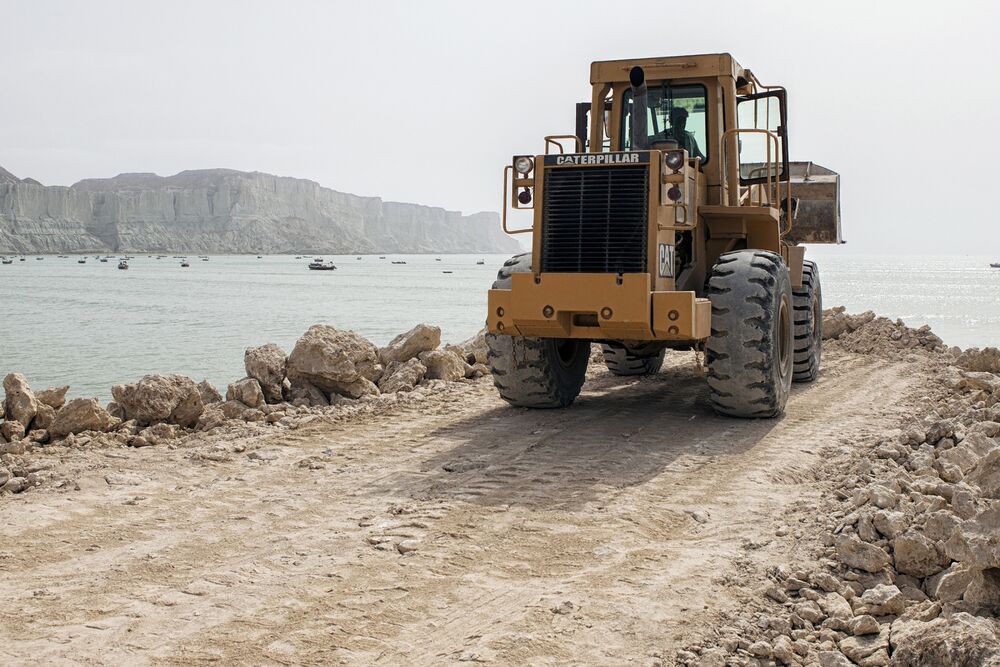
Construction on the One Belt, One Road project in Gwadar, Balochistan, Pakistan, on Aug. 3, 2016.
 
Photographer: Asim Hafeez/Bloomberg
China’s new silk road stretching into the heart of Europe may be what ultimately delivers more climate-friendly technologies like batteries and electric cars.
The trade route known in Beijing as the Belt and Road Initiative is spurring $1 trillion of investment on rail, highways and ports linking Europe and Asia. China’s renewable-energy companies already are using the initiative to open new markets in southern Asia, the Middle East and Africa, according to Bloomberg New Energy Finance. 
Austrian executives gathered outside Vienna to discuss the future of energy are banking on similar market-making effects in Europe. They anticipate the scale of manufacturing from China and quicker market access through the Belt and Road links to drive down the costs electric cars and energy storage technologies in Europe. 
“It’s not a question of if but when, because it’s happening,” Verbund AG Chief Executive Officer Wolfgang Anzengruber said Wednesday at a green energy conference in the small Alpine town of Fuschl, Austria. “If China says it, it is so.”
China’s market-making role in Europe extends beyond developing EVs and is striking at the heart of traditional European businesses, according to Wolfgang Hesoun, chief executive officer of Siemens AG’s Austrian unit, which employs 2,500 workers making trains and trolleys.
“The best ideas come from outside,” Ramon Vullings told the energy executives gathered in Austria. The Dutch consultant said he traveled China’s ancient silk road for 1 1/2 years in a bid to bring back new ideas to help Europe’s companies deal with transition to renewables.


European companies will only be able to challenge Chinese companies by developing “locally-oriented” supply chains that cultivate customer loyalty, Hesoun said at the event a day after Siemens merged its rail unit with Alstom SA.
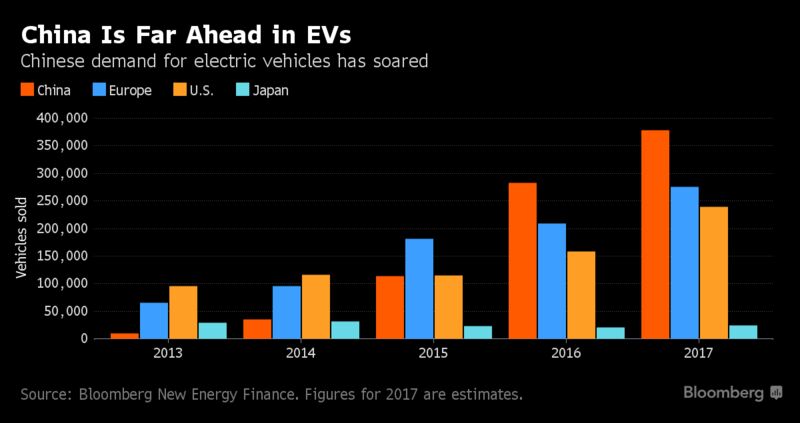
Similarly, just how quickly European companies can develop things like the lithium-ion batteries -- used in electric cars and grid-balancing systems -- depends on how much demand there is for those things consumers in China at the other end of the Belt and Road.
Automakers who employ 300,000 in Austria -- and supply German giants Volkswagen AG and Daimler AG -- are looking for ways to use electric cars to tap into China’s market of 1.4 billion people.
“We need to start developing these technologies because if we don’t, others will,” World Energy Institute Secretary General Christoph Frei said, adding that China’s huge market is leading the green energy shift.

3rd gradedropout


Future of Retail